
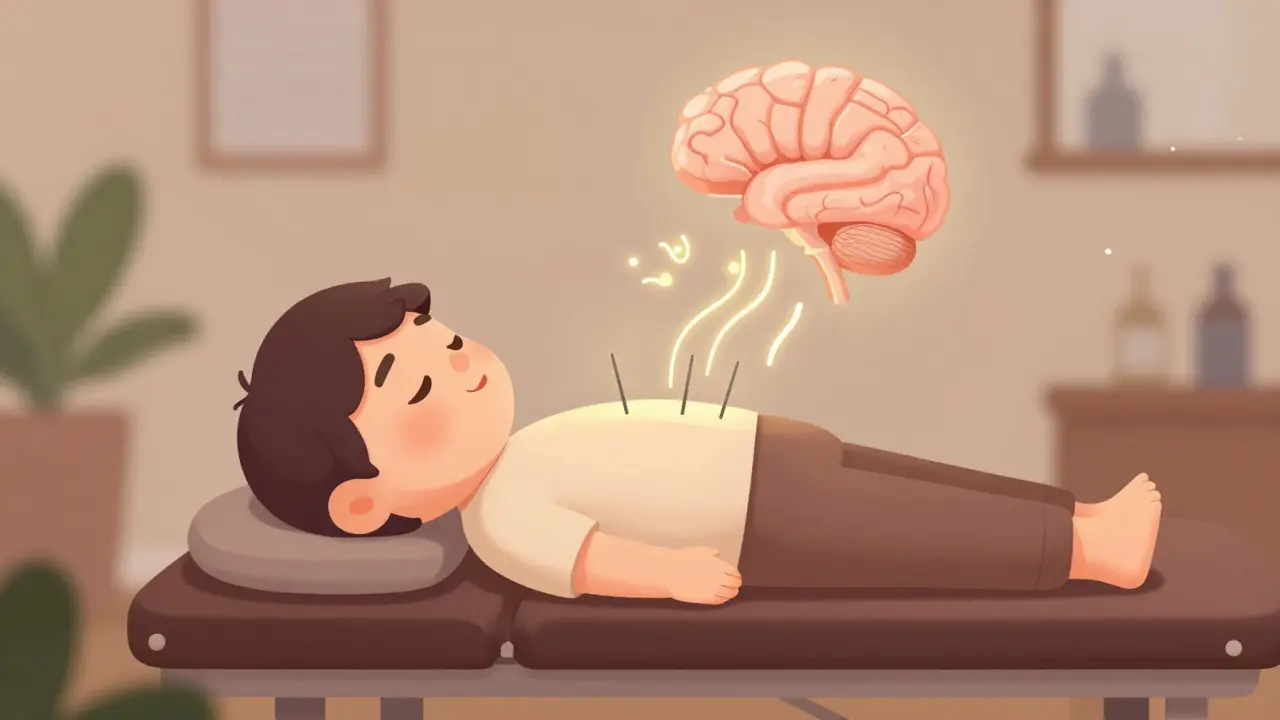
For millions of people living with chronic pain, the search for relief often feels like a dead end. Painkillers bring side effects. Opioids carry addiction risks. And yet, the pain doesn’t go away. That’s where acupuncture comes in-not as a miracle cure, but as a real, evidence-backed option that’s been used for over 2,500 years and is now being taken seriously by modern medicine.
How Acupuncture Actually Works for Pain
Acupuncture isn’t magic. It’s not about balancing "energy flows" in a mystical way, even though that’s how it’s often described. At its core, it’s a physical intervention: thin, sterile needles are inserted into specific points on the body. These points aren’t random. They’re mapped along pathways called meridians, a concept from traditional Chinese medicine, but modern research has found something more concrete: many of these points sit near nerves, muscles, and connective tissues. When a needle is inserted, it triggers a cascade of biological responses. Studies show it stimulates nerves that send signals to the brain, prompting the release of natural painkillers like endorphins and serotonin. It also reduces inflammation at the site of pain and can change how the brain processes pain signals over time. This isn’t just theory. Brain imaging studies have shown actual changes in activity in pain-processing areas like the thalamus and insula after acupuncture treatments. Unlike drugs that mask pain, acupuncture seems to help the body recalibrate how it responds to pain. That’s why many people report lasting relief even after treatment ends.What the Science Says: Real Data from Real Studies
The biggest question people have is: "Does it actually work?" The answer, backed by decades of rigorous research, is yes-for certain types of pain. A landmark 2018 meta-analysis in the Journal of Pain reviewed data from nearly 21,000 patients across 39 clinical trials. The results were clear: acupuncture provided meaningful pain relief compared to no treatment at all. And the effects didn’t fade after a few weeks-they lasted at least a year. For chronic low back pain, osteoarthritis (especially in the knee), and tension-type headaches, the evidence is strongest. In fact, a 2012 analysis in JAMA Internal Medicine found acupuncture was more effective than no treatment for these conditions, with pain reduction scores that were clinically significant. For back pain, the effect size was 0.55 standard deviations-similar to what you’d see with physical therapy or certain NSAIDs. Even when compared to sham acupuncture-where needles are placed randomly or don’t even penetrate the skin-real acupuncture still showed a small but real advantage. That’s important. It means the benefits aren’t just placebo. The difference isn’t huge, but it’s consistent enough that experts like Dr. Andrew Vickers, lead author of the JAMA study, say acupuncture is a "reasonable referral option" for chronic pain.How It Compares to Other Pain Treatments
Acupuncture doesn’t replace medicine-it complements it. When compared to NSAIDs like ibuprofen or diclofenac, acupuncture delivers similar pain relief for back pain and osteoarthritis, but without the stomach ulcers, kidney damage, or cardiovascular risks. NSAIDs cause over 100,000 hospitalizations in the U.S. each year. Acupuncture? Serious side effects happen in less than 0.05% of treatments. It also helps reduce reliance on opioids. A 2022 review of 22 studies found that patients who received acupuncture after surgery needed fewer opioid pills. In veterans with chronic pain, the VA now offers acupuncture at 64% of its facilities-not because it’s a magic bullet, but because it cuts down on dangerous medications. The catch? It’s not great for sudden, acute pain like a broken bone or post-surgical pain. For those, drugs still win. But for long-term, stubborn pain? Acupuncture holds its own.
What a Typical Treatment Looks Like
Most people start with 6 to 12 sessions over 6 to 8 weeks. Sessions are usually once or twice a week and last under 30 minutes. The needles are left in for 15 to 30 minutes. Some practitioners use gentle electrical stimulation (electroacupuncture), which research suggests may boost results for certain types of pain. Point selection varies. Some clinics use fixed points for each condition. Others customize based on your symptoms, energy patterns, or even your pulse and tongue-traditional diagnostic tools still used today. Either way, the goal is the same: trigger the body’s natural healing response. You won’t feel a sharp pain. Most people describe it as a mild tingling, warmth, or heaviness. Many even fall asleep during treatment.Who Should Try It-and Who Should Skip It
Acupuncture is a strong option if you have:- Chronic low back pain lasting more than 12 weeks
- Knee osteoarthritis that doesn’t respond well to exercise or NSAIDs
- Tension headaches or migraines you’re trying to reduce without daily pills
- Neck pain that won’t quit
- A desire to cut back on opioids or NSAIDs
- Sudden, severe pain from injury or surgery
- Blood disorders or are on blood thinners (needles carry a small bleeding risk)
- A pacemaker (if electroacupuncture is used)
- Expectations of instant, dramatic results
John Tran
okay so i just spent 45 minutes reading this like it was the dead sea scrolls and honestly? i feel like acupuncture is the only thing that hasn't been co-opted by capitalism yet. we're talking about a 2500-year-old practice that predates the concept of insurance, yet somehow now it's a $120/hr luxury service for people who can't afford to be sick? the fact that the VA uses it but my employer's insurance won't cover it makes me want to burn down a pharmaceutical warehouse. also, i once fell asleep during a session and dreamed i was a dragon breathing out lavender smoke. that's science too, right? maybe the needles are just tiny portals to ancient wisdom? i don't know. but i know my back hasn't hurt this much since i tried to lift a couch by myself while high on melatonin.
January 12, 2026 AT 22:34
lucy cooke
How utterly pedestrian. Of course acupuncture works-it’s not about needles, it’s about the *ontological reorientation* of the somatic self through subtle energetic harmonics. The real tragedy isn’t that insurance won’t cover it-it’s that we’ve reduced millennia of Daoist medical philosophy to a series of statistically significant p-values. You can’t quantify the soul’s resonance with the meridians with a meta-analysis. I mean, really? You’d rather trust a 2018 JAMA study than the quiet hum of qi flowing through the Conception Vessel? How utterly… bourgeois.
January 13, 2026 AT 10:36
Trevor Davis
Hey, just wanted to say I’ve been doing acupuncture for my chronic neck pain for about a year now. I used to take ibuprofen like candy. Now? I take it maybe once a month. My therapist is a certified NCCAOM practitioner-super chill, asks about my sleep and stress levels, not just where it hurts. It’s not magic, but it’s the closest thing I’ve found that doesn’t make me feel like a zombie. Also, the whole ‘falling asleep during treatment’ thing? Real. I’ve woken up with my face on the table twice. Worth every penny.
January 14, 2026 AT 07:21
mike swinchoski
Everyone’s acting like this is some deep secret but it’s just placebo. People believe in it so their brain tricks them into thinking it works. You think your back feels better? It’s because you paid $100 and now you’re desperate to justify it. I’ve seen people cry over a $50 massage. This is the same thing. Stop wasting your money. Just take a nap and drink water.
January 14, 2026 AT 19:05
Jesse Ibarra
Let me stop you right there, you naive idealists. Acupuncture is a scam dressed up in silk robes. The NCCAOM? That’s a glorified hobbyist club. The fact that Medicare covers it doesn’t mean it works-it means politicians are too lazy to say no. I’ve seen people with degenerative disc disease crying because their ‘acupuncturist’ told them their ‘chi was blocked’ by unresolved childhood trauma. This isn’t medicine. It’s spiritual tourism for the middle class. And now we’re funding it with tax dollars? Wake up.
January 16, 2026 AT 09:55
laura Drever
so i tried it once. needles hurt. i felt nothing. paid 90 bucks. no change. end of story. also why is everyone talking about jama like its the bible? newsflash: studies are just opinions with footnotes.
January 17, 2026 AT 23:22
Randall Little
Interesting how the article acknowledges the placebo effect but still frames acupuncture as ‘real science.’ That’s like calling astrology ‘real astronomy’ because some stars are in the same place they were 2000 years ago. The fact that sham acupuncture still shows a small benefit? That’s the placebo effect *in action*-not evidence of meridians. But hey, if it helps people feel better without opioids, maybe we should call it ‘therapeutic narrative’ and stop pretending it’s physiology. Also, the 78% positive Reddit rate? That’s survivorship bias with extra steps.
January 19, 2026 AT 02:29
jefferson fernandes
Let me just say this: if you’re suffering from chronic pain, you deserve every tool that helps-even if we don’t fully understand how it works yet. Acupuncture isn’t about magic or mysticism. It’s about listening to the body. It’s about giving people agency when the system has failed them. I’ve seen veterans who were on 80mg of oxycodone daily cut down to zero after 10 sessions. That’s not placebo. That’s dignity. And yes, it’s expensive. But we spend billions on pills that don’t work and cause harm. Isn’t it time we invest in something that heals without destroying? Don’t dismiss it because it’s old. Sometimes the old ways are the ones we forgot how to see.
January 19, 2026 AT 11:27
Acacia Hendrix
From a neurophysiological standpoint, the somatosensory stimulation elicited by percutaneous needle insertion triggers afferent C-fiber activation, which modulates descending inhibitory pathways via the periaqueductal gray and rostral ventromedial medulla-essentially engaging the endogenous opioidergic circuitry. The observed fMRI changes in the insula and thalamus corroborate this. However, the clinical efficacy is confounded by practitioner variability and lack of standardized point selection protocols. The NCCAOM certification, while administratively robust, fails to operationalize the epistemic gap between TCM diagnostic paradigms and evidence-based biomedicine. Until we achieve a unified mechanistic taxonomy, acupuncture remains a phenomenological intervention masquerading as a therapeutic modality. Also, electroacupuncture at ST36 shows a 0.78 effect size in meta-regression-so, yes, it’s real-but we need RCTs with double-blind sham controls that account for tactile expectation bias.
January 21, 2026 AT 00:10