
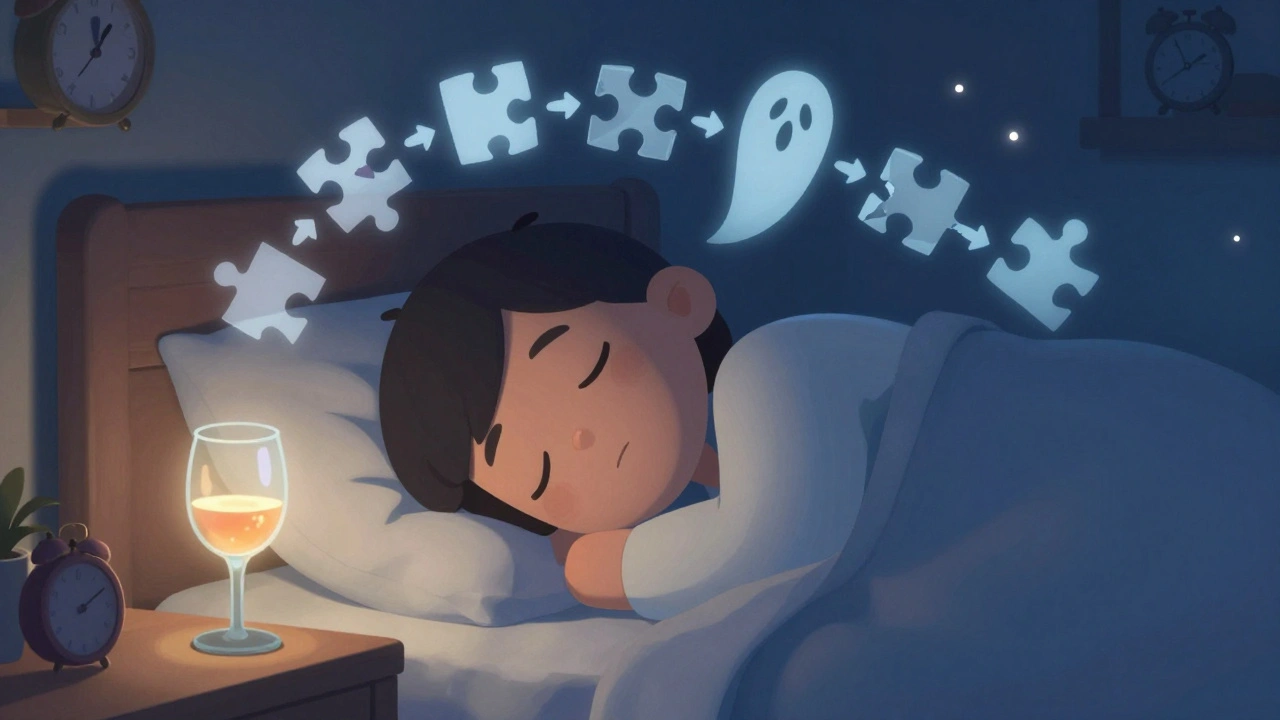
Many people believe a nightcap helps them fall asleep faster. It’s a common habit: a glass of wine after dinner, a beer with the show, or a shot before bed. But what actually happens to your sleep when alcohol enters the picture? The truth is, alcohol doesn’t improve sleep-it fragments it, worsens apnea, and leaves you feeling off the next day-even if you think you slept fine.
Alcohol Makes You Fall Asleep Faster, But It Ruins the Rest
Yes, alcohol has a sedative effect. If you drink two or three standard drinks, you’ll likely fall asleep quicker than usual. That’s why it feels like a solution when you’re stressed or wired. But this is just the first half of a two-part problem.
As your body breaks down alcohol-about one drink per hour-the sedative effect fades. By the time you’re halfway through your sleep cycle, your brain is no longer being suppressed. Instead, it starts to overcompensate. This triggers a rebound effect: more wakefulness, more tossing and turning, and less of the deep, restorative sleep your body needs.
Studies show that even moderate alcohol consumption reduces total sleep time by nearly 20 minutes and lowers sleep efficiency by over 4%. Your body spends less time in the most important sleep stages-especially REM sleep, which is critical for memory, mood, and emotional balance. One study found that just one drink before bed cuts REM sleep by 9.3%. With three drinks, that number jumps to over 25%.
Sleep Fragmentation: Waking Up Without Realizing It
You might think you slept through the night because you don’t remember waking up. But that’s not how sleep fragmentation works. It’s not always about full awakenings. Often, it’s brief micro-arousals-seconds long-that pull you out of deep sleep without you noticing.
Alcohol causes these micro-arousals to spike in the second half of the night. Why? Because as alcohol metabolizes, your brain’s adenosine system (which naturally builds up during wakefulness to signal sleepiness) gets thrown off. Normally, adenosine helps you stay asleep. Alcohol disrupts this process, so your brain struggles to maintain steady sleep pressure.
Research shows that 67% of people who drink alcohol within two hours of bedtime experience at least one nighttime awakening. Compare that to just 39% of non-drinkers. And those awakenings aren’t harmless. Each one interrupts the natural progression of sleep cycles, preventing your body from completing full cycles of deep sleep and REM.
Polysomnography data reveals that alcohol causes a 50% drop in REM sleep early in the night, followed by a 20-30% surge later on. That’s why people often report vivid dreams or nightmares after drinking-they’re catching up on missed REM sleep, but in a chaotic, fragmented way.
Alcohol Worsens Sleep Apnea-Even If You Don’t Think You Have It
If you snore, feel tired during the day, or wake up gasping, you might suspect sleep apnea. But even if you’ve never been diagnosed, alcohol can make your airway collapse more easily during sleep.
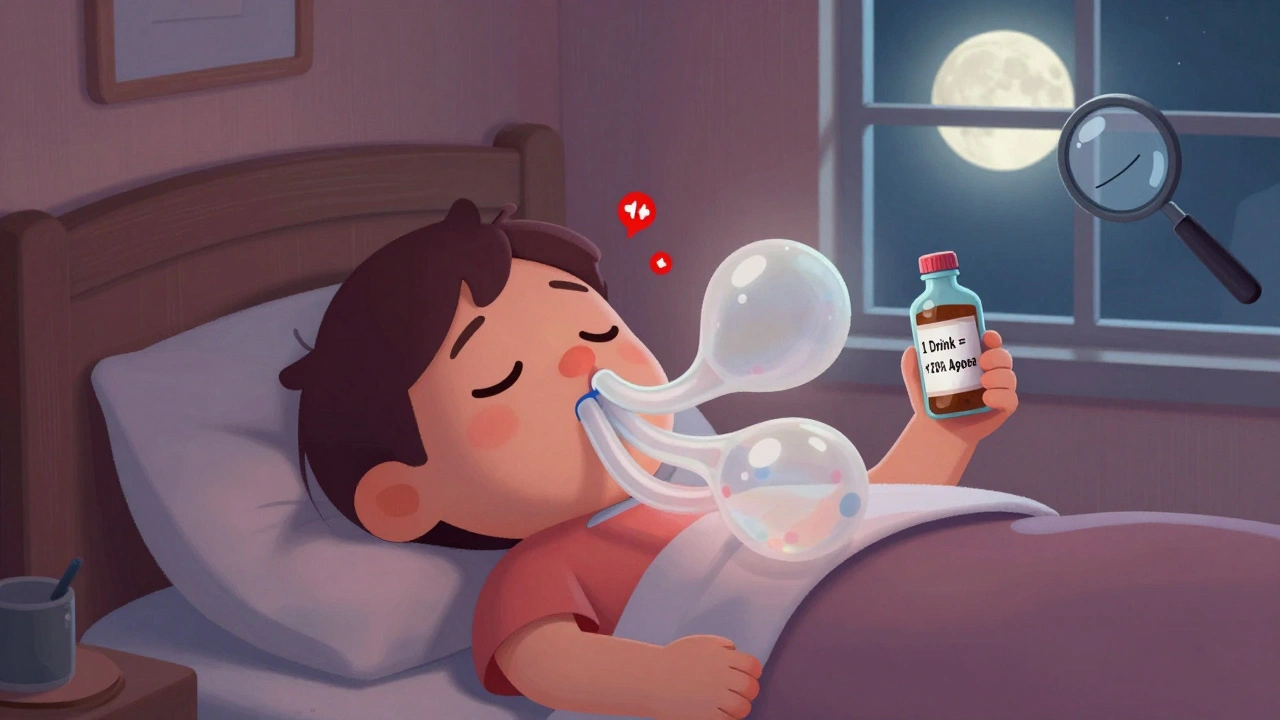
Alcohol relaxes the muscles in your throat. When those muscles are too loose, your airway narrows or closes entirely. That’s what causes obstructive sleep apnea: pauses in breathing that can last 10 seconds or longer, sometimes dozens of times an hour.
Each standard drink before bed increases your apnea-hypopnea index (AHI)-a measure of breathing disruptions-by 20%. That means if you normally have mild apnea, one drink could push you into moderate territory. Two drinks? You’re looking at a 40% increase. Five drinks? Risk jumps by over 50%.
Studies from the American Thoracic Society show that alcohol can reduce oxygen levels during sleep by 3-5 percentage points. That’s not just uncomfortable-it’s dangerous. Your heart has to work harder to pump oxygen, and your brain is repeatedly startled awake. Over time, this contributes to high blood pressure, heart disease, and stroke.
For anyone with diagnosed sleep apnea, the recommendation is clear: avoid alcohol within three hours of bedtime. Even one drink can undo the benefits of your CPAP machine.
Next-Day Effects: You Feel Fine, But Your Brain Isn’t
Here’s the kicker: most people don’t realize how much alcohol is affecting them the next day. You might feel “fine.” Maybe you had eight hours in bed. But quality isn’t the same as quantity.
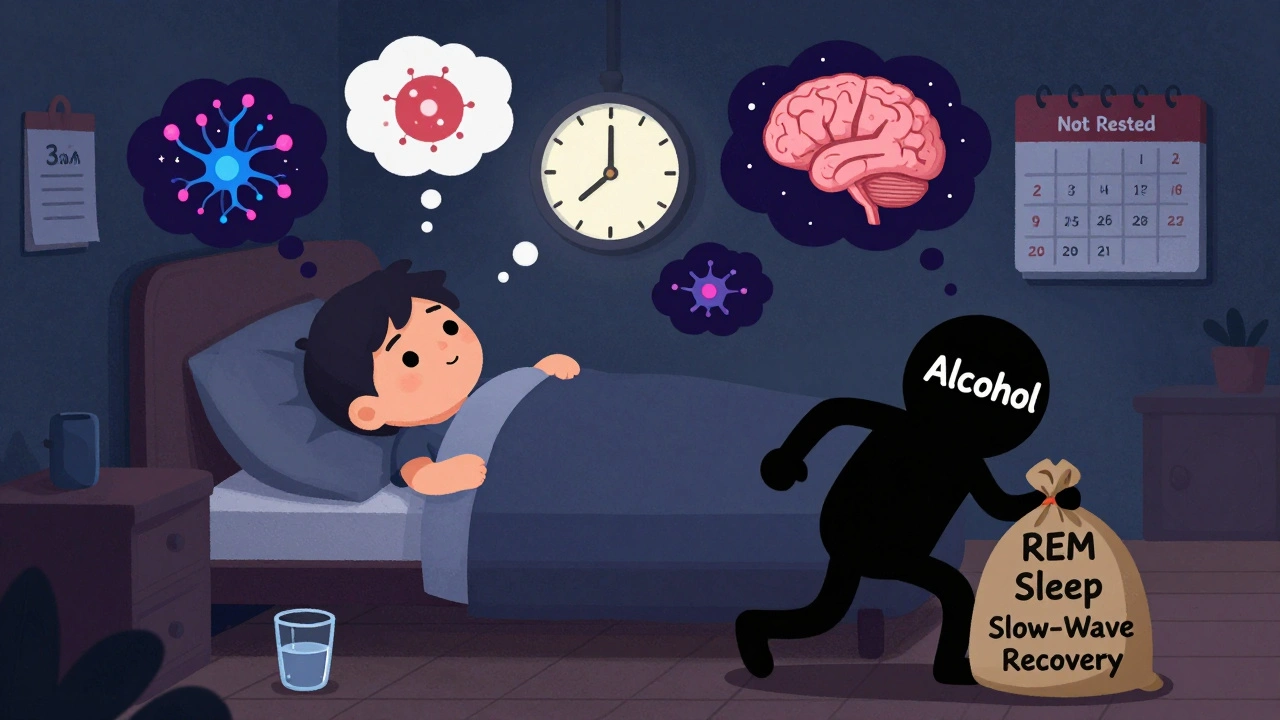
After a night of drinking, you lose 15.3% of your slow-wave sleep-the deepest, most restorative stage. That’s the kind of sleep that repairs tissues, strengthens your immune system, and clears brain waste. Without it, your cognitive performance takes a hit.
Studies show that even after moderate alcohol consumption, people experience an 8.7% drop in cognitive task performance and a 12.7% slowdown in processing speed. Working memory drops by nearly 10%. Reaction times get slower. Decision-making gets clouded.
And it’s not just mental. Your emotional control takes a dive. One study found that people who slept after drinking reacted with 31.2% more emotional intensity to negative stimuli the next day. A minor annoyance feels like a crisis. A neutral comment feels like an attack. That’s because alcohol disrupts the brain regions responsible for regulating emotions.
Many people mistake this foggy, irritable state for “just a bad morning.” But it’s not. It’s a direct result of alcohol-induced sleep disruption. And if you do this regularly, you’re training your brain to function on less rest-without even knowing it.
The Cycle: Poor Sleep Leads to More Drinking
There’s a dangerous loop here. You drink to sleep better. You wake up tired. You think, “I need another drink tonight to get through this.”
Research from the University of Missouri shows that after a night of binge drinking, the brain’s natural sleep drive becomes impaired. The usual build-up of sleep pressure doesn’t happen the way it should. So the next night, you feel more awake than you should be-and reach for alcohol again to force yourself to sleep.
This cycle is a major reason why people with alcohol use disorder struggle so much with insomnia during recovery. Even after they stop drinking, it can take 3 to 6 months for sleep patterns to normalize. And during that time, the risk of relapse is highest.
It’s not weakness. It’s neurobiology. Your brain has learned to rely on alcohol to shut down. When you remove it, the system is out of balance.
What About Tolerance? Doesn’t Your Body Get Used to It?
Some people say, “I’ve been drinking before bed for years. I don’t have trouble sleeping anymore.” That’s tolerance-and it’s misleading.
After 3 to 7 days of regular alcohol use, your body adjusts to the sedative effect. You might fall asleep faster than you used to. But that doesn’t mean your sleep is better. Polysomnography studies show that even with tolerance, REM sleep remains suppressed, sleep fragmentation increases, and slow-wave sleep stays reduced.
You’re not sleeping better-you’re just less aware of how bad it is. Your brain adapts to a lower baseline of rest. That’s why long-term drinkers often report “never feeling rested,” even after “full nights.”
One Drink Still Hurts Your Sleep
There’s a myth that “just one glass won’t hurt.” But the data says otherwise. A 2021 review by the European Sleep Research Society found that even one standard drink reduces REM sleep by 9.3% and increases sleep fragmentation by 11.7%.
That’s not negligible. That’s enough to disrupt emotional processing, memory consolidation, and next-day focus. And if you’re over 40? The risks are higher. A 2023 study in Sleep Medicine Reviews found that regular pre-bed alcohol use increases the risk of chronic insomnia by 38% in middle-aged adults.
There’s no safe threshold. No “moderate” amount that improves sleep. Every drink, at every dose, degrades sleep architecture.
What Should You Do Instead?
If you’re using alcohol to help you sleep, you’re treating a symptom, not the cause. Insomnia, stress, anxiety, or poor sleep hygiene are the real issues.
Try these instead:
- Stop drinking at least 3 hours before bed. Give your body time to metabolize it before sleep.
- Build a wind-down routine: dim lights, read a book, listen to calm music, or practice 5 minutes of breathing.
- Avoid screens an hour before bed. Blue light suppresses melatonin, the hormone that tells your body it’s time to sleep.
- Keep your bedroom cool, dark, and quiet. Even small changes here improve sleep quality.
- If you’re still struggling, talk to a sleep specialist. Cognitive behavioral therapy for insomnia (CBT-I) is more effective than any pill or nightcap.
You don’t need alcohol to sleep. Your body already knows how to do it. It just needs the right conditions.
Long-Term Risks: Cognitive Decline and Health Consequences
Chronic alcohol-related sleep disruption doesn’t just leave you tired. It accelerates brain aging.
Research from the University of Pittsburgh Medical Center found that regular pre-sleep drinkers experienced cognitive decline 23% faster over five years than those who didn’t drink before bed. That’s not a small difference-it’s the difference between staying sharp into your 70s and needing help with daily tasks.
And it’s not just your brain. Poor sleep from alcohol raises your risk of diabetes, obesity, heart disease, and depression. The National Council on Aging links chronic sleep disruption to reduced longevity. Alcohol doesn’t just steal your sleep-it steals your future.
Alcohol isn’t a sleep aid. It’s a sleep thief. And every drink before bed is a withdrawal from your rest, your health, and your tomorrow.
Does alcohol help you sleep better?
No. While alcohol may help you fall asleep faster, it disrupts sleep quality by reducing REM sleep, increasing awakenings, and worsening sleep apnea. Objective sleep studies show no dosage of alcohol improves overall sleep architecture. Even one drink reduces REM sleep by nearly 10% and increases fragmentation.
How does alcohol cause sleep apnea?
Alcohol relaxes the muscles in your throat, making your airway more likely to collapse during sleep. This increases the number of breathing pauses (apneas) and shallow breaths (hypopneas). Each standard drink before bed raises your apnea-hypopnea index (AHI) by 20%, and heavy drinking can increase risk by over 50%. Even people without diagnosed apnea can develop symptoms after drinking.
Why do I wake up at 3 a.m. after drinking?
Alcohol metabolizes at about one drink per hour. If you drink at 10 p.m., your blood alcohol level drops near zero by 3 a.m. At that point, your brain rebounds from the sedative effect, triggering increased wakefulness, heart rate, and arousal. This is when sleep fragmentation peaks, often causing you to wake up without fully realizing why.
Can alcohol cause long-term insomnia?
Yes. Regular alcohol use before bed increases the risk of chronic insomnia by 38%, especially in middle-aged adults. Even after stopping, sleep patterns can take 3 to 6 months to return to normal. Insomnia is also one of the strongest predictors of relapse in people recovering from alcohol use disorder.
Does tolerance mean alcohol doesn’t affect my sleep anymore?
No. Tolerance means you fall asleep faster, but your sleep quality doesn’t improve. REM sleep stays suppressed, slow-wave sleep remains reduced, and fragmentation increases. Your brain adapts to lower-quality sleep, so you may feel like you’re sleeping fine-but your body isn’t getting the rest it needs.
How long should I wait after drinking before going to bed?
Wait at least 3 hours. This gives your body time to metabolize alcohol before sleep begins. Even then, some effects linger. For optimal sleep, avoid alcohol entirely in the evening. If you must drink, limit it to earlier in the day and stick to one drink.
What are the next-day effects of alcohol on sleep?
Next-day effects include slower cognitive processing (up to 12.7% slower), reduced working memory (9.4% lower), increased emotional reactivity (31.2% higher), and decreased physical energy. Many people don’t realize these symptoms are linked to alcohol’s impact on sleep-not just a hangover.
Is there any benefit to drinking alcohol before bed?
No. A comprehensive review by the European Sleep Research Society concluded that no level of alcohol consumption improves sleep quality. All studies using objective measures show deterioration in sleep architecture, regardless of dose. The idea of a “nightcap” helping sleep is a myth.
Girish Padia
People still do this? Alcohol is just a chemical crutch for poor sleep hygiene. You wouldn't take a painkiller to fix a broken leg and call it a solution-you'd fix the leg. Same here. Stop masking the problem with a bottle.
December 2, 2025 AT 06:45
Chris Wallace
I used to swear by that one glass of red wine before bed-felt like a ritual, you know? Calm, cozy, winding down. But after reading this, I checked my sleep tracker... and wow. My REM was basically gone after 10pm drinks. I didn’t realize I was just trading deep rest for unconsciousness. I’ve cut it out for two weeks now. I still wake up once or twice, but it’s different-less frantic, less like my brain is panicking. I’m not saying it’s perfect, but it’s… quieter. And I don’t feel like I’ve been run over by a truck at 9 a.m.
December 2, 2025 AT 18:08
william tao
It is beyond comprehension that individuals continue to endorse the consumption of ethanol as a soporific agent, particularly in light of the overwhelming polysomnographic evidence demonstrating its deleterious impact on sleep architecture. One must ask: Is this not a form of self-sabotage masquerading as self-care? The cognitive dissonance is staggering.
December 4, 2025 AT 07:35
John Webber
man i used to drink before bed all the time and i thought i was fine but now i read this and i think maybe i was just used to feeling like crap in the morning? like i thought it was just being tired but its actually my brain being messed up? i just dont know anymore. i think im gonna try not drinking before bed and see if i feel better. maybe.
December 6, 2025 AT 03:39
Shubham Pandey
One drink = bad sleep. Stop lying to yourself.
December 7, 2025 AT 10:15
Elizabeth Farrell
I just want to say how brave it is to share this kind of information-so many of us are stuck in this cycle without even realizing it. I used to drink to quiet my mind after a long day, thinking I was being kind to myself. But I was just stealing rest from my future self. I started swapping wine for chamomile tea and a 5-minute gratitude journal. It felt weird at first. Like I was missing something. But now? I wake up feeling like I actually slept, not just passed out. It’s not about perfection. It’s about choosing small, gentle changes that add up. You’re not broken. You’re just learning. And that’s okay.
December 9, 2025 AT 05:41
Sheryl Lynn
Alcohol, darling, is the ol’ bourgeois’s opiate for the exhausted masses-a liquid sedative draped in velvet and candlelight, masquerading as self-care. One sips not to sleep, but to numb the existential dread of modernity’s relentless churn. The real tragedy? We’ve been trained to mistake dissociation for rest. Your REM is not a luxury-it’s the cathedral of your psyche. And you’ve been torching it with Merlot.
December 9, 2025 AT 21:09
Paul Santos
Interesting analysis, but let’s not ignore the neurochemical paradox: alcohol induces GABAergic inhibition → initial sedation → then glutamate rebound → fragmented sleep. Classic homeostatic dysregulation. 😅 But honestly, I’ve noticed that even after cutting out nightcaps, my sleep latency increased for 3 weeks. The brain’s like a stubborn cat-it resists change until it’s bored of the chaos. So patience, my friends. Your circadian rhythm isn’t broken. It’s just recalibrating. 🍵✨
December 11, 2025 AT 15:01