
When a child squints to see the TV or tilts their head to look at something, it might seem like a quirky habit. But in many cases, it’s a sign of something more serious - a vision problem that could permanently affect their sight if not caught early. Pediatric vision screening isn’t just another checkmark on a well-child visit. It’s one of the most effective, low-cost ways to prevent lifelong vision loss in kids. And the window for intervention is narrow: before age 7, the brain can still rewire itself to fix vision issues. After that, treatment becomes much harder - and sometimes impossible.
Why Early Screening Matters
One in 20 children has a vision problem that can lead to permanent vision loss. The most common culprits are amblyopia (lazy eye), strabismus (crossed or wandering eyes), and significant refractive errors like nearsightedness, farsightedness, or astigmatism. These conditions often don’t cause obvious symptoms. A child might not say their vision is blurry because they don’t know what normal looks like. That’s why screening isn’t optional - it’s essential.
Studies show that when amblyopia is detected before age 5, treatment improves vision in 80 to 95% of cases. But if it’s not caught until after age 8, success rates drop to just 10 to 50%. The Vision in Preschoolers (VIP) study, which tracked over 4,000 children between 2002 and 2008, confirmed this dramatic difference. That’s why experts agree: screening at ages 3 to 5 is non-negotiable.
How Screening Works by Age
Screening methods change as kids grow. What works for a 6-month-old won’t work for a 4-year-old.
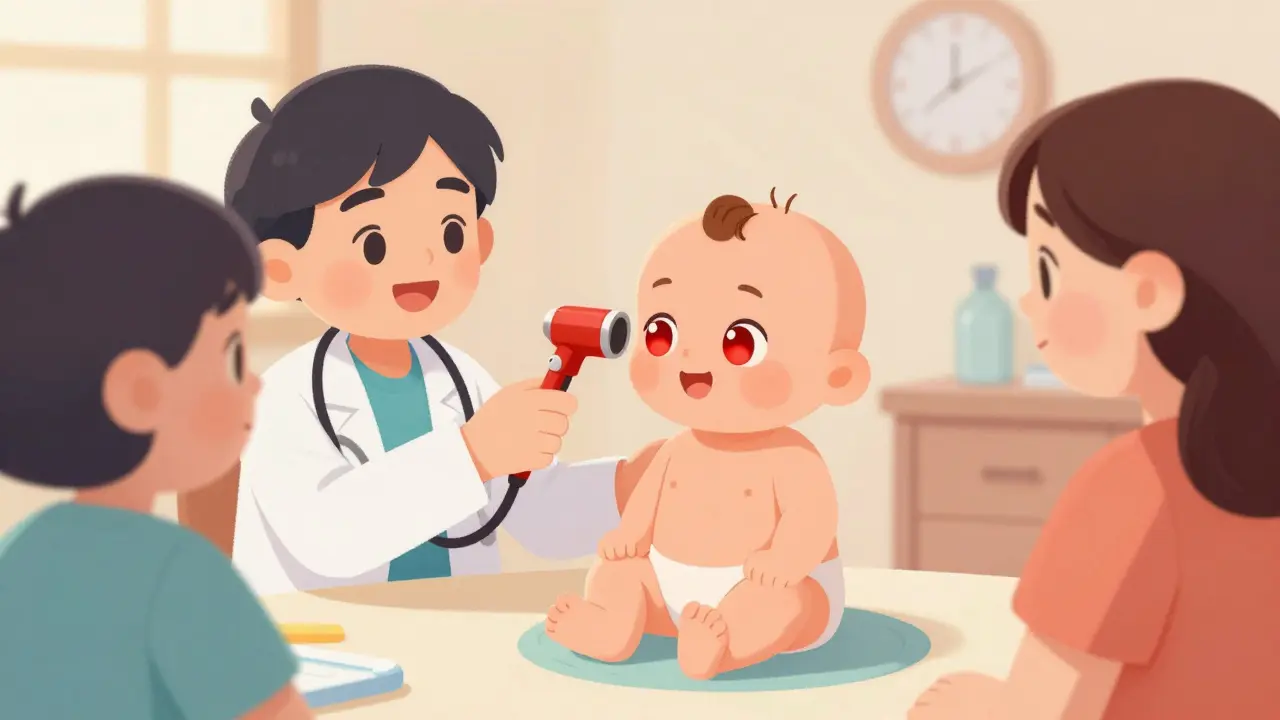
- Infants (0-6 months): The red reflex test is the standard. A doctor shines a light into each eye using an ophthalmoscope. A healthy eye reflects a red glow. A dim, white, or uneven reflection can signal cataracts, retinoblastoma, or other serious conditions.
- 6 months to 3 years: Along with red reflex, providers check for eye alignment, pupil response, and how well the eyes track moving objects. Parents might notice one eye turning in or out - that’s a red flag.
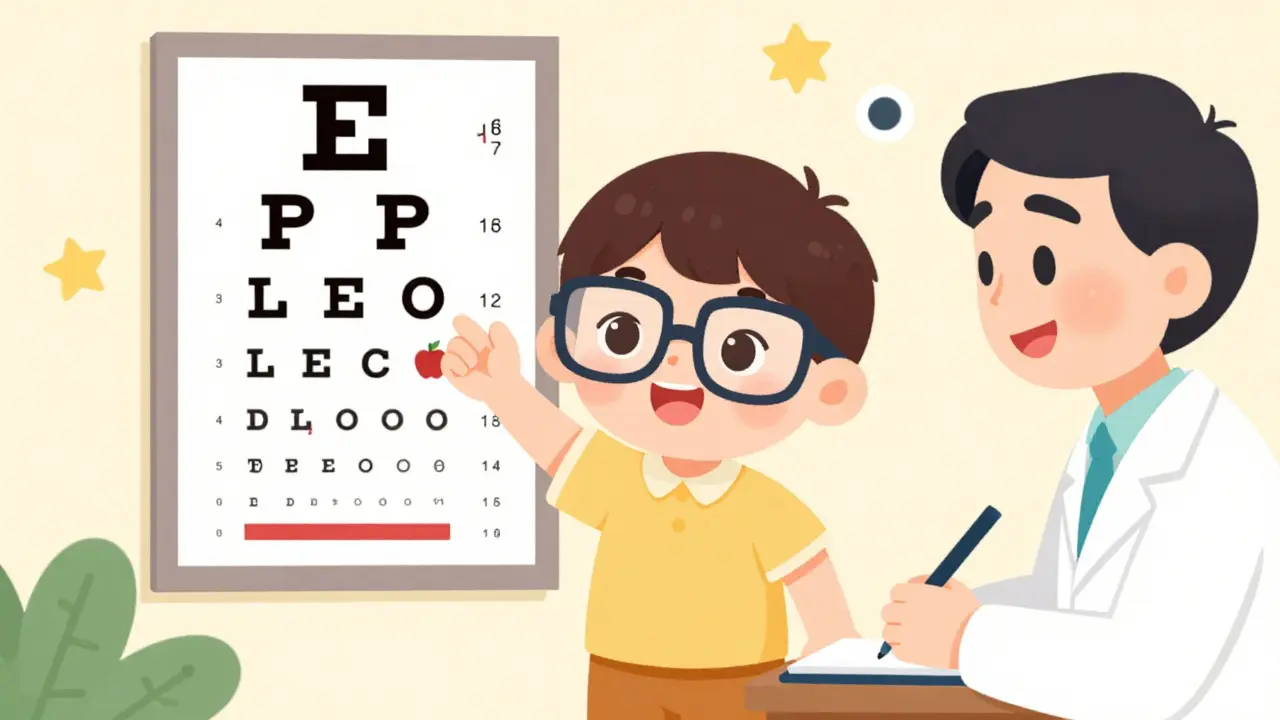
- Age 3 and older: This is when visual acuity testing begins. Kids are asked to identify shapes or letters on a chart. LEA symbols (circles, squares, apples, and houses) are used for younger kids who can’t read. HOTV letters (H, O, T, V) are introduced around age 4. By age 5, most kids can use Sloan letters (like those on an eye chart).
The key is matching the test to the child’s ability. A 3-year-old doesn’t need to read 20/20. They just need to identify the majority of symbols on the 20/50 line. A 4-year-old must pass the 20/40 line. By age 5+, they should read the 20/32 line. If they can’t, they’re referred for a full eye exam.
Two Main Methods: Charts vs. Machines
There are two main ways to screen: using charts with letters or shapes, or using handheld devices that measure how light reflects off the eye.
Optotype-based screening (charts) is the traditional gold standard. It’s simple, low-cost, and doesn’t need batteries. But it requires cooperation. About 1 in 5 children aged 3 to 4 refuse to participate or can’t focus long enough. That’s where instrument-based screening shines.
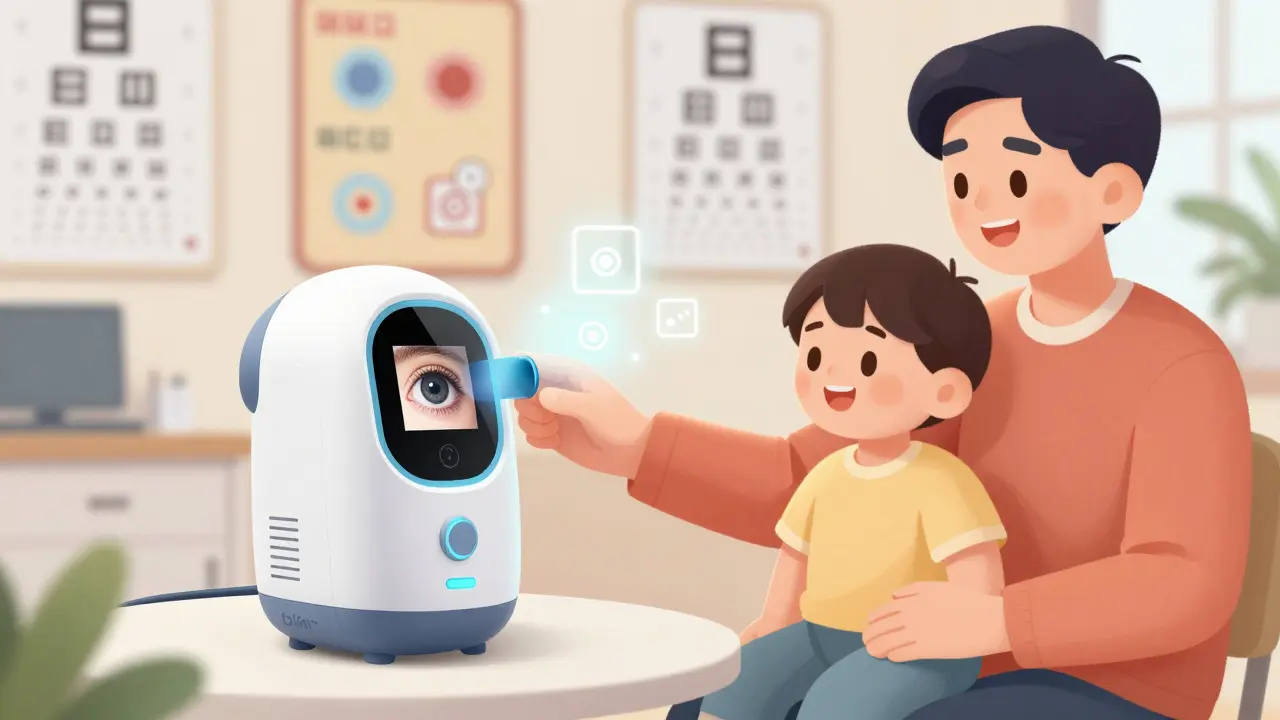
Instrument-based screening uses devices like autorefractors (SureSight, Retinomax, Power Refractor) or photoscreeners (iScreen, blinq™). These devices take a quick photo of the eyes and analyze how light focuses on the retina. They can detect refractive errors even in toddlers who won’t sit still. The blinq™ scanner, FDA-cleared in 2018, has shown 100% sensitivity for detecting amblyopia and strabismus in children aged 2 to 8. It takes less than a minute per child.
But here’s the catch: instruments can flag kids who don’t actually need treatment. A small amount of farsightedness is normal in toddlers. Over-screening leads to unnecessary referrals, stress, and costs. That’s why experts recommend using instrument-based screening for kids who can’t cooperate - not as a replacement for charts in older, cooperative children.
Who Should Be Screened and When
The American Academy of Pediatrics (AAP) and the U.S. Preventive Services Task Force (USPSTF) agree: every child needs at least one vision screening between ages 3 and 5. The USPSTF gives this a Grade B recommendation - meaning there’s strong evidence it works.
But screening shouldn’t stop there. The AAP recommends additional checks at ages 8, 10, 12, and 15. Why? Because vision can change. A child who passed at age 3 might develop a lazy eye at age 7. School-age children often don’t complain about blurry vision - they just struggle in class or avoid reading.
High-risk kids - those with premature birth, cerebral palsy, Down syndrome, or a family history of amblyopia - need earlier and more frequent screening. The American Academy of Ophthalmology advises starting as early as 1 year for these children.
What Happens After a Failed Screen
A failed screen doesn’t mean a child has a serious problem. But it does mean they need a full eye exam by a pediatric ophthalmologist or optometrist. That exam will confirm whether there’s a real issue and what treatment is needed.
Treatment for amblyopia usually involves patching the stronger eye or using eye drops to blur it temporarily. This forces the brain to rely on the weaker eye. Glasses correct refractive errors. Strabismus may need glasses, vision therapy, or surgery.
Time matters. The earlier treatment starts, the better the outcome. A child who begins patching at age 3 has a much higher chance of normal vision than one who starts at age 8. That’s why a failed screen isn’t a failure - it’s a lifesaver.
Barriers to Screening
Even though screening works, it doesn’t always happen. Common problems include:
- Uncooperative children - especially under age 4
- Improper lighting - too dim or too bright ruins test accuracy
- Incorrect distance - the chart must be 10 feet away for accurate results
- Lack of training - providers who haven’t been trained in screening protocols make mistakes
A 2018 study found that 25% of screenings had lighting issues. Another 20% had the chart too close or too far. These errors create false positives and false negatives - both dangerous.
Disparities also exist. Hispanic and Black children are 20 to 30% less likely to get screened than white children, according to the National Survey of Children’s Health. This isn’t about access alone - it’s about awareness, provider bias, and systemic gaps in pediatric care.
The Future of Screening
Technology is making screening easier. The blinq™ scanner is just the beginning. Researchers are now testing AI-powered tools that can analyze eye images from smartphones. Early trials show promise for screening as young as 9 months.
The National Eye Institute has invested $2.5 million (2021-2024) to improve screening accuracy in diverse populations. And by 2025, the AAP is expected to update its guidelines - possibly recommending instrument-based screening for all children starting at age 1.
One thing is clear: the economic return is huge. The USPSTF found that every dollar spent on pediatric vision screening saves $3.70 in lifetime costs related to untreated vision loss - including special education, lost productivity, and long-term care.
What Parents Should Do
You don’t need to be an expert. But you do need to ask:
- Has my child had a vision screening at age 3?
- Was it done with the right method for their age?
- Did they pass the critical line for their age group?
- If they failed, was a referral made?
If your child’s pediatrician doesn’t mention vision screening - ask. Don’t wait for a school form. Don’t assume they’ll catch it. Vision problems don’t fix themselves. And the longer you wait, the harder it becomes to help.
Mariah Carle
I just watched my 4-year-old squint at the TV like she’s solving a quantum equation 😅
Turns out she’s got astigmatism. We didn’t even know to ask until this post. Thank you. 🙏
March 3, 2026 AT 20:10
Megan Nayak
Let’s be real - this whole ‘screening before age 7’ thing is just capitalism repackaged as pediatric care.
Who decided that a child’s brain is a machine that ‘rewires’? That’s not neuroscience - that’s corporate jargon dressed up in stethoscopes.
And don’t get me started on the blinq™ scanner. Another $200 device that turns every toddler into a ‘false positive’ so the healthcare-industrial complex can keep raking in cash.
March 4, 2026 AT 00:18
Tildi Fletes
The clinical evidence presented here is robust and aligns with current AAP and USPSTF guidelines.
Instrument-based screening, particularly with devices like the iScreen or blinq™, demonstrates high sensitivity in non-cooperative populations.
However, the distinction between screening and diagnosis remains critical - screening identifies risk; diagnostic evaluation by a pediatric optometrist or ophthalmologist confirms pathology.
Overreliance on technology without clinical correlation may lead to unnecessary referrals, increased parental anxiety, and resource strain.
Standardized protocols, provider training, and environmental controls (e.g., lighting, distance) are non-negotiable components of valid screening.
Disparities in screening rates among racial and ethnic minorities reflect systemic inequities in access to preventive care, not clinical inadequacy.
Further investment in community-based outreach and culturally competent education is essential to closing this gap.
March 5, 2026 AT 01:13
Siri Elena
Oh honey, you mean we’re supposed to *actually* check kids’ eyes before they start failing math because they can’t see the board? 🤦♀️
Wow. Groundbreaking. Next you’ll tell us water is wet and the sky is blue.
And yes, I know the blinq™ is FDA-cleared - I read the brochure while waiting in line at Target.
Also, my 3-year-old ‘failed’ because she was busy licking the chart. Not sure if that’s a vision issue or a snack issue.
March 5, 2026 AT 03:59
Divya Mallick
In India, we have been screening children since the 1980s through community-based ASHA workers - not with $500 scanners, but with printed LEA charts and parental education.
Why are Western countries only now waking up?
Because profit > prevention.
Here, we don’t wait for FDA approval to save a child’s sight. We act.
And if your child can’t identify a square at age 3? You take them to the local clinic. Not a private ophthalmologist. Not a startup. A clinic.
Stop commodifying childhood vision. It’s not a SaaS product.
March 6, 2026 AT 13:18
Pankaj Gupta
The data on early intervention outcomes is unequivocal.
Studies from the VIP trial, Cochrane reviews, and longitudinal pediatric ophthalmology databases consistently support screening between ages 3 and 5.
Instrument-based tools are adjuncts, not replacements, for behavioral testing.
False positives are a known limitation, but the cost of missing amblyopia - permanent monocular vision loss - far outweighs the burden of unnecessary referrals.
Systemic disparities are real and require policy-level intervention, not individual blame.
Parents are not medical professionals. They need clear, actionable guidance - not jargon.
March 7, 2026 AT 09:43
Alex Brad
My kid passed at age 3. No drama. No scanner. Just a chart and a few shapes.
Don’t overcomplicate it. Ask your pediatrician. Do it. Done.
March 7, 2026 AT 13:38
Renee Jackson
To every parent reading this: You are your child’s first and most powerful advocate.
If your provider doesn’t mention vision screening, say: ‘Can we do the screening today?’
It takes two minutes. It could change their life.
You don’t need permission. You don’t need a form. Just ask.
And if they say no? Find someone who says yes.
Your child’s vision is worth fighting for.
March 7, 2026 AT 19:10
Callum Duffy
I appreciate the thoroughness of this post. The distinction between screening and diagnosis is often blurred in public discourse.
Instrument-based tools are excellent for populations with limited cooperation, but their predictive value is context-dependent.
One size does not fit all - age, developmental stage, and cultural factors must inform method selection.
It’s not about choosing between charts and machines. It’s about choosing the right tool for the right child at the right time.
March 7, 2026 AT 22:19
Chris Beckman
LMAO so now we’re scanning babies’ eyes like they’re barcodes? My cousin’s kid got flagged for ‘mild hyperopia’ at 18 months and they’re now on ‘vision therapy’ for $200 a session.
My uncle’s dog has better vision than half these ‘screened’ kids.
Also, why is the government paying for this? Can’t we just tell parents to take their kids to the optometrist?
And who says 20/32 is the magic number? My 5-year-old reads ‘C’ upside down and still beats me at Mario Kart.
March 9, 2026 AT 18:01
Levi Viloria
I grew up in rural Nepal. We didn’t have charts or scanners. We had elders who noticed when a kid bumped into things or squinted at the sun.
They’d take them to the temple healer - who’d give them herbal drops and tell them to stare at the horizon at dawn.
Some kids got better. Some didn’t.
Now I live in the US and see kids with $3000 glasses because they ‘failed’ a screening that used a chart placed 8 feet away in a fluorescent-lit room.
Maybe we’re over-engineering something that was once simple.
Not saying we should go back. Just… maybe we should remember what ‘observation’ used to mean.
March 10, 2026 AT 19:26
Richard Elric5111
The neuroplasticity of the developing visual cortex is a well-documented phenomenon, anchored in Hubel and Wiesel’s Nobel Prize-winning work on critical periods.
Deprivation amblyopia, when left uncorrected during the sensitive period (approximately 0–7 years), results in irreversible cortical reorganization.
Thus, the imperative for early detection is not merely clinical - it is ontological.
To defer screening is to permit the erosion of perceptual potential.
This is not policy. It is metaphysics.
March 11, 2026 AT 13:53
Dean Jones
Look. I get it. Screening saves vision. But let’s not pretend this isn’t a multi-billion dollar industry built on fear.
Every time a parent hears ‘lazy eye’ they panic.
Every time a device beeps ‘abnormal’ they pay $400 for a referral.
Every time a school sends a form, they get billed.
Meanwhile, the real issue? Kids staring at tablets for 8 hours a day.
Not enough outdoor time.
Not enough natural light.
Screening doesn’t fix that.
It just gives us a checklist to feel like we’re doing something while the real problem - our digital lifestyle - keeps growing.
We’re treating symptoms while ignoring the disease.
And the disease is called modernity.
March 11, 2026 AT 20:23
Betsy Silverman
I’m a pediatric nurse and I’ve seen this firsthand.
One little girl, age 4, passed screening at her well visit.
Two months later, her teacher noticed she was squinting at the whiteboard.
Turns out she developed amblyopia from a mild refractive shift.
She got glasses. Vision improved 100% in 3 months.
That’s the power of vigilance.
Not magic. Not tech. Just consistent attention.
Keep asking. Keep checking. Keep caring.
March 12, 2026 AT 09:38
Ethan Zeeb
If your pediatrician doesn’t screen at age 3, switch doctors.
It’s not optional. It’s not ‘nice to have.’
It’s as essential as immunizations.
And if they say ‘we don’t have the equipment’ - that’s a red flag.
They’re not equipped to care for your child.
Find someone who is.
March 14, 2026 AT 04:30