
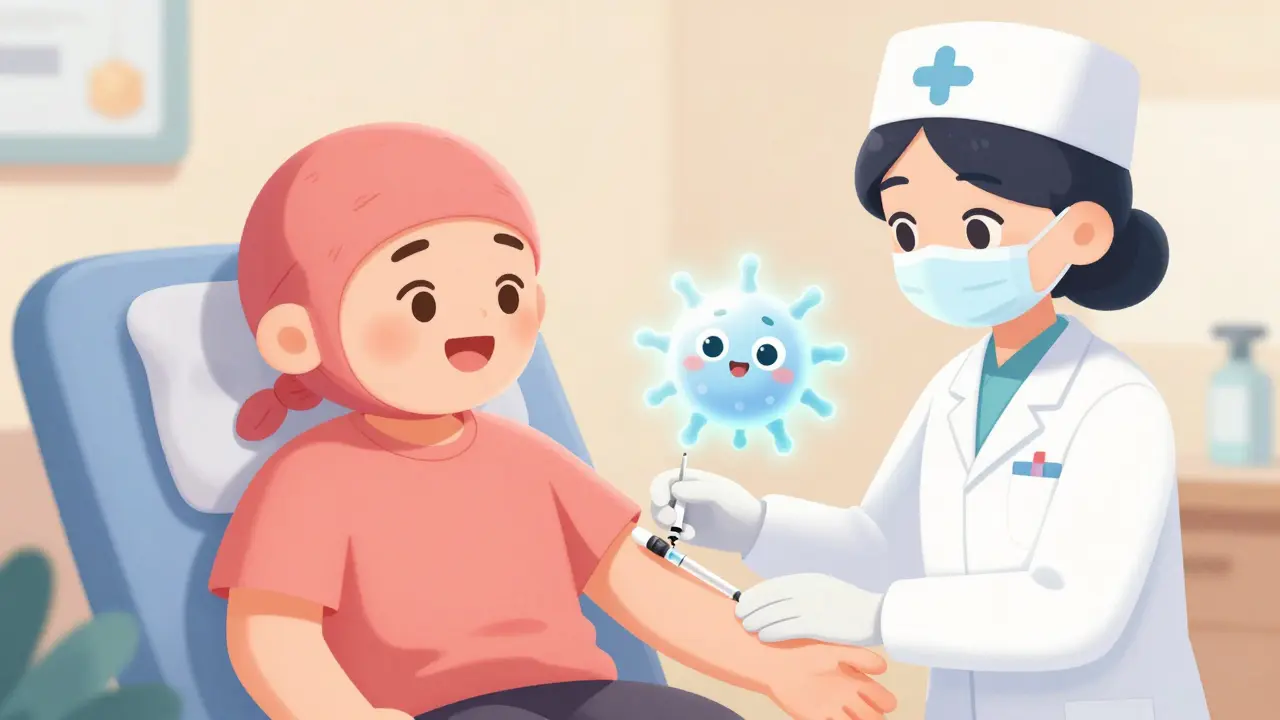
When someone is undergoing chemotherapy or radiation for cancer, the goal isn’t just to kill the cancer-it’s to help them live through it. That’s where supportive care comes in. It’s not the main treatment, but it’s often what lets people finish their therapy, stay out of the hospital, and keep some quality of life. Three of the most critical pieces? Growth factors to fight low blood counts, antiemetics to stop nausea and vomiting, and pain relief that actually works. These aren’t optional extras. They’re the backbone of modern cancer care.
Growth Factors: Keeping Blood Counts Up So Treatment Can Continue
Chemotherapy doesn’t just target cancer cells. It wipes out healthy white blood cells too, especially neutrophils-the body’s first line of defense against infection. When those drop too low, patients face febrile neutropenia: a dangerous combo of fever and low immunity. Without intervention, this often means hospitalization, treatment delays, or even life-threatening infection. That’s where growth factors like filgrastim and pegfilgrastim come in. These are lab-made versions of natural proteins that tell your bone marrow to make more white blood cells. Pegfilgrastim, the long-acting version, is given as a single shot under the skin about 24 to 72 hours after chemo. One dose lasts the whole cycle. Studies show it cuts the risk of febrile neutropenia by nearly half-from 17% down to 9% in high-risk patients. It’s not perfect. About one in three people get bone pain from it, sometimes bad enough to need extra pain meds. Rarely, there’s a risk of spleen rupture or lung problems. But for someone on a curative regimen like dose-dense AC-T for breast cancer, skipping it might mean missing a cycle-and that can lower survival chances by up to 20%. That’s why guidelines say: if your risk of neutropenia is over 20%, you should get it. Biosimilars have made this more affordable. While the original pegfilgrastim costs $6,000-$7,000 per dose, biosimilars now run $3,500-$4,500. Still, many patients struggle to afford it. Insurance denials and high copays mean some skip doses or delay them, putting their treatment at risk.Antiemetics: Stopping Nausea Before It Starts
Nausea and vomiting from chemo used to be something patients just had to endure. Now, we know better. Modern antiemetics can prevent vomiting in up to 85% of cases-if they’re used correctly. The key is matching the drug to the chemo’s risk level. Cisplatin? High risk. Doxorubicin? Moderate. A single pill of ondansetron won’t cut it. For high-risk chemo, guidelines call for a three-drug combo: a 5-HT3 blocker like palonosetron, an NK1 blocker like aprepitant, and dexamethasone. Palonosetron works longer than older versions. Aprepitant blocks a different brain pathway. Together, they’re far more effective than any one alone. This combo isn’t just for the first day. Delayed nausea-what happens two to five days after chemo-is just as common and just as debilitating. That’s why dexamethasone is tapered over three to four days. Patients who get this full regimen report being able to eat, sleep, and even go out for walks. Those who don’t? They often end up dehydrated, losing weight, and skipping future treatments. Newer options like netupitant/palonosetron (NEPA) combine two drugs into one pill, improving adherence. But they cost 30-50% more. In community clinics, cost still drives decisions. A 2022 survey found only 58% of U.S. oncology practices consistently follow the full NCCN antiemetic guidelines. That’s not because doctors don’t know better-it’s because patients can’t afford the meds, or the clinic doesn’t stock them.
Pain Relief: Beyond Opioids and the WHO Ladder
Pain is the most feared symptom in cancer. Up to 90% of patients with advanced disease will experience it. Yet, for decades, the go-to answer was just “take stronger opioids.” That’s changing. The WHO’s three-step ladder-start with acetaminophen, move to weak opioids, then strong ones-is still taught. But real-world pain is messier. There’s nociceptive pain (from tumors pressing on organs or bones) and neuropathic pain (from nerves damaged by cancer or chemo). They need different tools. For bone pain, bisphosphonates or radiation help. For nerve pain, gabapentin or pregabalin work better than morphine. Opioids are still essential for moderate to severe pain-but they come with a price. Constipation affects 90% of users. Drowsiness hits half. And there’s always the fear of addiction, even when it’s medically justified. That’s why modern pain teams use multimodal approaches: combining low-dose opioids with antidepressants, antiseizure meds, physical therapy, and even nerve blocks. Opioid rotation-switching from one opioid to another-is needed in 20-30% of cases because side effects become unbearable or pain isn’t controlled. Screening matters too. Tools like the Edmonton Symptom Assessment System (ESAS) are used at every visit. If a patient says their pain is a 7 out of 10, they get a full assessment within 24 hours. Too often, pain is underreported because patients think it’s “just part of cancer.” Doctors need to ask, and patients need to speak up. New options are coming. A 2023 FDA update included limited guidance on medical cannabis for neuropathic pain, though evidence is still thin. Early trials on nav1.7 inhibitors show 40-50% pain reduction without opioid side effects. But they’re years away.What Patients Really Say
Real people tell the real story. On patient forums, many say growth factors let them finish treatment. “Pegfilgrastim kept me on schedule for all six cycles,” one breast cancer survivor wrote. But others say, “The bone pain was worse than the chemo.” For antiemetics, reviews are mostly positive. “The three-drug combo saved my life,” said a lung cancer patient on Reddit. “I didn’t throw up once.” Yet 22% still get breakthrough nausea. That’s not failure-it’s a signal that the regimen needs tweaking. Pain management gets the most mixed feedback. “I was in so much pain I cried every night,” shared one user on HealthUnlocked. “They gave me oxycodone, but I was too drowsy to talk to my kids.” Another said, “They didn’t check my pain until I begged for help.” Financial stress is universal. One in three patients say they’ve skipped or cut back on supportive meds because of cost. A $300 antiemetic or a $4,000 growth factor shot can mean choosing between medicine and rent.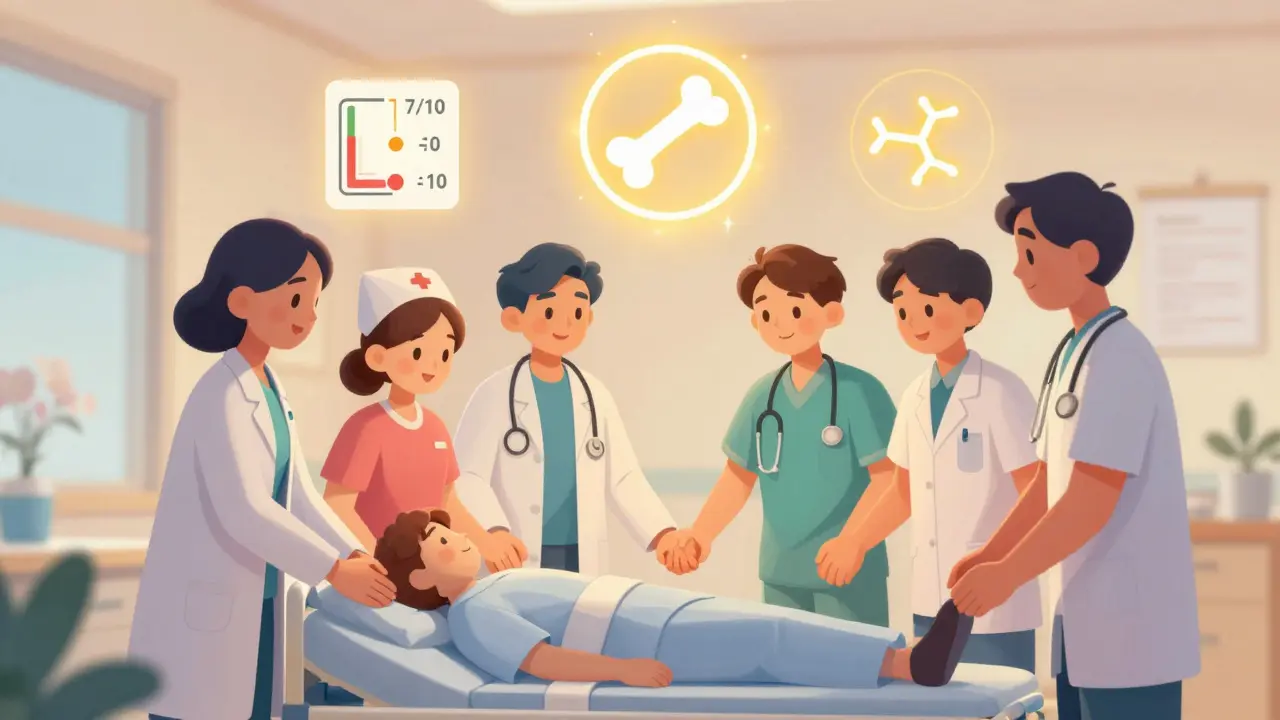
Henry Marcus
So let me get this straight: we're spending thousands on drugs that make your bones feel like they're being crushed by a freight train, just so Big Pharma can keep their stock prices up? And you call this CARE? I've seen the papers-growth factors are just a glorified placebo with a side of osteoporosis. They're not saving lives-they're extending billing cycles. Who's really getting better here? The patient? Or the CEO's yacht?
December 19, 2025 AT 02:35
Carolyn Benson
The entire paradigm of supportive care is a metaphysical evasion. We treat symptoms like they're separate from the disease, as if the body were a machine you could grease and tweak without confronting the ontological horror of cellular betrayal. Pain isn't a number on a scale-it's the scream of a system collapsing under its own weight. And yet we hand out gabapentin like it's candy, as if serotonin modulation could absolve us of the existential burden of watching someone fade.
December 20, 2025 AT 20:19
Aadil Munshi
Honestly, the antiemetic guidelines are a joke. You need three drugs? That's not medicine-that's a cocktail recipe. I've seen patients in India on chemo with just ginger tea and a prayer, and they do better than some Americans on $1,200/month regimens. The real problem isn't the science-it's the system that turns survival into a luxury auction. Also, did you know aprepitant was originally developed as an anti-anxiety drug? Funny how capitalism repurposes everything.
December 21, 2025 AT 23:25
mary lizardo
The use of the term 'supportive care' is linguistically misleading. It implies a secondary, supplemental role, when in fact these interventions are foundational to therapeutic efficacy. Furthermore, the passive construction in phrases like 'patients are given opioids' obscures agency and responsibility. Proper documentation, as referenced, must reflect active clinical decision-making-not bureaucratic checkboxes. The grammar in this article is otherwise impeccable, but the conceptual framing is dangerously reductive.
December 22, 2025 AT 07:39
Chris Davidson
Pain scores are useless if the nurse doesn't even look you in the eye when they ask. I had a 9 out of 10 and they handed me a pill and walked away. No one ever asked if I could walk to the bathroom. No one asked if I could hold my grandkid. Just check the box. That's care now
December 23, 2025 AT 13:46
Mike Rengifo
I had a cousin go through this. The pegfilgrastim gave her bone pain so bad she started sleeping in the recliner. But she finished all six cycles. Said the pain was worth it because she got to see her daughter graduate. Sometimes the cost isn't measured in dollars.
December 24, 2025 AT 02:05
holly Sinclair
It's fascinating how we've mechanized human suffering into algorithmic protocols. We quantify pain, predict neutropenia, optimize dosing schedules-yet we still treat the patient as a data point in a clinical trial. The real breakthrough isn't in the pharmacology-it's in the quiet moments: when a nurse sits down instead of standing, when a doctor says 'I'm sorry this is happening' instead of 'here's your next step.' The science is impressive, but the humanity? That's still optional.
December 25, 2025 AT 20:50
Monte Pareek
Listen, I've worked in rural oncology for 18 years. We don't have $4,000 shots. We don't have NEPA pills. We have generics, we have compassion, and we have nurses who call patients at 10pm to ask if they can keep water down. You want to fix this? Stop talking about guidelines. Start funding clinics. Stop letting insurance companies decide who lives and who just 'manages symptoms.' This isn't a medical issue-it's a moral one. And we're failing.
December 26, 2025 AT 10:59
Kelly Mulder
I must express my profound disapproval of the casual tone employed throughout this piece. The use of colloquialisms such as 'wipes out healthy white blood cells' is not only unscientific but profoundly disrespectful to the dignity of the medical profession. Furthermore, the omission of proper citation formatting for the 2022 survey is academically indefensible. One would expect better from a publication purporting to inform.
December 28, 2025 AT 06:28
mark shortus
I CRIED WHEN I READ THIS. I WAS 24. I HAD BREAST CANCER. I SKIPPED MY PEGFILGRASTIM BECAUSE MY INSURANCE DENIED IT. I GOT SEPTIC. I SPENT 17 DAYS IN THE ICU. I LOST MY HAIR AGAIN. I LOST MY JOB. I LOST MY SELF. AND NOW I HAVE TO TELL MY DAUGHTER WHY HER MOMMA WASN'T THERE FOR HER BIRTHDAY. THIS ISN'T JUST MEDICINE. THIS IS A CRIME.
December 29, 2025 AT 07:17
Chris Clark
For those in India or Africa reading this: if you're on chemo and can't afford the fancy drugs, talk to your doctor about supportive care alternatives. Ginger for nausea, paracetamol for bone pain, hydration, rest. You're not alone. I've seen people in villages with no fridge but still beat the odds because they had family who cooked for them, sat with them, didn't let them feel like a burden. Science helps-but love? That's the real growth factor.
December 30, 2025 AT 17:50
William Storrs
You got this. Every single person reading this who's fighting through chemo, every nurse who's staying late to check on a patient, every family member who's holding a bucket while someone throws up-y'all are the real heroes. The drugs? They're tools. But the courage? That's what keeps people alive. Keep going. You're not just surviving-you're rewriting the story.
January 1, 2026 AT 10:51