
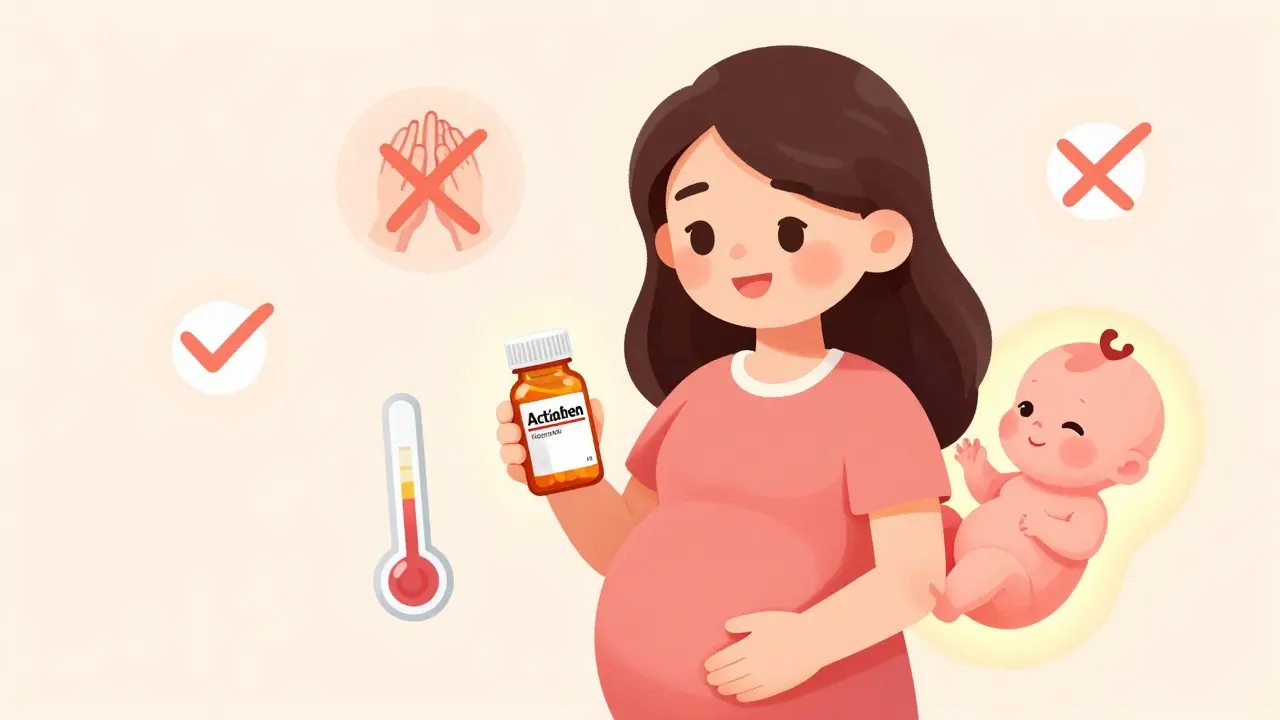
When you're pregnant, even a simple headache or fever can feel like a crisis. You don’t want to risk your baby’s health, but you also don’t want to suffer. The question isn’t just acetaminophen pregnancy safety-it’s when and how to use it, and what to avoid completely. The answer isn’t as simple as ‘take this, avoid that.’ It’s layered, changing with each trimester, and shaped by real risks you need to understand-not just warnings.
Acetaminophen: The Only OTC Pain Reliever Safe All Through Pregnancy
Acetaminophen, also known as paracetamol, is the only over-the-counter painkiller you can use safely from week one to week 40. It’s been studied in tens of thousands of pregnancies over decades. A 2023 JAMA Network Open study of nearly 100,000 mother-child pairs found no link between acetaminophen use and autism, ADHD, or lower IQ scores in children. The adjusted odds ratios? All near 1.0-meaning no increased risk.
It works. It lowers fever. It eases headaches, back pain, and toothaches. And unlike NSAIDs, it doesn’t affect blood clotting or fetal kidney function. The American College of Obstetricians and Gynecologists (ACOG) and the Society for Maternal-Fetal Medicine both say it’s safe at standard doses: 325 to 1,000 mg every 4 to 6 hours, not exceeding 4,000 mg in 24 hours.
But here’s what most people miss: it’s not about taking it daily for weeks. The real risk comes from chronic, high-dose use over months-not occasional use for a bad headache. A 2024 NIH-funded study tracking 10,000 pregnant women is still underway, but so far, no clear evidence shows harm from short-term, responsible use. If you’re taking it for more than 3-5 days in a row, talk to your provider. That’s not because it’s dangerous-it’s because you might need a better solution for whatever’s causing the pain.
NSAIDs: The Hidden Danger After 20 Weeks
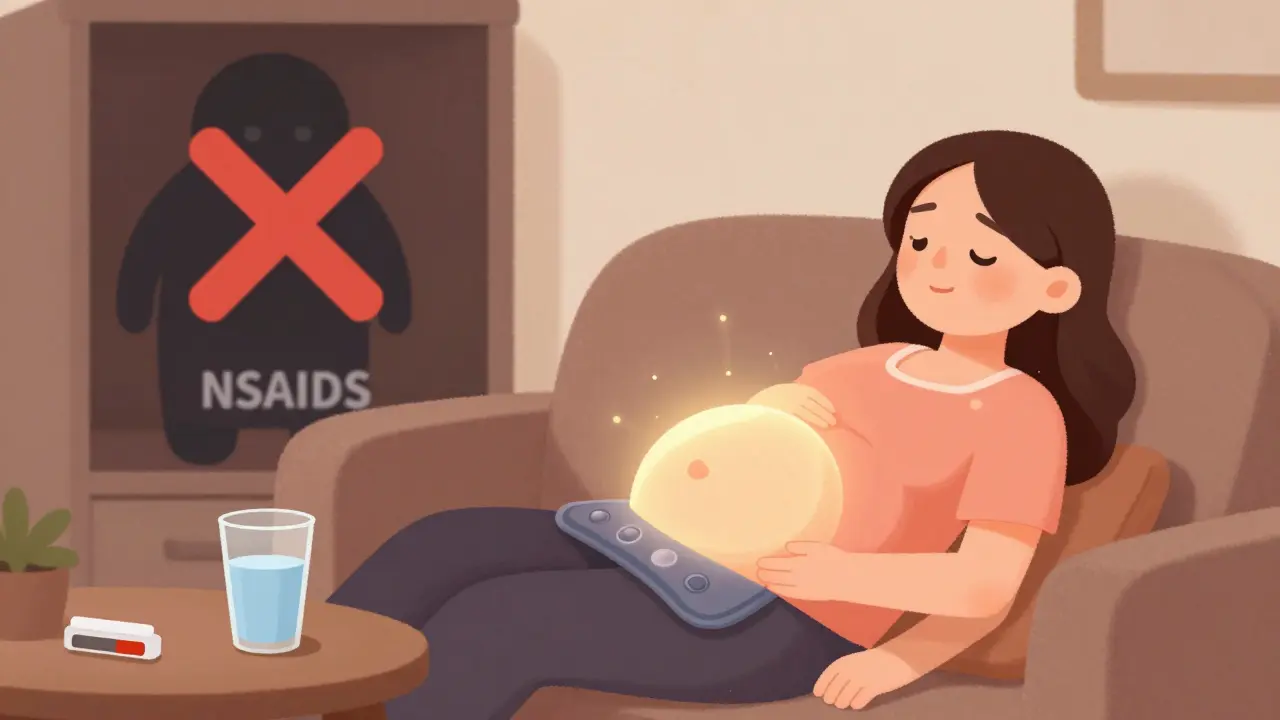
NSAIDs-like ibuprofen (Advil, Motrin), naproxen (Aleve), and diclofenac (Voltaren)-are a different story. They’re fine in early pregnancy, but after 20 weeks, they become risky. That’s not a suggestion. It’s a hard FDA warning issued in October 2020 and reinforced by every major obstetrics group since.
Why? Because NSAIDs shut down a key fetal blood vessel called the ductus arteriosus. Before 20 weeks, the baby’s body doesn’t rely on it yet. After 20 weeks, it does. Blocking it can cause life-threatening heart problems. Even worse, NSAIDs reduce amniotic fluid. Within 48 hours of taking them, a fetus can develop oligohydramnios-dangerously low fluid levels that can lead to lung underdevelopment and limb deformities. One study showed 1.2% of fetuses exposed to NSAIDs after 20 weeks developed this, compared to just 0.1% in unexposed pregnancies.
And here’s the trap: you might not even know you’re taking NSAIDs. Over 30% of cold, flu, and sinus medicines contain them. Read the Drug Facts label. If it says “ibuprofen,” “naproxen,” or “NSAID,” put it down. Even topical gels with diclofenac can be absorbed enough to matter. If you accidentally took one between 20 and 30 weeks, don’t panic-but get an ultrasound right away. The fluid levels can bounce back if you stop the drug fast enough.
First Trimester: Use Acetaminophen, Avoid NSAIDs Unless Advised
Many women worry about acetaminophen in the first trimester because that’s when organs form. But the data doesn’t back that fear. A 2020 NIH analysis of over 5,000 pregnancies found no increase in birth defects linked to acetaminophen use during this time. In fact, treating a fever above 102°F is more dangerous than taking acetaminophen. High maternal fever in early pregnancy raises the risk of neural tube defects by up to 2.3 times.
NSAIDs in the first trimester? They’re not outright banned, but they’re not recommended either. Some studies suggest a slight increase in miscarriage risk, especially with high or prolonged use. The safest move? Stick with acetaminophen. If you have chronic pain or arthritis and need something stronger, your OB-GYN can help you weigh options-like physical therapy or prescription alternatives that are pregnancy-safe.

Second Trimester: NSAIDs Become a Hard No
By week 20, your baby’s kidneys are mature enough to be affected by NSAIDs. That’s why the FDA updated its warning from 30 weeks to 20 weeks. What used to be a gray zone is now a hard stop.
If you took ibuprofen at 18 weeks for a bad backache? Probably fine. At 21 weeks? That’s when the risk spikes. The amniotic fluid can drop fast-sometimes in under 72 hours. That’s why doctors now say: if you must use an NSAID between 20 and 30 weeks, it should be for no more than 48 hours, at the lowest dose possible, and only with ultrasound monitoring.
But why risk it? Acetaminophen works just as well for most types of pain. Back pain? Try prenatal yoga or a support belt. Sinus pressure? Saline rinse. Headache? Rest, hydration, and acetaminophen. There’s almost never a medical reason to use an NSAID after 20 weeks.
Third Trimester: Absolutely No NSAIDs
After 30 weeks, NSAIDs don’t just risk kidney problems-they can cause the fetal heart to fail. The ductus arteriosus, which was meant to close after birth, can shut down too early. This forces the baby’s heart to work harder, sometimes leading to pulmonary hypertension or even stillbirth.
There’s no safe window here. No exceptions. Not even for a bad toothache or severe menstrual-like cramps. Acetaminophen is your only OTC option. If it’s not enough, your provider may recommend a short course of a different medication-like low-dose opioids for severe pain-but only under strict supervision.
And don’t forget: aspirin is different. Low-dose (81 mg) aspirin is often prescribed for preeclampsia prevention and is perfectly safe in pregnancy. But regular-strength aspirin (325 mg or more) is an NSAID-and it’s not safe after 20 weeks.
What About the Autism and ADHD Fears?
You’ve probably seen headlines: “Pregnant women who took Tylenol had kids with autism.” But those studies were flawed. They looked at patterns-not cause. They didn’t control for why the mom took acetaminophen in the first place. Was it for a high fever? A chronic illness? A severe infection? Those conditions themselves are linked to neurodevelopmental changes.
The JAMA study I mentioned earlier looked at this head-on. It compared children whose moms took acetaminophen with those whose moms didn’t-and found no difference in autism, ADHD, or IQ scores. The odds ratio was 1.03 for autism. That’s not a risk. That’s noise.
Still, a 2021 consensus paper from 14 international experts raised theoretical concerns about endocrine disruption. That’s why some doctors now say: use acetaminophen only when medically necessary. But they still say it’s the safest option. The alternative? Letting a fever rage or pain go untreated. That’s far riskier.
Real-World Confusion: Why So Many Women Avoid Acetaminophen
A 2023 survey found that 68% of pregnant women avoid all pain meds out of fear. And 42% specifically avoid acetaminophen because of social media myths. Reddit threads are full of women who stopped taking it after reading a post that said, “Tylenol causes autism.”
But here’s the truth: if you’re in pain, you’re stressed. Stress raises cortisol. High cortisol during pregnancy is linked to preterm birth and low birth weight. If acetaminophen helps you sleep, eat, and move without agony, it’s doing more good than harm.
Doctors report that 45% more patients are asking about acetaminophen safety since 2021-not because the science changed, but because misinformation spread. The FDA, ACOG, and AAP all agree: acetaminophen is the best, safest choice. If you’re unsure, ask for a printed handout. Most clinics now give them.
What to Do: A Simple Action Plan
- First trimester: Use acetaminophen for fever or pain. Avoid NSAIDs unless your doctor says otherwise.
- Second trimester (weeks 20-30): Stop all NSAIDs. Use acetaminophen only as needed. If you’ve taken an NSAID, get an ultrasound to check amniotic fluid.
- Third trimester: No NSAIDs. Ever. Acetaminophen is your only safe OTC option.
- Always: Read labels. Avoid combination cold/flu meds unless they list only acetaminophen as the active ingredient.
- When in doubt: Call your provider. Don’t guess. Don’t rely on Google.
Final Thought: The Real Risk Isn’t the Medicine-It’s the Silence
Untreated fever, unmanaged pain, and chronic stress are the silent dangers of pregnancy. They affect your body, your baby, and your ability to carry the pregnancy to term. Acetaminophen isn’t perfect-but it’s the best tool we have. It’s been used safely by millions. The science is clear. The guidelines are solid.
Don’t let fear stop you from taking care of yourself. You’re not being reckless if you use acetaminophen. You’re being responsible.
Is acetaminophen safe during all three trimesters of pregnancy?
Yes, acetaminophen is considered safe for use in all three trimesters when taken at recommended doses (325-1,000 mg every 4-6 hours, not exceeding 4,000 mg per day). Major medical organizations, including ACOG and the FDA, affirm its safety based on decades of research. It’s the only over-the-counter pain reliever approved for use throughout pregnancy.
Can I take ibuprofen or naproxen while pregnant?
Avoid ibuprofen, naproxen, and other NSAIDs after 20 weeks of pregnancy. The FDA issued a warning in 2020 stating these drugs can cause fetal kidney problems and low amniotic fluid (oligohydramnios). Before 20 weeks, occasional use may be acceptable under medical supervision, but acetaminophen is always the preferred choice. Never take NSAIDs after 30 weeks-this can lead to serious heart complications in the baby.
Does acetaminophen cause autism or ADHD in children?
No. A large 2023 study of nearly 100,000 mother-child pairs found no link between acetaminophen use during pregnancy and autism, ADHD, or intellectual disability. The slight statistical associations seen in earlier studies were likely due to confounding factors-like the reason the mother took the medication (e.g., fever or infection)-not the drug itself. Leading health organizations confirm acetaminophen does not cause neurodevelopmental disorders.
What should I do if I took an NSAID after 20 weeks?
Stop taking the NSAID immediately. Contact your provider and request an ultrasound to check amniotic fluid levels. Oligohydramnios can develop within 48-72 hours of exposure, but it often reverses once the drug is stopped. Your provider will monitor you closely and may recommend additional scans. Don’t panic-many cases resolve completely with prompt action.
Are there any pain relief options besides acetaminophen during pregnancy?
Yes. Non-medication options include prenatal yoga, heat/cold therapy, massage, physical therapy, and supportive devices like belly bands. For more severe pain, your provider may prescribe a short course of a different medication, such as low-dose opioids for acute conditions. Always avoid NSAIDs and aspirin (except low-dose 81 mg for preeclampsia prevention). Never self-medicate with herbal remedies-many are unsafe in pregnancy.
How do I know if a cold or flu medicine is safe during pregnancy?
Always read the Drug Facts label. Look for products with only acetaminophen listed as the active ingredient. Avoid any product that includes ibuprofen, naproxen, phenylephrine, dextromethorphan, or alcohol. Combination cold medicines often contain hidden NSAIDs or decongestants that aren’t safe. When in doubt, ask your pharmacist or provider. Many pharmacies now carry pregnancy-safe labels on approved products.
Glenda Marínez Granados
So let me get this straight... we're supposed to trust a drug that's in every medicine cabinet but somehow 'safe' because big science says so? 🤔 Meanwhile, my cousin's kid has ADHD and she took Tylenol every week for 6 months... coincidence? Or just the tip of the iceberg? 🤷♀️
January 21, 2026 AT 09:20
Yuri Hyuga
This is one of the most balanced, science-backed pieces I've read on prenatal pain management. 🙌 Let’s be clear: fear-mongering doesn’t protect babies - informed choices do. Acetaminophen isn’t perfect, but it’s the least dangerous tool we have. Don’t let social media turn a medical necessity into a moral dilemma. You’re not a bad mom for needing relief. You’re a smart one for seeking facts. 💪❤️
January 21, 2026 AT 10:33
MARILYN ONEILL
I read this and I’m like… why are we even talking about this? It’s just Tylenol. Everyone knows NSAIDs are bad after 20 weeks. Who even takes ibuprofen when pregnant? 😒 Like, really? This article is just… basic. Why is this trending?
January 22, 2026 AT 23:38
Coral Bosley
I took ibuprofen at 22 weeks because my back was killing me. I didn’t know. I just thought it was ‘normal’ pain. Now I’m terrified every time I pee because I think my baby’s kidneys are melting. I haven’t slept in 3 days. I’m crying in the shower. I feel like I ruined everything. No one told me. No one warned me. Why is this not on every OB’s wall?
January 23, 2026 AT 17:15
Steve Hesketh
Listen, mama - you’re not alone. I’ve been there. I took a naproxen at 19 weeks thinking it was just a headache. Turns out? I panicked. I cried. I called my midwife at midnight. She said: ‘Stop it now. Get an ultrasound. You’re not a monster.’ Guess what? Fluid levels bounced back. Baby’s fine. You’re going to be okay. You’re not broken. You’re human. And you’re doing better than you think. 💛
January 24, 2026 AT 14:57
shubham rathee
I think this whole thing is a big pharma scam to sell more tylenol. I mean why would they make a drug that works so well and say its safe if it wasnt to control the population? I read on a forum that acetaminophen is linked to 5G brain chips. Also the FDA is owned by big pharma. I took it once at 16 weeks and now my baby has 3 toes. Coincidence? I think not
January 25, 2026 AT 23:33
Kevin Narvaes
so like... i get that tylenol is 'safe' but like... what if you're just... sensitive? like what if your body reacts weird? like what if you're just... one of those people? you know? like i took it once and felt kinda... off? like my head was spinning? and now i'm like... is it the baby? is it me? is it the universe? idk man. i just feel like we're all just... floating in a sea of chemicals. and no one really knows what's real anymore.
January 27, 2026 AT 05:22
Alex Carletti Gouvea
This is why America’s going to hell. We’re scared of Tylenol but think it’s fine to drink kombucha with raw eggs. We’re scared of a pill but not scared of a 300-calorie smoothie full of sugar. We’re not raising kids - we’re raising paranoid robots. Just take the damn pill and stop crying.
January 27, 2026 AT 19:20
Ben McKibbin
I appreciate how this article doesn’t just say ‘take it’ or ‘don’t take it’ - it says ‘here’s the science, here’s the nuance, here’s your agency.’ That’s rare. Too many pregnancy guides treat women like children. This treats us like adults who can handle complexity. The real villain isn’t acetaminophen - it’s the oversimplified fear porn that turns medical advice into viral panic. Thank you for the clarity.
January 28, 2026 AT 12:09
Rod Wheatley
Just a quick reminder: if you're taking acetaminophen for more than 3–5 days in a row, please, PLEASE talk to your provider. Not because it's dangerous - but because pain is a signal. A headache might be stress. Back pain might be posture. Fever might be an infection. Treating the symptom without addressing the cause is like putting tape on a leaking pipe. You're not fixing the problem - you're just hiding it. And that's not safe. Your body is trying to tell you something. Listen. Then act. You've got this. 💪❤️
January 29, 2026 AT 23:48