
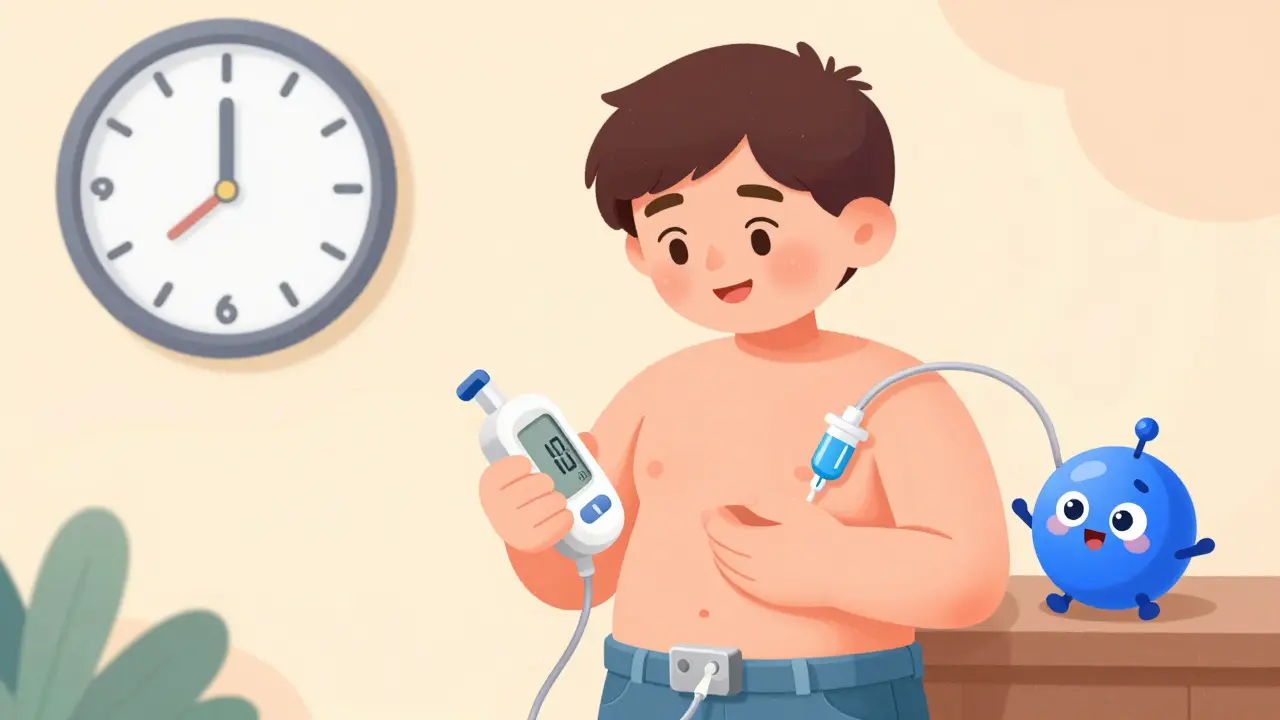
Using an insulin pump isn’t like plugging in a phone charger and forgetting about it. If you’re on continuous subcutaneous insulin infusion (CSII), you’re managing a small, programmable device that’s delivering insulin into your body 24 hours a day. One wrong setting, one clogged tube, one missed bolus - and things can go south fast. This isn’t science fiction. It’s real life for over 30% of people with type 1 diabetes in the U.S., and growing numbers of those with unstable type 2 diabetes too.
How Insulin Pumps Actually Work
Insulin pumps don’t use long-acting insulin. They only use rapid-acting analogs like Humalog or Novolog. That’s key. These insulins start working in 10-15 minutes, peak around 1 hour, and wear off in 3-4 hours. The pump mimics how a healthy pancreas works by giving you a steady trickle of insulin all day (basal rate) and extra bursts when you eat (bolus).
Think of it like a drip feed system. Your body needs different amounts of insulin at different times. You might need more insulin overnight because of the dawn phenomenon - that natural rise in blood sugar before you wake up. Or less during exercise. The pump lets you program these changes hour by hour. Most modern pumps let you store multiple basal profiles: one for weekdays, one for weekends, one for illness, one for workouts.
Setting the Basal Rate: The Foundation
Your basal rate is the most important setting. Get this wrong, and your blood sugar will drift up or down all day - even when you haven’t eaten. Most people start with 40-50% of their total daily insulin dose spread across 24 hours. But that’s just a guess. The real test? A 24-hour fast.
Here’s how to check it: skip a meal. Don’t bolus. Don’t exercise. Test your blood sugar every 2-3 hours. If your numbers stay steady, your basal is right. If it climbs, you need more insulin. If it drops, you need less. Dr. John Walsh, author of Pumping Insulin, says improper basal testing is the #1 reason pump users end up in the hospital. Most people skip this step or do it too quickly. Do it right. Do it slowly. Do it when you’re healthy.
Bolus Settings: Mealtime Math
When you eat, you need to cover the carbs. That’s where your insulin-to-carbohydrate ratio (ICR) comes in. If your ICR is 1:10, that means 1 unit of insulin covers 10 grams of carbs. But that’s not the whole story. You also need your insulin sensitivity factor (ISF) - how much 1 unit of insulin lowers your blood sugar. If your ISF is 1:3, then 1 unit drops your glucose by 3 mmol/L.
Here’s where it gets tricky. Not all meals are the same. A pizza or a curry with coconut milk digests slowly. A regular sandwich? Fast. That’s why pumps have extended and dual-wave boluses. An extended bolus spreads the insulin over 2-4 hours. A dual-wave gives half right away, half later. If you’re eating high-fat meals and only using a normal bolus, you’ll spike after eating and crash hours later. That’s not a pump failure. That’s a missed setting.
Infusion Sets and Site Care
Your cannula sits under your skin - usually in the abdomen, thigh, or upper arm. Change it every 2-3 days. No exceptions. If you leave it in longer, you risk infection, poor absorption, or lipohypertrophy - those lumpy scar tissue areas that absorb insulin poorly. A 2022 study found 27% of new pump users developed lipohypertrophy because they rotated sites poorly.
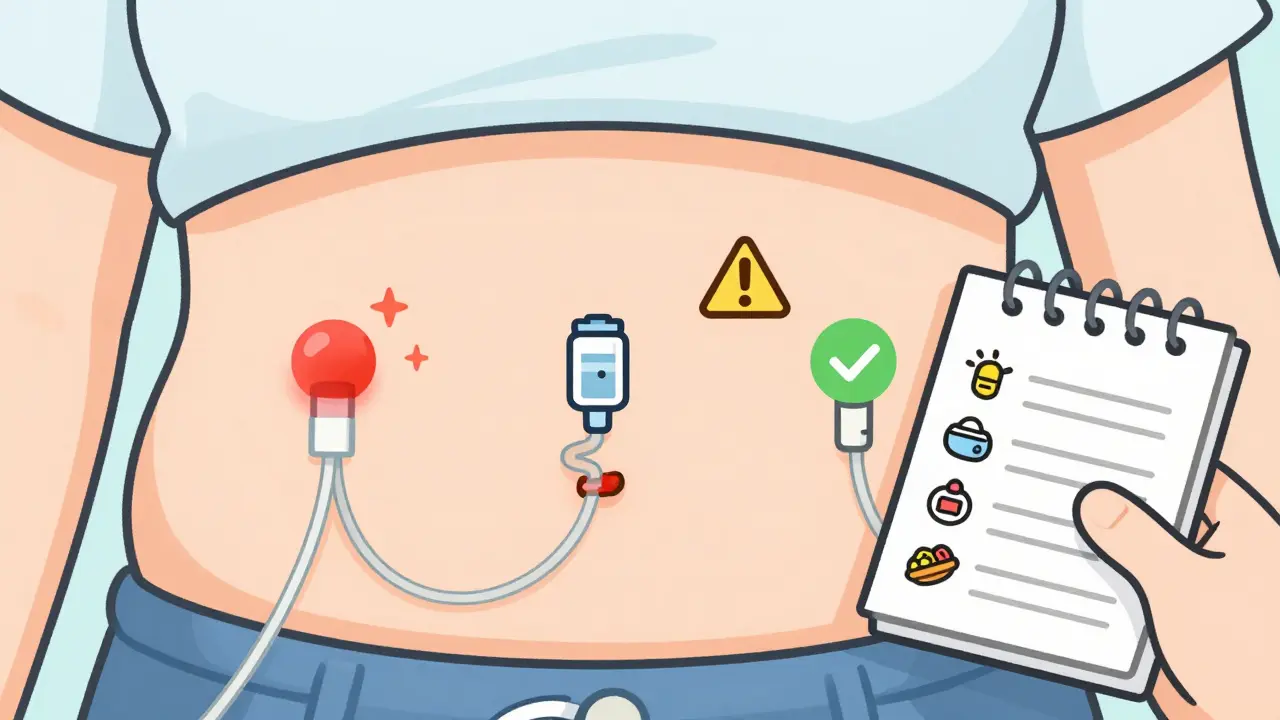
Rotate your sites like clockwork. Don’t reuse the same spot. Don’t stick it in the same spot every time you eat. Keep a simple log: Monday - left abdomen, Tuesday - right hip, Wednesday - left upper arm. That’s it. It sounds basic, but it’s the difference between stable glucose and wild swings.
Safety: What No One Tells You
Here’s the scary part: if your tubing gets kinked, your infusion set falls out, or your pump runs out of insulin, it keeps going - but now you’re not getting any insulin. Diabetic ketoacidosis (DKA) can happen in 2-4 hours. That’s faster than most people realize.
That’s why you need to check your pump every time you test your blood sugar. Look at the tubing. Make sure the reservoir is full. Check for alarms. If your blood sugar is high and you haven’t bolused recently, suspect a blockage. Remove the set. Inject insulin by pen. Call your clinic. Don’t wait. Don’t assume it’s just a bad day.
And if you’re sick? Your insulin needs go up. Your basal might need a 20-50% increase. Your ISF might change too. Don’t guess. Test every 2 hours. Adjust. Keep a backup pen handy. Always.
Special Situations: Surgery, Pregnancy, and Sleep
If you’re having surgery, your pump might stay on - but only if you’re eating within a few hours. For longer procedures, you’ll need IV insulin. Hospitals have protocols for this. Make sure your care team knows your settings.
After giving birth, your insulin needs drop fast - often by 30-50%. Breastfeeding drops them even more. Many women get dangerously low in the first few days. Talk to your diabetes team before delivery. Have a plan. Adjust your basal rates immediately after birth.
At night? Some pumps now have predictive low-glucose suspend. If your glucose is dropping fast, the pump stops insulin for 30-120 minutes. That’s helpful. But it’s not perfect. You still need to check your glucose before bed. Set a low alarm. Keep glucose tabs by your bed. Don’t rely on tech alone.
Technology Is Helping - But Not Replacing You
The Tandem Mobi is tiny - smaller than a credit card. The Medtronic 670G and Omnipod 5 can auto-adjust basal rates. They’re called hybrid closed-loop systems. They’re amazing. But they still need you. You still have to bolus for meals. You still have to enter carbs. You still have to change the set. You still have to test.
Dr. Anne Peters says it best: “CSII is not an artificial pancreas.” It’s a tool. A powerful one. But if you don’t use it right, it won’t save you. It might hurt you.

What You Need to Succeed
Successful pump users don’t just follow instructions. They learn the why behind the numbers. They track patterns. They adjust. They ask questions.
You need to be able to:
- Count carbs accurately - within 5 grams
- Understand insulin action times
- Recognize signs of high and low blood sugar
- Test at least 4 times a day - more when you’re sick or changing settings
- Carry backup: insulin pen, extra sets, batteries, glucose tabs
Most people take 2-4 weeks to get comfortable. Six months to master it. Don’t rush. Don’t skip training. The Association of Diabetes Care & Education Specialists recommends at least 15 hours of education before starting.
Common Problems and How to Fix Them
Here’s what users actually run into:
- High blood sugar after meals - Probably under-bolused. Check your ICR. Did you forget fat/protein? Try an extended bolus next time.
- Low blood sugar overnight - Basal too high. Do a fasting test.
- Site infections - Changed set too late. Switch sites. Use alcohol wipes before inserting.
- Pump alarm going off constantly - Air in tubing. Prime again. Check for kinks.
- Unexplained high glucose - Check your infusion set. 45% of pump users have had a device failure within the first year.
Keep a log. Not just glucose. Write down meals, activity, stress, illness. Look for patterns. Your pump downloads can show you trends - but only if you’re paying attention.
Cost and Access
Insulin pumps cost $6,500-$8,200 a year in the U.S. - including supplies and insulin. That’s $2,000 more than multiple daily injections. In Australia, Medicare and private insurance cover most of it, but you still pay out-of-pocket for sets and reservoirs. If you’re struggling, talk to your diabetes educator. There are programs. There are options. Don’t give up because of cost.
Final Thought: You’re the Boss
The pump doesn’t think for you. It doesn’t know if you’re stressed, sick, or eating pizza. It just follows the code you gave it. You’re the one who has to interpret the numbers. You’re the one who has to adjust. You’re the one who has to stay alert.
There’s no magic button. No auto-fix. Just discipline, attention, and the willingness to learn every single day. That’s what makes CSII work - not the technology. You.
Can I swim or shower with my insulin pump?
Most pumps are water-resistant but not waterproof. You can shower with it if it’s rated for water resistance (check your manual), but swimming or soaking requires disconnecting. Always recheck your site and blood sugar after reconnecting. Never swim with a disconnected pump - you risk DKA.
What happens if my pump breaks?
If your pump fails, switch to insulin injections immediately. Use your backup pen. Don’t wait for a replacement. Your basal insulin needs don’t stop. Call your clinic or pharmacy for emergency supplies. Most manufacturers offer loaner pumps while yours is repaired.
Do I still need to test my blood sugar if I have a CGM?
Yes. CGMs are great, but they’re not perfect. They can be off by 10-20%. Always confirm high or low readings with a fingerstick - especially before treating a low, before meals, or if you feel symptoms that don’t match your CGM reading.
Can children use insulin pumps?
Yes. In fact, younger users often adapt faster than adults. The Tandem Mobi is designed for kids, with a simple interface and durable design. Parents or caregivers manage the settings, but kids as young as 2 can use pumps with proper supervision and training.
Is CSII better than multiple daily injections?
For many, yes - especially if you have wide glucose swings, unpredictable meals, or frequent lows. Studies show CSII users often get lower A1c levels and fewer hypoglycemic events. But it’s not easier. It requires more responsibility. If you’re not willing to track carbs, test often, and adjust settings, MDI might be safer and simpler.
What if I forget to bolus for a meal?
If you realize within 2 hours of eating, you can still bolus - but reduce the dose by the amount of insulin still active from your last bolus (insulin on board). If it’s been longer, don’t bolus. Instead, correct with your ISF. Forcing a full bolus late can cause a dangerous low.
Can I use an insulin pump if I have type 2 diabetes?
Yes - if you’re insulin-requiring and your diabetes is unstable. The American Diabetes Association supports CSII for type 2 patients who need intensive management and can handle the responsibility. It’s not for everyone, but it’s an option when injections aren’t controlling your numbers.
Ed Di Cristofaro
Look, if you're too lazy to test your blood sugar 4 times a day, maybe you shouldn't be on a pump. It's not a magic wand. I've seen people blame the device when they skip meals, forget to bolus, and then wonder why they're in DKA. You're not a patient-you're a data entry clerk for your own body. Get your shit together.
February 2, 2026 AT 03:00
Sami Sahil
bro this is lit!! 🙌 i was scared to start pump after my doc said 'you need this' but after 6 months i'm finally stable! yeah u gotta check sites n test n all that but its worth it. no more 3am lows n i can eat pizza without panic. just dont skip the fasting test!! i did once n got wrecked 😅
February 3, 2026 AT 12:00
Deep Rank
Okay but let’s be real-how many of you are actually doing the 24-hour fast properly? I’ve seen people test once at 8am and once at 8pm and call it a day. That’s not science, that’s wishful thinking. And don’t even get me started on the people who change their infusion set every 5 days because ‘it’s still fine.’ Lipohypertrophy isn’t a suggestion, it’s a consequence. You think your body doesn’t remember the same spot you stabbed 17 times? Please. And if you think your pump can handle your emotional eating binges? Honey, the pump doesn’t care if you’re sad. It just gives insulin. You’re the one who needs therapy, not a new cannula.
February 4, 2026 AT 22:13
Bryan Coleman
Biggest thing no one talks about: your ISF changes when you’re sick. I had a cold last winter and kept crashing because I didn’t adjust. Ended up in the ER. Now I have a ‘sick day protocol’ saved in my pump. Basal up 30%, check every 2 hours, keep glucose tabs by the bed. Also-always prime your tubing after a new set. Air bubbles are silent killers. And yes, you still need fingersticks even with a CGM. Mine said 120, I was sweating and shaky. Fingerstick said 68. Saved my ass.
February 5, 2026 AT 14:24
Naresh L
It’s interesting how we treat the pump like a black box. We program it, trust it, then blame it when things go wrong. But it’s just a mirror-it reflects our discipline, or lack thereof. The real question isn’t whether the pump works-it’s whether we’re willing to show up every day, even when we’re tired, even when we’re angry, even when we just want to forget. The numbers don’t lie. But we? We’re experts at lying to ourselves.
February 6, 2026 AT 00:33
Ishmael brown
Y’all are overcomplicating this. 😒 I just set my basal, eat what I want, and let the pump figure it out. My Omnipod 5 auto-adjusts! Why are you all still doing math like it’s 2010? 🤦♂️ I don’t care if Dr. Walsh says ‘test your basal’-I’ve got AI on my side now. Also, I changed my site last week. It’s fine. 🤷♂️ #TrustTheProcess #PumpLife
February 6, 2026 AT 23:34
June Richards
Wow. So much effort. Why not just take Lantus once a day and be done with it? You’re making diabetes into a full-time job. I’ve been on MDI for 15 years and my A1c is 6.8. You don’t need a $8k device to live. You need to stop eating carbs. 🙄
February 8, 2026 AT 18:36
Lu Gao
Actually, the 24-hour fast isn’t the gold standard anymore. A 2023 study in Diabetes Care showed that dynamic basal testing with continuous glucose monitoring (CGM) trend analysis is more accurate and less stressful. Also, ‘don’t use the same site’ is outdated advice-rotating by 2cm is sufficient. And yes, you can swim with your pump if it’s rated IPX8. The manual says so. Read it.
February 10, 2026 AT 07:58
Chris & Kara Cutler
My kid’s 7 and uses a Tandem Mobi. 🥰 She changes her own sites (with help) and logs her meals. We just make it a game. ‘Can you guess your sugar before you check?’ She’s better at this than I was at 30. 💪 #PumpKidsRock
February 11, 2026 AT 23:33
Rachel Liew
just wanna say thank you for writing this. i was so scared to start the pump after my diagnosis. reading this made me feel like i could do it. i’ve been on it 3 months and i still mess up sometimes. but i’m learning. you’re not alone. 💛
February 12, 2026 AT 05:42
Lisa Rodriguez
I’ve been on pumps since 2010 and the biggest thing I’ve learned? It’s not about perfection. It’s about showing up. I had a bad week last month-got sick, missed a few boluses, forgot to change my site. My A1c went up. But I didn’t quit. I reset my basal, called my educator, and started logging again. You don’t have to be perfect. You just have to keep trying. And yes, you need backup insulin. Always. 🙏
February 13, 2026 AT 08:25
Nicki Aries
...I just want to say... that... the... part... about... the... dawn... phenomenon... was... really... well... explained... and... I... think... everyone... should... read... it... again... and... again... and... again... because... it... is... critical... and... I... wish... I... had... known... this... sooner... because... I... have... been... struggling... with... it... for... years... and... now... I... finally... get... it...
February 14, 2026 AT 11:10
Lilliana Lowe
Dr. Walsh? Please. He published his last book in 2015. The field has evolved. Modern pumps use adaptive algorithms and machine learning. The ‘24-hour fast’ is a relic of analog insulin. Your entire argument is based on outdated protocols. Also, ‘lipohypertrophy’ is misspelled in your post-should be ‘lipohypertrophy,’ not ‘lipohypertrophy.’
February 15, 2026 AT 17:00
vivian papadatu
As someone who moved from India to the U.S. and switched from MDI to pump, I can say: the education here is better, but the cost is insane. In India, I paid $50/month for insulin. Here? $300 just for supplies. I’m grateful for the pump, but I’m also angry that access is tied to wealth. We need to fix this. Not everyone can afford to be ‘disciplined’ if they’re working two jobs.
February 17, 2026 AT 02:08
Melissa Melville
So you’re telling me I have to log my meals, test 4 times a day, rotate sites, adjust for pizza, and still carry a backup pen... just to not die? Cool. I’ll just go back to eating donuts and hoping for the best. 😘
February 18, 2026 AT 06:51