
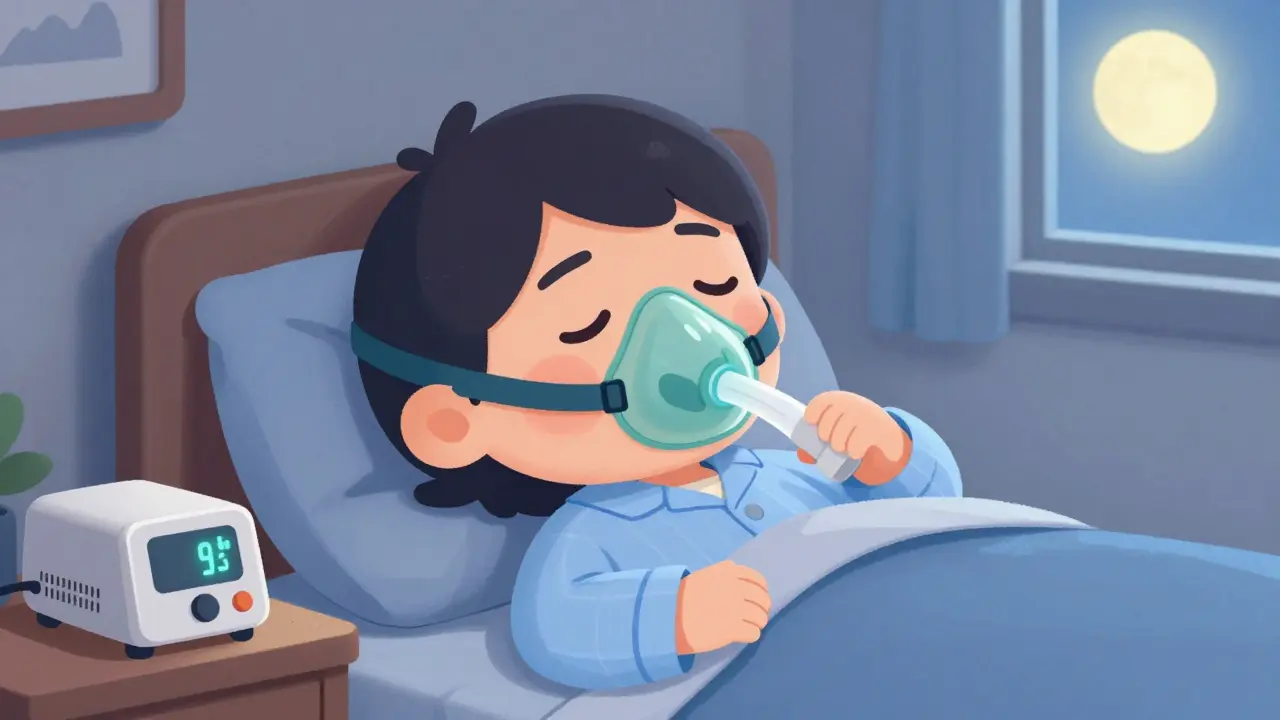
Why Your CPAP Isn’t Working (And How to Fix It)
If you’re using a CPAP machine and still waking up with a dry mouth, your mask is hissing like a teakettle, or you feel like the air pressure is crushing your chest-you’re not alone. About 42% of CPAP users deal with dry mouth, 58% report mask leaks, and 31% say their pressure feels too high or too low. These aren’t minor annoyances. They’re the main reasons people quit using their machines altogether. The good news? Most of these problems have simple, proven fixes.
Dry Mouth? It’s Probably Not the Humidifier
Most people blame their CPAP humidifier when their mouth feels like sandpaper in the morning. But here’s the truth: if you’re breathing through your mouth while sleeping, no amount of humidity will fix it. Your CPAP is pushing air into your nose, but if your mouth is open, that air escapes-and pulls moisture out of your throat as it goes.
Dr. Raj Dasgupta, a sleep specialist at the University of Southern California, says dry mouth in CPAP users is almost always linked to mouth breathing, not humidifier settings. A 2022 study in Sleep Medicine Reviews found that 67% of users who complained of dry mouth stopped experiencing it after switching to a full-face mask or using a chin strap.
Try this: First, check if you’re breathing through your mouth. Look in the mirror before bed. If your lips are parted, you’re likely doing it while asleep. Solutions:
- Switch to a full-face mask (covers nose and mouth). Users on Reddit’s r/CPAP community report 85% fewer dry mouth issues after this change.
- Use a chin strap. These simple fabric straps hold your jaw closed. Used by 45% of mouth breathers, they’re cheap, easy to fit, and work for most people.
- Adjust your humidifier. Set it to level 3 or 4 on a 0-6 scale. Too high (level 5-6) can cause condensation in the tube; too low (level 1-2) won’t help if you’re mouth breathing.
- Try heated tubing. Philips and ResMed both offer heated tubes that keep air warm from machine to mask. A 2022 Philips clinical trial showed a 32% drop in dry mouth complaints with heated tubing alone.
Mask Leaks: The Silent CPAP Killer
A mask leak doesn’t just make noise-it cuts your therapy effectiveness. Dr. David White, a CPAP pioneer from Harvard, says leaks over 24 liters per minute reduce treatment success. That’s not a loud hiss-it’s often just a quiet puff of air you don’t even notice.
Leak problems usually come down to three things: wrong mask size, worn-out cushion, or loose headgear. Here’s how to fix them:
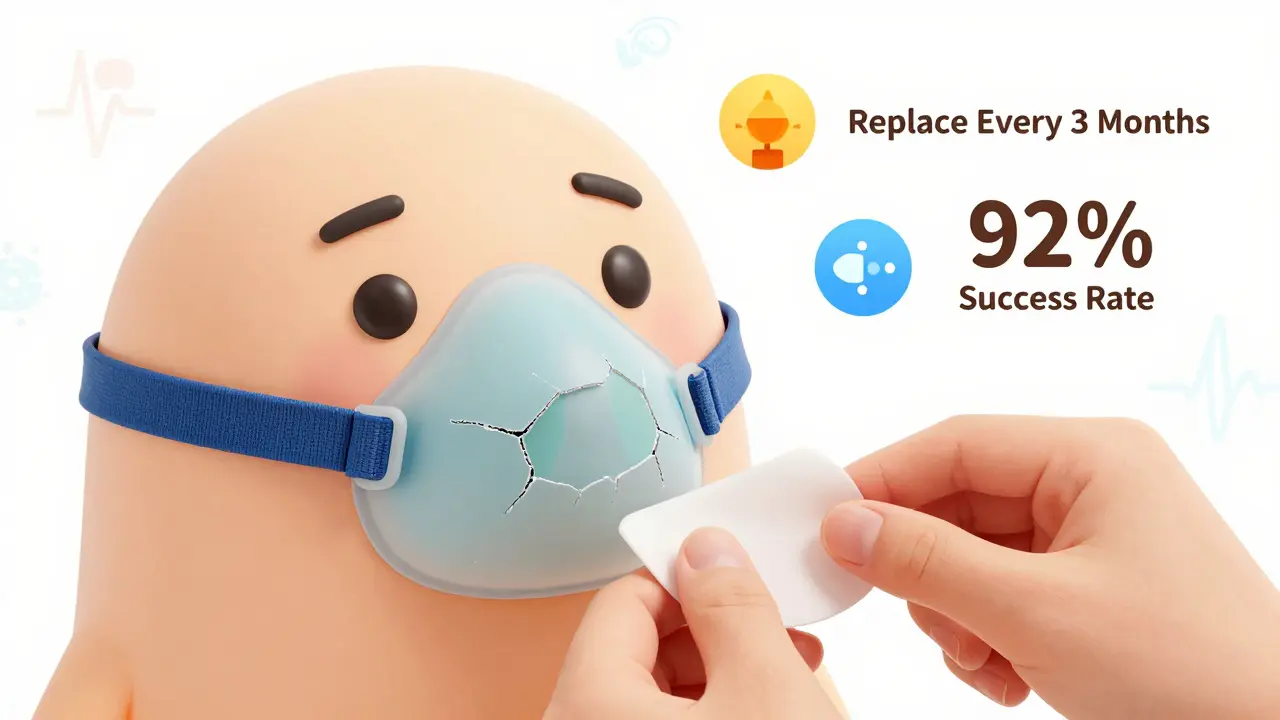
- Check your cushion. If it’s cracked, flattened, or has lost its softness, replace it. DME providers say 92% of leaks are solved just by swapping out the cushion every 3 months.
- Adjust the headgear. Don’t tighten it like a helmet. Too much pressure causes red marks and actually makes leaks worse by distorting the seal. Try the “airflow test”: turn on your CPAP, then gently pull the mask away from your face until you hear air escaping. Slowly bring it back until the noise stops. That’s your ideal fit.
- Don’t ignore the frame. If your mask feels loose even after tightening straps, you might have the wrong size. Most people use medium or large masks when they need small. Try the manufacturer’s sizing guide-many offer printable templates.
- Use leak detection. Newer machines like the ResMed AirSense 11 and Philips DreamStation 2 show real-time leak data in their apps. If your leak rate stays above 24 L/min for more than 3 nights, it’s time to re-fit.
Pressure Too High? Too Low? Don’t Guess-Adjust Right
Pressure settings are not one-size-fits-all. Too high (above 14 cm H₂O) can cause chest discomfort, bloating, or even ear pain. Too low (under 5 cm H₂O) won’t keep your airway open. Most people start at 10 cm H₂O, but that’s just a baseline.
Dr. Nancy Collop from Johns Hopkins says: “Pressure adjustments below 5 cm H₂O can dramatically improve comfort without compromising efficacy for many patients.” That means if you’re at 12 cm H₂O and feel uncomfortable, dropping to 8 or 9 might work better.
Here’s how to handle pressure issues:
- Use auto-adjust mode. If your machine is an APAP (like the ResMed AirSense 11 AutoSet), it automatically changes pressure based on your breathing. These models respond within 5-10 seconds and adjust between 4-25 cm H₂O. They’re 4.2/5 stars in user reviews for comfort.
- Enable expiratory pressure relief. This feature lowers pressure slightly when you breathe out. It’s called EPR on ResMed, C-Flex on Philips. Many users say it feels like “breathing with a pillow.” One Reddit user, u/ExhaustedEngineer, went from 14 cm H₂O (chest pain) to 9 cm H₂O with EPR on-and slept better than ever.
- Don’t adjust pressure yourself. Most manufacturers (including ResMed) warn that changing pressure beyond ±2 cm H₂O from your prescribed setting voids your warranty. Talk to your sleep specialist. They can run a remote data check via your machine’s app and adjust it safely.
- Review your sleep data. Machines like the DreamStation 2 and AirSense 11 track your apnea events (AHI). If your AHI is above 5 after 2 weeks, your pressure might be too low. If it’s under 1 and you still feel tired, your pressure might be too high.
What You’re Probably Doing Wrong (And How to Stop)
Many CPAP users make the same mistakes over and over. Here are the top three:
- Skipping mask fitting. You bought the mask, put it on, and forgot about it. Fit matters more than brand. Spend 10 minutes each night adjusting straps. It’s not a one-time setup.
- Ignoring filter changes. Foam filters need replacing every 30 days. HEPA filters every 90. Clogged filters reduce airflow and make your machine work harder-leading to more noise and less pressure.
- Waiting too long to ask for help. If you’ve been struggling for more than 2 weeks, you’re in the danger zone. The American Academy of Sleep Medicine says 78% of users master basic fixes within 14 days. After that, frustration leads to quitting.
When to Call Your Sleep Specialist
You don’t have to figure this out alone. Call your provider if:
- Your mask leaks more than 24 L/min for 3+ nights in a row
- You’ve tried a chin strap and full-face mask and still have dry mouth
- Your AHI (apnea events per hour) is above 5 after 3 weeks of use
- You’re experiencing ear pain, bloating, or chest discomfort
- Your machine shows frequent “high leak” or “pressure error” alerts
Most providers now offer telehealth check-ins. Medicare covers remote CPAP management since January 2024. You can often adjust pressure or troubleshoot leaks without leaving your house.
Real Fixes, Real Results
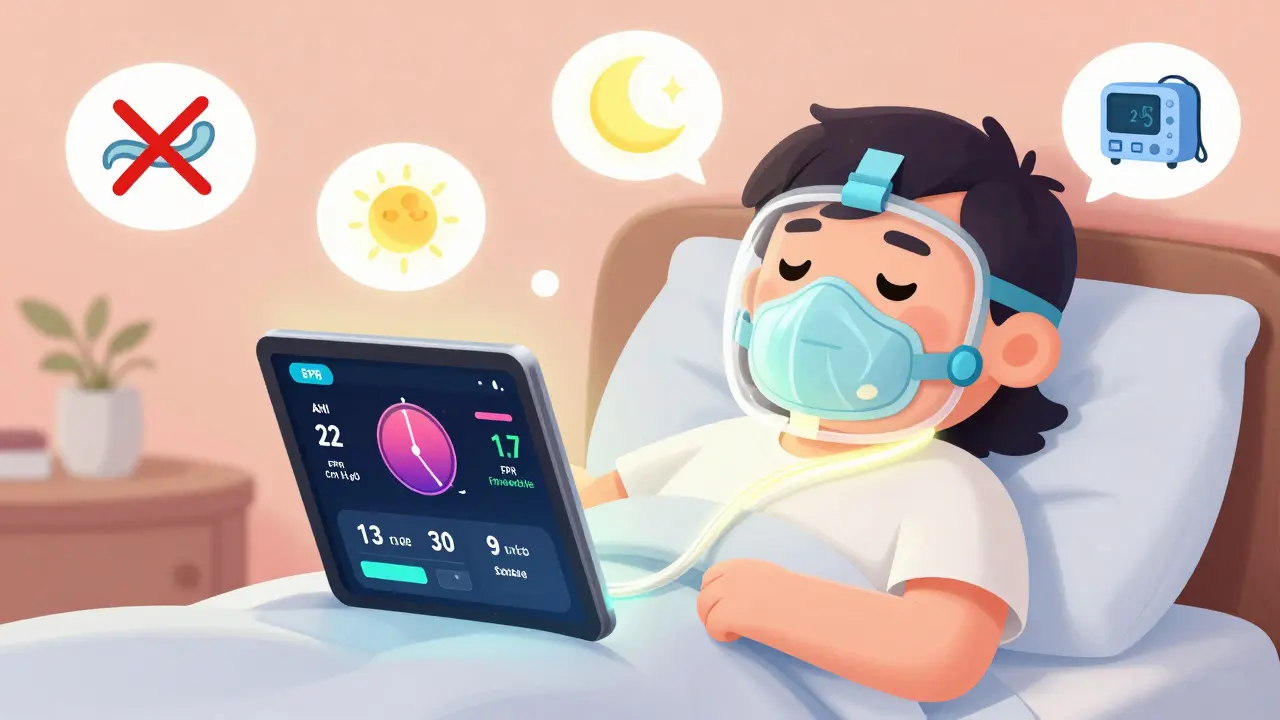
One user on SleepApnea.org, after 18 months of failed CPAP use, switched to a full-face mask, added a chin strap, lowered pressure from 13 to 9 cm H₂O, and enabled EPR. Within 3 nights, his dry mouth vanished. His AHI dropped from 22 to 1.7. He’s now using his CPAP 7 nights a week.
CPAP works. But it’s not magic. It’s a tool. And like any tool, it needs tuning. The machines today are smarter, quieter, and more responsive than ever. The ResMed AirSense 11 runs at just 25-27 decibels-quieter than a whisper. The Philips DreamStation 2’s app gives personalized tips based on your sleep data.
You don’t need to suffer through this. The fixes are simple. The support is there. You just need to take the next step.
Why does my CPAP make my mouth dry even with a humidifier?
Dry mouth from CPAP is almost always caused by mouth breathing, not low humidity. Your CPAP delivers air through your nose, but if your mouth is open during sleep, the air escapes and dries out your throat. A humidifier helps, but it can’t compensate for mouth breathing. Solutions include switching to a full-face mask or using a chin strap to keep your mouth closed.
How do I know if my CPAP mask is leaking?
Signs of a leak include loud hissing, feeling air blowing on your face, red marks from over-tightening straps, or your machine showing high leak rates in the app. Use the airflow test: turn on your CPAP, gently pull the mask away until you hear air escaping, then slowly bring it back until the noise stops. That’s your best seal. Leaks over 24 L/min reduce therapy effectiveness and need fixing.
Can I adjust my CPAP pressure myself?
Most manufacturers, including ResMed and Philips, warn against adjusting pressure beyond ±2 cm H₂O from your prescribed setting. Doing so can void your warranty and may reduce treatment effectiveness. If you feel pressure is too high or low, contact your sleep specialist. They can review your machine’s data remotely and adjust it safely-often without an office visit.
How often should I replace my CPAP mask cushion?
Replace your mask cushion every 3 months. Over time, the silicone softens, cracks, or loses its seal-even if it looks fine. DME providers report that 92% of mask leaks are solved simply by replacing the cushion. Clean it daily with mild soap, but don’t wait for visible damage-replace it on schedule.
Is a chin strap safe to use with CPAP?
Yes, chin straps are safe and commonly used by 38-45% of CPAP users who breathe through their mouths. They’re soft, adjustable fabric straps that gently hold your jaw closed. They work best with nasal masks or nasal pillows. Avoid over-tightening-just enough to prevent mouth opening. Many users report dry mouth disappearing within 2-3 nights of use.
What’s the best CPAP machine for beginners?
For beginners, the ResMed AirSense 11 AutoSet is widely recommended. It automatically adjusts pressure, has built-in heated humidification, tracks sleep data, and connects to a simple app. It’s also one of the quietest at 25-27 dB. Philips DreamStation 2 is another strong option with excellent leak detection. Both include 24/7 customer support and are covered by Medicare. Avoid basic manual-pressure machines unless your doctor specifically recommends one.
Meghan O'Shaughnessy
I switched to a full-face mask last month and my dry mouth is GONE. No more waking up with cotton in my throat. Also, the chin strap I got off Amazon for $12? Game changer.
PS: Stop tightening your straps like you're trying to win a wrestling match. That's what caused my red cheeks.
December 17, 2025 AT 19:02
Evelyn Vélez Mejía
The fundamental flaw in conventional CPAP discourse lies in its anthropocentric assumption that physiological adaptation must yield to mechanical imposition. One does not merely "fix" a mask; one negotiates a symbiotic relationship between bio-rhythms and engineered airflow. The humidifier is not a panacea-it is a mediator, and its efficacy is contingent upon the integrity of oronasal occlusion. To reduce dry mouth to a matter of humidity settings is to mistake the symptom for the disease. The true pathology is not in the machine, but in the unconscious abandonment of nasal respiration during sleep-a primal regression we mistake for mere habit.
December 18, 2025 AT 23:20
Nishant Desae
Hey everyone, i just wanted to say thank you for this thread. I’ve been using CPAP for 2 years and i was about to give up. My mask was leaking like crazy and i thought it was me. But after reading this, i tried the airflow test and turns out my cushion was worn out. Replaced it and now i’m sleeping like a baby. Also, i didn’t know about heated tubing-got one last week and wow. No more water in the tube. Just wanted to say you’re not alone and small changes make a big difference. Keep going, you got this! 💪
December 19, 2025 AT 07:29
Kaylee Esdale
Chin strap worked for me. No more dry mouth. Just put it on and forget it. Machine is quiet now too. Life changed.
December 20, 2025 AT 06:53
CAROL MUTISO
Oh sweet mercy, another post telling me to just "use a chin strap" like that’s the magic bullet.
Let me guess-next you’ll tell me my dog’s barking is why I’m tired. No, Karen. I’ve tried the strap. I’ve tried the full-face. I’ve tried heated tubes. My machine still feels like a jet engine trying to inflate a balloon in my throat. And yes, I’ve adjusted pressure. And no, my doctor won’t touch it because "your AHI is fine."
So congrats. You solved your problem. I’m still here, choking on air and wondering if I’ll ever sleep without feeling like I’m being suffocated by a robot.
December 21, 2025 AT 17:55
Virginia Seitz
Full face mask + chin strap = life saver 😌💤
December 23, 2025 AT 16:28
Michael Whitaker
I must say, the level of amateurish advice in this thread is frankly alarming. The suggestion to use a chin strap without first ruling out anatomical obstruction is not merely irresponsible-it is dangerously reductive. One cannot treat a complex neuromuscular disorder with fabric straps and humidifier settings. The real issue lies in the absence of polysomnographic titration, which most users neglect entirely. I have a Ph.D. in sleep physiology, and I can tell you: if you're still struggling after 14 days, you're not being diligent-you're being delusional.
December 24, 2025 AT 18:22
Brooks Beveridge
To Carol (the one with the jet engine comment)-I hear you. I was you two years ago. I thought I was broken. Then I found a sleep tech who actually listened. She switched me to an APAP, turned on EPR, and helped me find a mask that didn’t feel like a medieval torture device. It took three tries. It took patience. But now? I sleep 7 hours. I don’t wake up gasping. I actually look forward to putting it on.
You’re not failing. The system failed you. But you can still fix it. One small step at a time.
December 24, 2025 AT 18:36
Anu radha
I use nasal pillows and still get dry mouth. I think it is because I sleep on my side. Maybe try back sleeping? I am trying.
December 25, 2025 AT 03:50
Sachin Bhorde
Guys if you’re still havin issues with leaks and dry mouth after all this, you prob need to upgrade to a machine with smart pressure algo like the AirSense 11 AutoSet. The default pressure settings on older machines are totally outdated. Also, make sure your filter is clean-clogged filters cause pressure drops and you think it’s the mask. I used to think my mask was bad, but it was just a dirty filter. Changed it and boom-problem solved. Also, don’t use tap water in the humidifier-use distilled. Tap water leaves mineral gunk and kills the heater. Trust me, I’m a med tech.
December 25, 2025 AT 18:42
Joe Bartlett
Chin strap? In the UK we just use tape. Works better and cheaper. Brits know best.
December 25, 2025 AT 21:51
Marie Mee
I think the government is using CPAP machines to track our dreams. That’s why they say "just change your mask"-they don’t want us to know the truth. My machine makes a clicking sound at 3am. It’s not the air. It’s the signal. I’ve seen the documents. They’re watching. And the humidifier? It’s not for moisture. It’s for vaporizing our thoughts. I’m not crazy. I just know too much
December 26, 2025 AT 19:12