
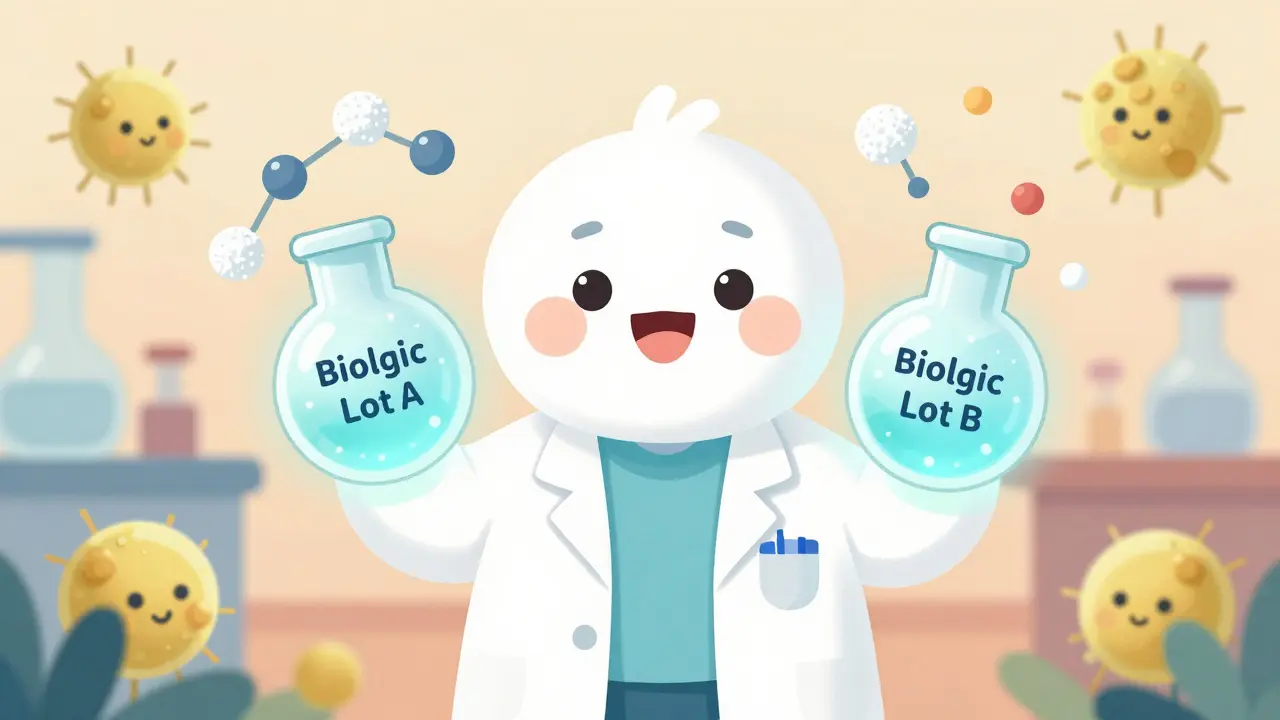
What Is Lot-to-Lot Variability, Really?
When you take a pill like aspirin, you expect every tablet to be exactly the same. That’s because small-molecule drugs are made through chemical reactions-like baking a cake from a recipe. Mix the same ingredients in the same way, and you get the same result every time.
But biologics? They’re not made that way. They’re grown inside living cells-yeast, bacteria, or mammalian cells. Think of it like brewing beer. Even with the same yeast, same grains, same temperature, no two batches taste exactly alike. There are subtle differences in flavor, aroma, strength. That’s not a mistake. That’s how biology works.
Lot-to-lot variability is the natural, unavoidable difference between batches of a biologic drug. Each lot contains millions of slightly different versions of the same protein or antibody. Some molecules might have an extra sugar molecule stuck to them. Others might have a slightly altered amino acid. These aren’t defects. They’re normal. The lot-to-lot variability is a natural feature of biologic manufacturing, not a flaw. The FDA says it plainly: ‘Inherent variation may also exist within lots and between different lots of reference products and biosimilars.’
Why Biosimilars Aren’t Generics
People often think biosimilars are just like generics. They’re not. And the reason comes down to this: generics copy a simple chemical compound. Biosimilars copy a living system.
A generic version of metformin? It’s chemically identical to the brand-name drug. The FDA only needs to prove it dissolves the same way in the body and gets absorbed the same way. That’s bioequivalence.
For a biosimilar? You can’t prove identity. You can’t prove sameness. You prove similarity. And you prove it with thousands of lab tests-analytical studies that look at structure, shape, charge, sugar attachments, purity. You test how the protein binds to its target. You test how the immune system reacts. You even test how it behaves in the body over time.
The 351(k) pathway under the Biologics Price Competition and Innovation Act of 2010 was created specifically for this. It doesn’t require repeating every clinical trial the original drug went through. But it does require proving that any differences between the biosimilar and the reference product are not clinically meaningful.
What Kind of Changes Happen Inside a Biologic?
It’s not random chaos. It’s predictable biology. The biggest changes happen after the protein is made-these are called post-translational modifications.
Glycosylation is the most common. That’s when sugar molecules attach to the protein. The number, type, and position of these sugars can change from lot to lot. And it matters. Glycosylation affects how long the drug lasts in the bloodstream, how well it binds to its target, and even how likely it is to trigger an immune response.
Other changes include deamidation (where an amino acid loses an ammonia group), oxidation (when oxygen reacts with parts of the protein), and aggregation (when proteins clump together). These aren’t always bad. In fact, the reference product itself has all these variations. The goal isn’t to eliminate them-it’s to keep them within the same range as the original.
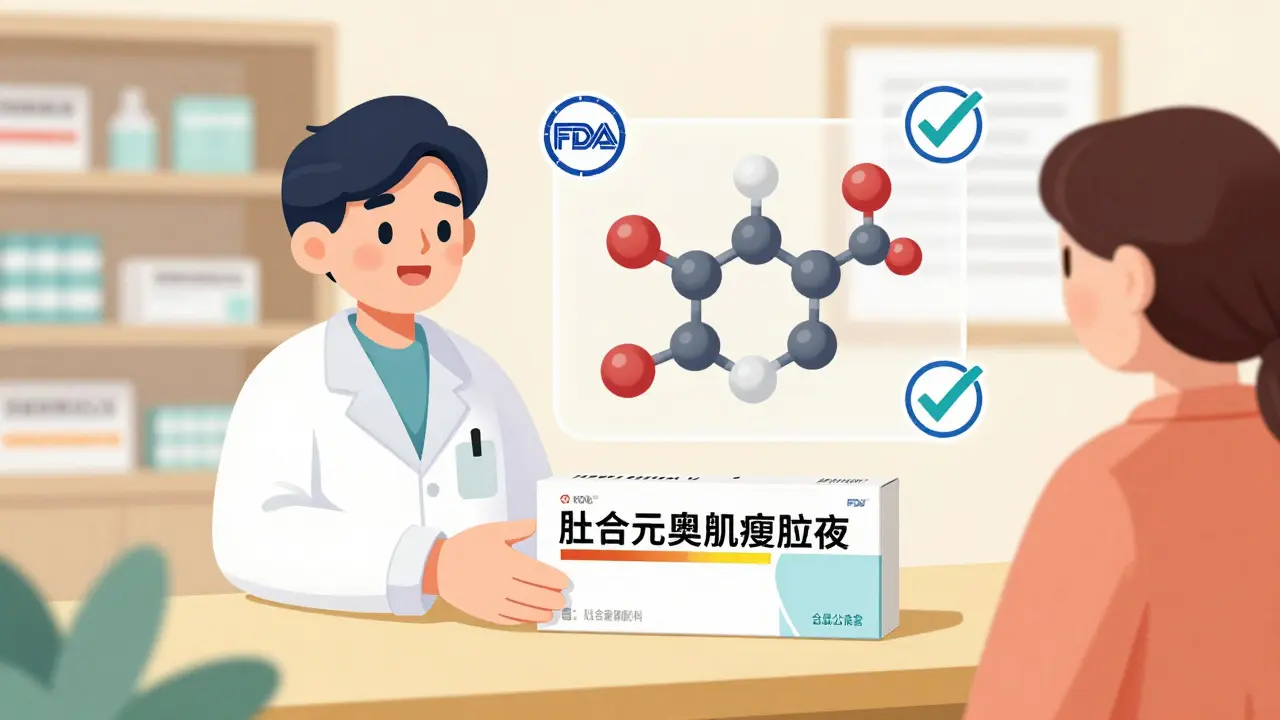
The FDA requires manufacturers to show their biosimilar’s variation pattern matches the reference product’s. Not exactly the same. But within the same envelope of variability. If the reference product’s glycosylation pattern ranges from 12% to 18%, the biosimilar’s must fall in that same range. Not 5% or 25%.
How Do Regulators Handle This?
The FDA doesn’t expect perfection. They expect control.
Every biosimilar application includes a detailed manufacturing control strategy. This is a blueprint for how the company ensures each lot stays within acceptable limits. It covers everything: the cell line used, the nutrients fed to the cells, the temperature and pH during growth, the purification steps, the final testing.
They don’t just test one or two lots. They test dozens. Sometimes hundreds. They look at trends over time. They check if changing a single filter or a pump speed changes the product. They model how small changes could affect safety or effectiveness.
And here’s the key: the FDA compares the biosimilar’s variability to the reference product’s variability. If the reference product has a 10% variation in a key attribute, and the biosimilar has an 8% variation? That’s actually better. It’s not a problem. It’s a win.
Dr. Sarah Y. Chan from the FDA’s Office of Therapeutic Biologics and Biosimilars says it clearly: ‘These slight differences between manufactured lots of the same biological product are normal and expected.’
What About Interchangeability?
Not all biosimilars are created equal. Only 12 out of 53 approved biosimilars in the U.S. as of May 2024 have the ‘interchangeable’ designation.
Interchangeable means a pharmacist can swap it for the brand-name drug without asking the doctor. That’s a big deal. It’s like generics at the pharmacy counter.
To get that label, the manufacturer must prove more than similarity. They must prove that switching back and forth between the reference product and the biosimilar doesn’t increase risk or reduce effectiveness. That means running a clinical study where patients alternate between the two drugs multiple times-sometimes over months.
Why? Because even if each lot is safe on its own, the body might react differently if you switch between slightly different versions. Imagine switching between two slightly different brands of insulin. Would your blood sugar stay stable? That’s what they test.
By 2026, experts predict 70% of new biosimilar applications will include interchangeability data. That’s up from 45% in 2023. The market wants it. Patients want it. Payors want it.
What Does This Mean for Labs and Testing?
It’s not just patients and doctors who feel the impact. Labs do too.
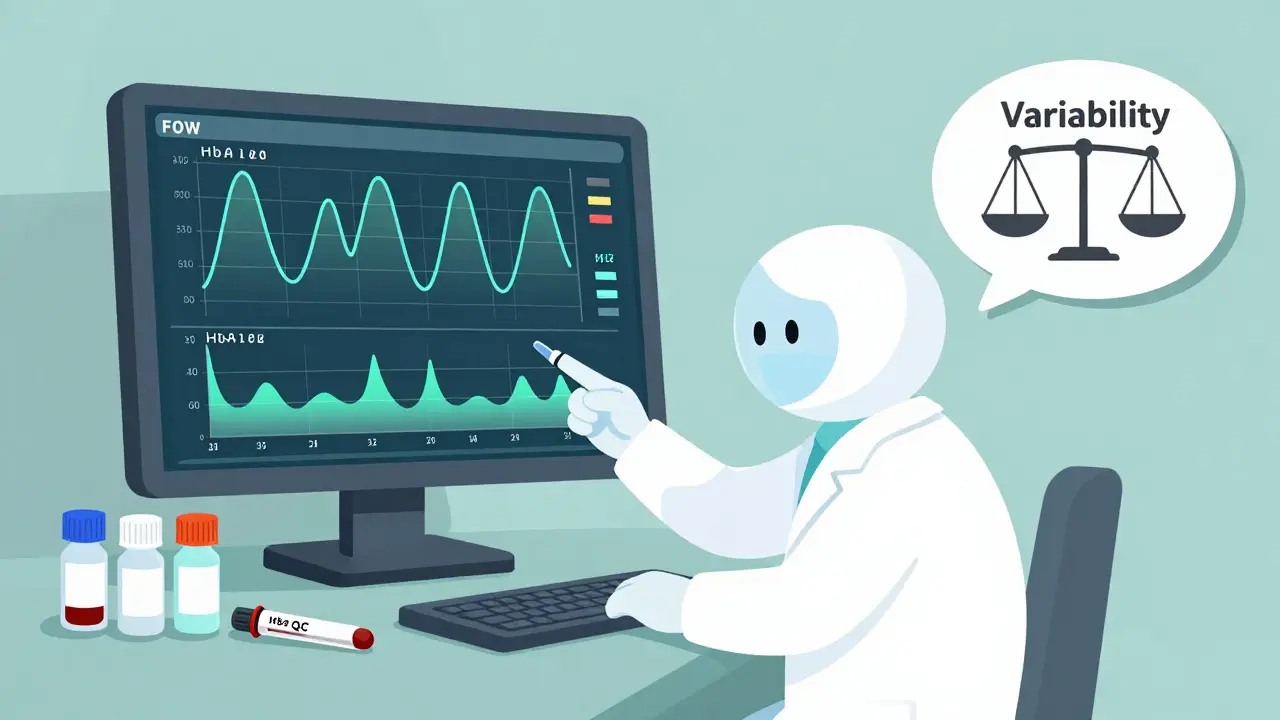
When a lab switches to a new lot of a testing reagent-say, for measuring HbA1c or thyroid hormone-the results can shift. Not always. But sometimes. And when they do, it can look like a patient’s condition changed, when it didn’t.
A 2022 survey found 78% of lab directors consider lot-to-lot variation a ‘significant challenge.’ One case showed a 0.5% increase in HbA1c results with a new reagent lot. That might sound tiny. But in diabetes care, a 0.5% shift can mean the difference between ‘well-controlled’ and ‘poorly controlled.’
Labs use moving averages and statistical controls to catch these shifts. They test 20 or more patient samples with the new lot and compare them to the old one. They need enough data to be 80-95% sure they’d detect a real difference. That’s called statistical power.
‘The limited commutability of QC materials with patient samples means you can’t predict patient results from quality control alone,’ says Dr. James H. Nichols of Vanderbilt. In other words, your control sample might look fine, but your patient results are drifting. That’s the hidden risk.
Why This Matters for Patients
Some doctors worry. They’ve seen cases where a patient switched to a biosimilar and their symptoms changed. Was it the drug? Or was it something else? Stress? Diet? Sleep?
The science says: if the biosimilar was approved under the 351(k) pathway and the variation is within the reference product’s range, the risk of harm is no higher than staying on the original.
But patients deserve transparency. They should know they’re getting a biosimilar. And they should know that switching between lots-even within the same biosimilar-is normal and monitored.
The biggest benefit? Cost. Biosimilars are 15-35% cheaper than the original biologics. That’s thousands of dollars saved per patient per year. For drugs that cost $20,000 a year, that’s life-changing.
And the market is growing fast. The global biosimilars market hit $10.6 billion in 2023 and is expected to reach $35.8 billion by 2028. More options. Lower prices. More access.
The Future: Bigger, More Complex, More Variable
Biologics are getting more complex. Next-generation drugs include antibody-drug conjugates, fusion proteins, and cell and gene therapies. These aren’t single proteins. They’re combinations. Living cells. Engineered tissues.
With complexity comes more variability. More things that can change. More steps where small differences can add up.
But the tools are getting better too. Advanced mass spectrometry can now detect changes at the molecular level we couldn’t see five years ago. High-throughput analytics let labs test hundreds of samples in hours. Machine learning helps predict how a manufacturing change might affect the final product.
The goal isn’t to eliminate variability. It’s to understand it. To measure it. To control it. And to prove that even with all these tiny differences, the medicine still works the same way-for every patient, every time.
What’s Next?
If you’re a patient on a biologic or biosimilar, you don’t need to worry about lot-to-lot variability. The system is designed to protect you. The FDA, manufacturers, and labs all have checks in place.
If you’re a clinician, know that switching to a biosimilar is safe when done properly. The data supports it. The experience supports it.
If you’re in manufacturing or lab testing, your job is to keep measuring, keep validating, keep improving. Because the more we understand this natural variation, the better we can make these life-saving drugs.
Lot-to-lot variability isn’t a bug. It’s a feature of biology. And we’re learning how to work with it-not against it.
Chuck Dickson
Just wanted to say this is one of the clearest explanations I’ve ever read on biosimilars. Seriously, if your doctor’s skeptical, send them this. The beer analogy? Perfect. I’ve been on a biologic for 6 years and never understood why my insurance kept switching me-now I get it. No more fear, just facts.
January 18, 2026 AT 16:52
Naomi Keyes
Actually, I must correct you: the FDA does not state that ‘inherent variation may also exist’-it’s ‘inherent variability may also exist.’ Grammatical precision matters in scientific discourse, especially when lives are at stake. Also, you omitted the 2021 guidance update on comparability protocols. This is sloppy.
January 20, 2026 AT 13:03
Dayanara Villafuerte
Beer analogy = chef’s kiss 🍻. Also, the fact that labs are scrambling to adjust for lot shifts? Yeah, that’s why my HbA1c jumped 0.4% last month-turns out it wasn’t my diet, it was the reagent. Thanks for naming the problem. Now if only insurers would stop forcing switches like it’s a game of musical chairs 😅
January 21, 2026 AT 13:59
Andrew Qu
Great breakdown. One thing I’d add: even within the same lot, there’s micro-heterogeneity. That’s why we don’t just test one sample per batch-we test 12. And we track trends over 20+ batches. It’s not about perfection. It’s about consistency within a known range. The science is solid. Patients just need to trust the process.
January 22, 2026 AT 17:42
kenneth pillet
this makes sense. i never thought about how cell growth affects the drug. just glad they test so much
January 24, 2026 AT 12:37
Robert Cassidy
Let me get this straight-you’re telling me the government lets companies sell drugs that are ‘slightly different’ every time, and we’re supposed to be okay with that? Meanwhile, China and Russia are making exact copies. This isn’t science. It’s corporate fraud dressed up as innovation. Wake up, people.
January 24, 2026 AT 13:32
Andrew Short
Wow. Just… wow. You actually think this is acceptable? A drug that changes subtly every batch? That’s not biology-that’s negligence. If you can’t replicate it exactly, you shouldn’t be selling it. And don’t give me that ‘it’s within range’ crap. What’s the range? 10%? 20%? Who’s measuring? Who’s watching? No one. That’s who. This is how people die.
January 24, 2026 AT 20:21
christian Espinola
Interesting. You mention the FDA’s stance. But did you know that the same agency approved a biosimilar in 2019 that had a 17% glycosylation variance-while the reference product was capped at 15%? That was quietly amended in the post-market report. Hidden. Buried. And now you’re calling it ‘normal’? No. It’s regulatory capture. The system is rigged.
January 25, 2026 AT 21:17
Danny Gray
So… if variability is natural, then why do we even bother manufacturing drugs? Why not just let people brew their own antibodies in their basements? After all, biology is messy. Maybe we should embrace chaos. Maybe the ‘real’ medicine is the one that evolves with the patient. Maybe the drug isn’t the cure-it’s the journey.
January 27, 2026 AT 19:50
Andrew McLarren
Thank you for this meticulously researched and thoughtfully presented analysis. The distinction between generics and biosimilars is profoundly misunderstood by the public, and your elucidation of post-translational modifications, particularly glycosylation, is both accurate and accessible. The regulatory framework, while complex, demonstrates a commendable balance between scientific realism and patient safety. I commend the FDA’s emphasis on comparative variability rather than absolute identity-a paradigm shift in pharmacological evaluation.
January 29, 2026 AT 09:14
Jodi Harding
So the drug changes. So what? We change. The body adapts. Stop treating medicine like a spreadsheet.
January 31, 2026 AT 03:27
Kristin Dailey
USA makes the best drugs. Other countries can’t even replicate the basics. This variability? It’s American innovation. We don’t need to copy. We lead.
January 31, 2026 AT 09:02
Wendy Claughton
Thank you for writing this. 💙 I’ve been on a biosimilar for 3 years. My rheumatoid arthritis is under control. I don’t care if the sugar molecules wiggle a little-I care that I can walk again. And that it costs $4,000 instead of $22,000. Let’s celebrate the science, not fear the molecules. We’re healing people. That’s the point.
February 2, 2026 AT 01:31
Zoe Brooks
I used to be terrified of switching biosimilars. Now I’m just… curious. Like, what’s the story behind this batch? Who brewed it? What did the lab techs eat for lunch? 😄 But seriously-this post made me feel safe. And grateful. Thank you.
February 3, 2026 AT 10:56
Tyler Myers
They’re lying. They always lie. The FDA? Pharma? They’re all in on it. They know these drugs are unstable. They know switching causes flares. But they don’t care because they’re making billions. You think this is science? It’s a money machine. And you’re just another cog. Wake up.
February 5, 2026 AT 04:57