
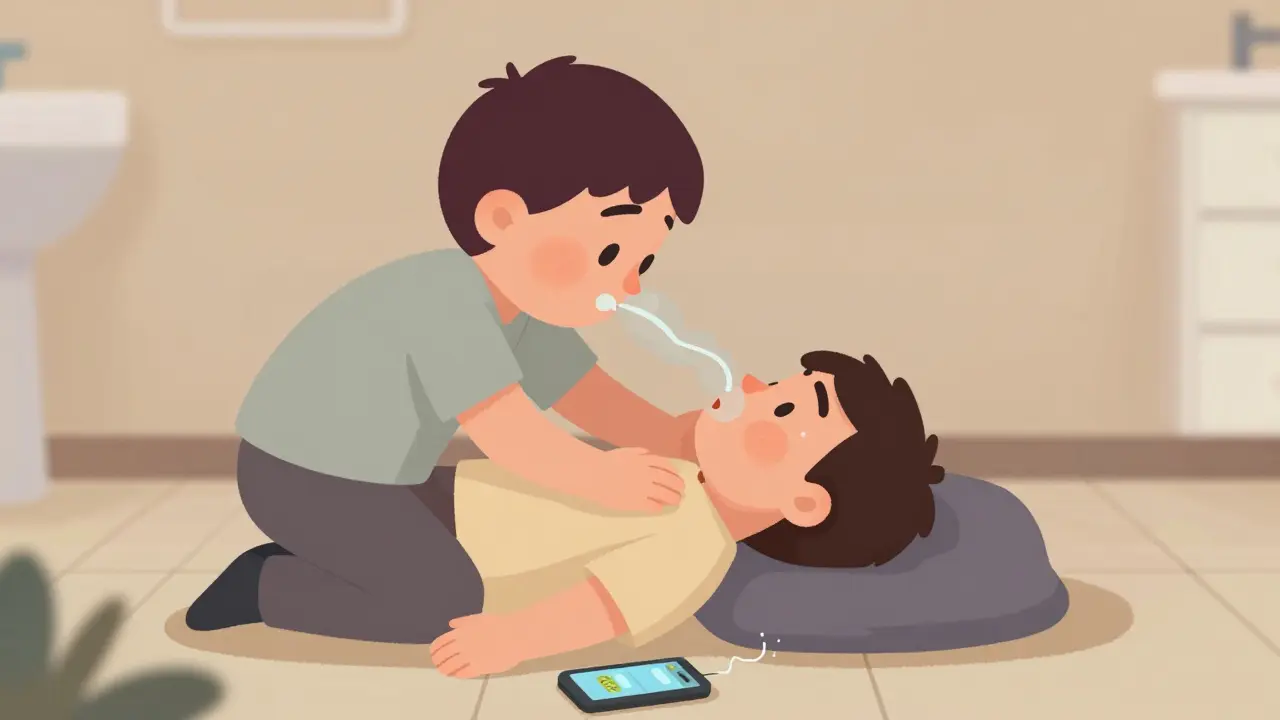
When someone overdoses, every second counts. A person can die within minutes if their breathing stops. But you don’t need to be a doctor to help. Knowing what to do while waiting for 911 can mean the difference between life and death. Most overdoses happen at home, in cars, or in bathrooms-far from hospitals. And the people who find them? Usually friends, family, or strangers who just happened to be there. You don’t need fancy gear. You don’t need training certificates. You just need to act-quickly and correctly.
Step 1: Check for Responsiveness
Don’t shake them or yell too hard. That’s not just ineffective-it wastes time. Instead, tap their shoulder hard and shout, "Are you okay?" Look for movement, eye opening, or any sound. If they don’t respond at all, assume they’re in cardiac or respiratory arrest. Even if they’re breathing, if it’s shallow, irregular, or sounds like snoring or gasping, that’s not normal. That’s a sign their brain isn’t getting enough oxygen. This is not sleep. This is not passed out. This is an emergency.
Step 2: Call 911 Immediately
Don’t wait to see if naloxone works. Don’t try to wake them up for five minutes first. Don’t call a friend or text someone. Call 911 right now. Say clearly: "Someone has overdosed. They’re not responding. They’re not breathing well." The dispatcher will ask for your location. Give it exactly. If you’re in an apartment, say the floor and unit number. If you’re outside, describe the building, street, or landmark. Stay on the line. They’ll guide you through what to do next. Many people panic and hang up because they think they’re "overreacting." They’re not. Emergency dispatchers are trained to handle this. They’ve heard it before. And they need you to stay on the line.
Step 3: Give Rescue Breaths
If they’re not breathing-or breathing badly-start rescue breathing right away. Tilt their head back gently by lifting their chin. Pinch their nose shut. Place your mouth fully over theirs and give one slow breath. Watch their chest rise. If it doesn’t rise, reposition the head and try again. You’re not trying to blow air in like a balloon. You’re just giving enough to make the chest move. One breath every 5 to 6 seconds. That’s about 10 to 12 breaths per minute. Keep going. Even if you’re tired. Even if you’re scared. You’re keeping their brain alive. Every breath delays brain damage. And brain damage starts after just 4 minutes without oxygen.
Step 4: Use Naloxone if Available
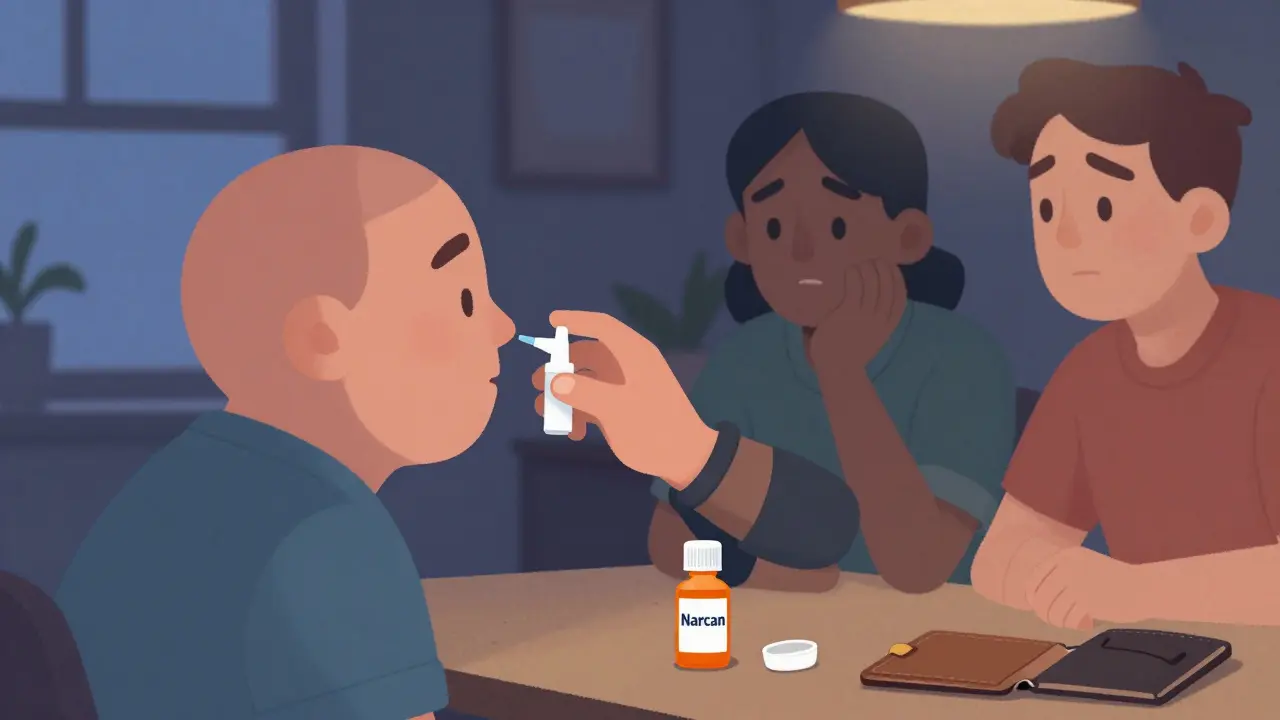
Naloxone (brand names like Narcan) reverses opioid overdoses. That includes heroin, fentanyl, oxycodone, and morphine. It doesn’t work for alcohol, cocaine, meth, or benzodiazepines. But if you’re not sure what they took? Give it anyway. Fentanyl is so common now that most overdoses involve opioids-even if other drugs were mixed in. The CDC says 74.7% of overdose deaths in 2021 were from opioids. Naloxone is safe. It won’t hurt someone who didn’t take opioids. It’s not addictive. It has no high. Administer it as soon as you can. For nasal spray: insert the nozzle into one nostril and press the plunger firmly. Hold it there for 2-3 seconds. If they don’t respond in 3-5 minutes, give a second dose in the other nostril. Some people think naloxone is a cure-all. It’s not. It wears off in 30-90 minutes. The drug might still be in their system. That’s why calling 911 is non-negotiable. They need medical care even after naloxone works.
Step 5: Put Them in the Recovery Position
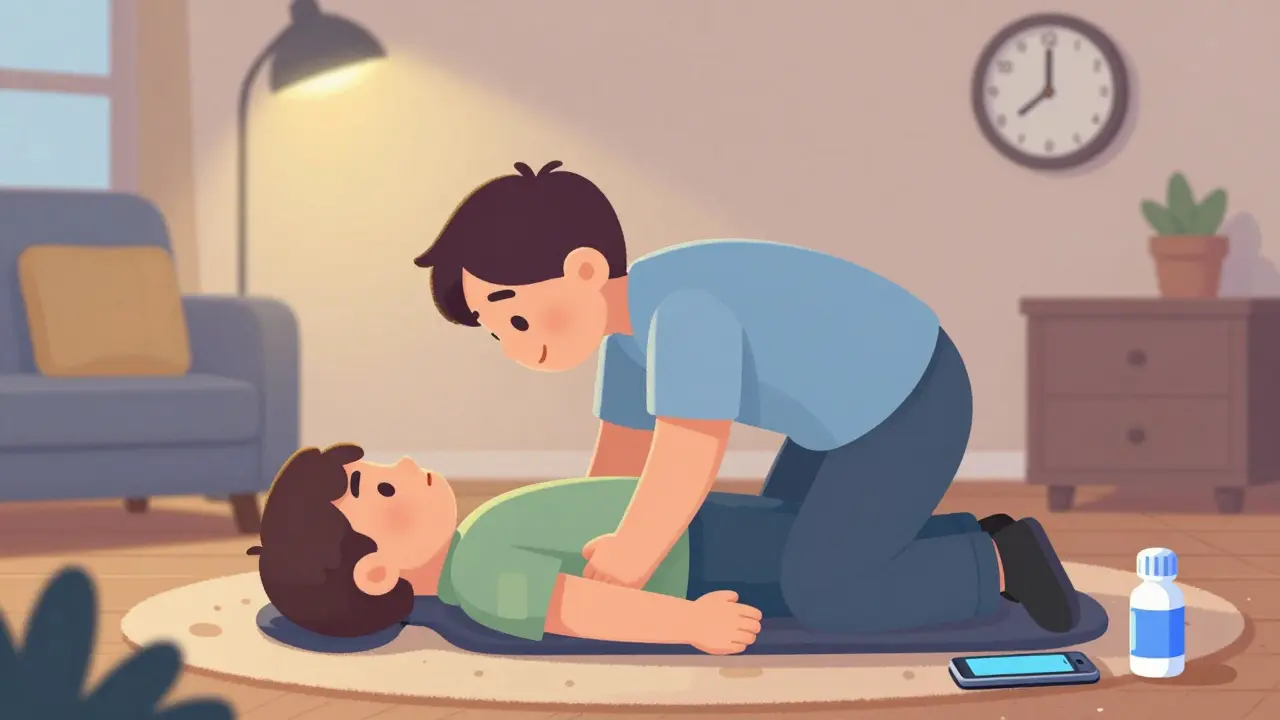
If they start breathing again, or if you’re giving rescue breaths and they’re still alive, roll them onto their side. This is called the recovery position. It keeps their airway open and stops them from choking if they vomit. To do it: kneel beside them. Straighten their legs. Bend their nearest arm at 90 degrees, palm up. Place their far arm across their chest, hand near their cheek. Bend their far knee up to 90 degrees. Gently roll them toward you, using the bent knee as a pivot. Tilt their head back slightly so their airway stays open. Make sure their mouth is facing down. Check their breathing every 2-3 minutes. Stay with them. Don’t leave them alone.
What Not to Do
Don’t put them in a cold shower. Don’t pour ice on them. That can trigger dangerous heart rhythms, especially with stimulants like meth or MDMA. Don’t try to make them walk. Don’t give them coffee. Don’t slap them. Don’t inject anything-not salt, not water, not milk. These myths are dangerous. They delay real help. And they can kill.
Recognizing Different Types of Overdoses
Not all overdoses look the same. Opioid overdoses usually mean slow or stopped breathing, blue lips or fingernails, and very small pupils. But fentanyl overdoses don’t always show pinpoint pupils-sometimes they look normal. Stimulant overdoses (like cocaine or meth) mean fast heartbeat, high body temperature, seizures, or confusion. Alcohol overdoses cause slow breathing, cold and clammy skin, vomiting, and unconsciousness. If someone is vomiting while unconscious, turn them on their side immediately. That’s how you prevent choking.
Why This Matters
In 2021, over 107,000 people died from drug overdoses in the U.S. Most of them were alone. But if someone had known what to do, many of those deaths could have been prevented. Communities with trained bystanders have reversed over 12,000 overdoses with near-perfect survival rates. You don’t need to be a hero. You just need to know what to do. And now you do.
Keep Naloxone Handy
Since March 2024, naloxone nasal spray is available over the counter at pharmacies without a prescription in all 50 states. Keep one in your car, your wallet, or your home. It costs less than $40. It lasts two years. It’s small enough to fit in your pocket. If you know someone who uses drugs-even if they’re in recovery-give them one. Teach them how to use it. The more people who have it, the more lives get saved.
Can I give naloxone to someone who didn’t take opioids?
Yes. Naloxone is safe and will not harm someone who didn’t take opioids. It only works on opioid receptors, so if no opioids are present, it does nothing. If you’re unsure what drug was taken, give naloxone anyway. Most overdoses today involve opioids-even when other drugs are mixed in.
What if I’m scared to call 911 because I’m using drugs too?
Good Samaritan laws protect you. In all 50 states and D.C., you cannot be arrested or charged for possession if you call 911 to report an overdose. These laws exist to save lives. EMS workers are there to help, not to punish. Your life matters. Their life matters. Calling 911 is the bravest thing you can do.
How long does naloxone last?
Naloxone lasts 30 to 90 minutes. Many opioids, especially fentanyl, last longer. That means the person can stop breathing again after naloxone wears off. That’s why they must go to the hospital-even if they wake up. Medical staff need to monitor them for at least 2-4 hours.
Do I need training to use naloxone?
No. Naloxone nasal spray is designed to be used by anyone. The instructions are printed on the device. Just insert it into one nostril and press the plunger. No needles. No mixing. No special skills. Many pharmacies offer free 5-minute training if you ask. But even without it, you can still save a life.
What if the person doesn’t wake up after naloxone?
Keep giving rescue breaths. Naloxone doesn’t work for everything. If they’re still not breathing, continue rescue breathing until help arrives. Don’t stop. Don’t assume it’s hopeless. Some people respond after multiple doses. Others need more time. Emergency responders will take over, but your actions are keeping them alive right now.
Oliver Calvert
Just saved a guy last month with this exact method. No training, just instinct. Tapped his shoulder, called 911, gave breaths while waiting. Naloxone was in my glovebox. He woke up on the ambulance. Don't overthink it. Do the steps. Time is everything.
February 16, 2026 AT 17:11
Kancharla Pavan
This is why society is collapsing. People think a spray in the nose fixes everything. No one takes responsibility anymore. You let someone die because you didn't want to get involved? That's not compassion. That's cowardice. And now we hand out naloxone like candy and call it progress? We need to stop enabling addiction not treat the symptoms. Every life matters but not every life deserves to be saved if they keep choosing destruction.
February 18, 2026 AT 01:00
PRITAM BIJAPUR
There's a quiet dignity in saving a life without fanfare. 🌱 No medals. No applause. Just a stranger's chest rising because you didn't look away. The science is simple: oxygen is the only currency that matters when the brain is fading. Naloxone? A tool. Rescue breaths? A lifeline. But the real miracle? You showing up. Even scared. Even unsure. You did what love demands. And that? That changes everything.
February 19, 2026 AT 10:02
Dennis Santarinala
This is so important!! I’ve had a Narcan kit in my backpack since last year!! 😊 I even gave one to my cousin who’s in recovery!! She cried and said it made her feel less alone!! I think everyone should have one!! It’s not about judgment-it’s about humanity!! And the recovery position? So simple but so life-changing!!
February 19, 2026 AT 13:33
Haley DeWitt
I showed my dad this article and he went out and bought two Narcan kits. He said he didn’t know it was that easy to use. Now he keeps one in his truck and one in his coat pocket. I’m so proud of him. We need more people like this.
February 20, 2026 AT 14:42
Geoff Forbes
I mean honestly this whole thing is just performative wokeness. You think a nasal spray is going to fix systemic decay? You’re not saving lives you’re prolonging a cycle. And the fact that we’re normalizing this as just 'common sense' is the problem. We need to stop treating addiction like a medical issue and start treating it like a moral failure.
February 21, 2026 AT 22:59
Jonathan Ruth
This is why America is falling apart. We give out free Narcan like candy but we don't teach kids discipline. We don't teach accountability. We don't teach consequences. You want to save lives? Stop enabling them. Stop treating addiction like it's a disease you can spray away. People need to choose to live. Not be pumped full of chemicals and told it's okay.
February 22, 2026 AT 20:33
Philip Blankenship
I work in EMS and I can tell you this guide is spot on. The biggest thing people mess up? Waiting. They think, 'Maybe they'll wake up.' Or 'I'll call after I text my friend.' No. Call 911 first. Always. I've seen people die because someone was too scared to dial. And the recovery position? So many folks forget it. If they're breathing but out? Side. Now. No debate. And yeah, naloxone doesn't fix everything but it buys you time. Time is everything.
February 23, 2026 AT 08:45
Tony Shuman
I don't get why we're making this so complicated. Why not just let nature take its course? If someone chooses to overdose, that's their choice. Why should I risk my safety, my time, my peace to save someone who clearly doesn't care? This whole 'bystander hero' thing is just guilt-driven nonsense. We're not obligated to fix other people's bad decisions.
February 25, 2026 AT 06:05
John Haberstroh
I used to think naloxone was some kind of magic bullet. Then I saw a guy go into arrest at a festival. We gave two doses. He woke up. Laughed. Said 'I’m good.' Then passed out again 20 minutes later. Took 12 minutes for the ambulance. We kept breathing for him. He lived. But here’s the wild part: he didn’t even know he’d been revived. Didn’t remember anything. That’s the thing no one talks about-you’re not saving someone’s story. You’re saving their future. The one they haven’t lived yet.
February 25, 2026 AT 23:04
Linda Franchock
You know what’s wild? People act like this is some groundbreaking revelation. Nah. This is just basic human decency. And yet, we need a 2000-word guide to remind us to not be monsters. I mean… we’re literally talking about breathing for someone. That’s not a skill. That’s a reflex. If you can’t do this… maybe check your soul.
February 27, 2026 AT 13:24