
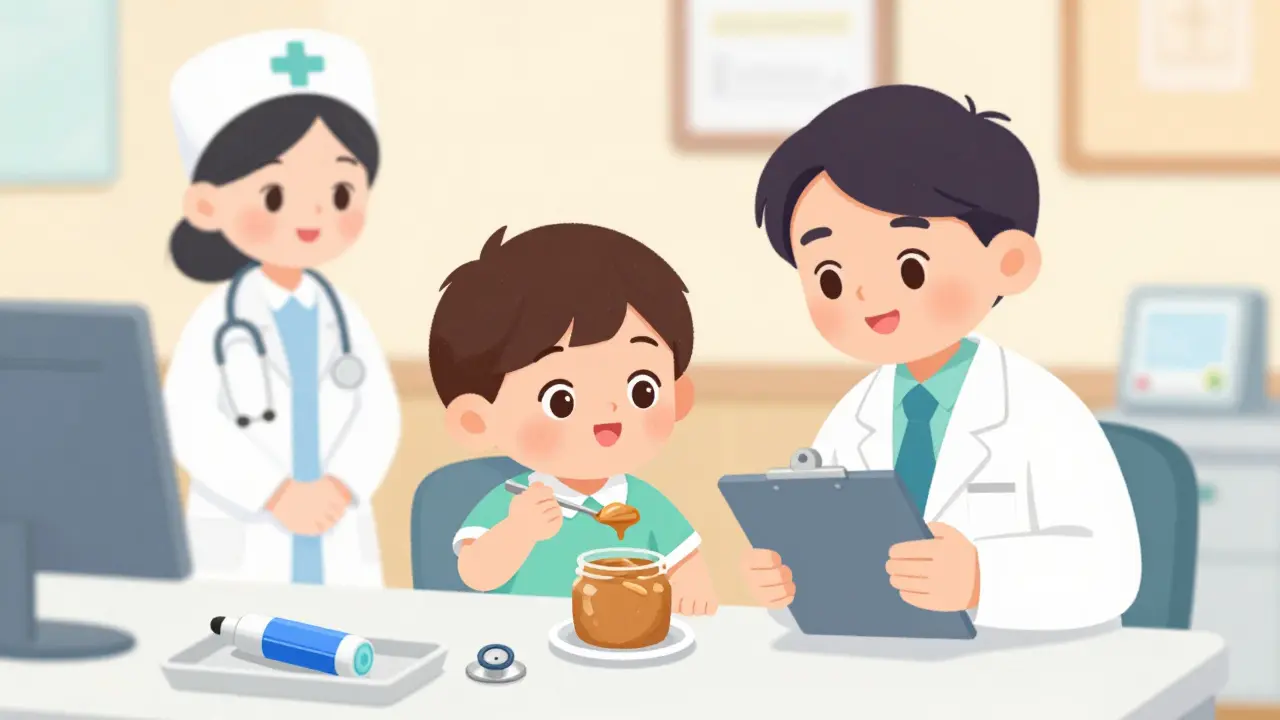
When a child breaks out in hives after eating peanut butter, or an adult gets stomach cramps every time they have milk, it’s easy to assume they have a food allergy. But here’s the truth: oral food challenge is the only way to know for sure. Clinical history and blood or skin tests often point in the wrong direction. Studies show they’re wrong more than half the time. That’s why doctors turn to the oral food challenge - not as a last resort, but as the gold standard.
Why Oral Food Challenges Are the Gold Standard
Doctors don’t guess when it comes to food allergies. They test. And the most reliable test isn’t a blood draw or a skin prick. It’s the oral food challenge (OFC). This procedure involves giving a patient tiny, increasing amounts of the suspected food under strict medical supervision. If symptoms appear, it’s confirmed. If none show up after eating a full serving, the allergy is ruled out.
The National Institutes of Health (NIH) and major allergy societies like the American Academy of Allergy, Asthma & Immunology (AAAAI) and the European Academy of Allergy and Clinical Immunology (EAACI) all agree: OFC is the most accurate method available. Skin prick tests and IgE blood tests have predictive values that range from 33% to 60% - meaning they’re wrong nearly half the time. Component-resolved diagnostics, while more advanced, still top out at 85% accuracy. Only the OFC gets you close to 100% certainty.
Why does this matter? Because unnecessary food avoidance is a real problem. Up to 30% of people told they have a food allergy based on lab tests don’t actually have one. They’re cutting out whole food groups - milk, eggs, nuts - based on false positives. That leads to nutritional gaps, anxiety, and social isolation. The OFC stops that. It gives families real answers.
How an Oral Food Challenge Works
An OFC doesn’t happen in a rush. It’s a slow, controlled process that can take 3 to 6 hours. The patient starts with a tiny amount - as little as 1 to 2 milligrams of the allergen. That’s about 1/1000th of a peanut. The dose is increased every 15 to 30 minutes, with careful observation after each step. Vital signs are checked. Skin is watched for hives. Lungs are listened to for wheezing. Gastrointestinal symptoms are noted.
The food can be given in different forms. Sometimes it’s pure - like a spoonful of peanut butter. Sometimes it’s disguised - baked into a cookie or mixed into applesauce. In rare cases, especially in research settings, it’s given in capsules so the patient doesn’t know if they’re eating the real food or a placebo. Most challenges in clinics are open - both the patient and doctor know what’s being tested. That’s because blinded tests are complex, time-consuming, and usually unnecessary outside of studies.
The final goal? To see if the patient can eat a full serving without a reaction. If they can, they’re cleared. If they can’t, the exact amount that triggered the reaction is recorded. That helps set a safe threshold for future avoidance.
When an Oral Food Challenge Is Used
OFCs aren’t for everyone. They’re not used as a first test. You don’t walk in with a history of anaphylaxis and get handed a peanut. That’s too dangerous. Instead, they’re used in three main situations:
- When test results are unclear. If a skin test is positive but the patient has never reacted to the food, an OFC can tell you if it’s a true allergy or just a false signal.
- To check if a child has outgrown an allergy. Many kids outgrow milk, egg, soy, and wheat allergies by age 5. OFCs confirm it. One study found 65% of children with milk or egg allergies outgrow them - but only an OFC can prove it.
- To find the reaction threshold. Some people can eat a little bit of the food without issue. An OFC helps determine how much is safe. That’s critical for managing daily life.
It’s also used when parents suspect their child’s allergy diagnosis was wrong. Maybe the child ate the food at a friend’s house and had no reaction. Maybe the initial test was done during a viral illness. These are red flags that an OFC might be needed.

Safety: What Happens During a Reaction?
It’s natural to worry. What if the challenge triggers a serious reaction? The answer is simple: that’s why it’s done in a clinic with emergency equipment on hand.
Every OFC is performed in a setting equipped with epinephrine, antihistamines, IV fluids, oxygen, and at least two trained medical staff - one doctor and one nurse. Protocols require this. The AAAAI mandates it. The risk of a severe reaction is low. Studies show only 1 to 2% of challenges require epinephrine. Most reactions are mild - a few hives, a flushed face, or a slight stomach ache. These are managed right there in the office.
A 2020 study in the Journal of Allergy and Clinical Immunology found only 0.9% of OFCs needed emergency treatment. That’s lower than the risk of a car ride. But it’s still a medical procedure. That’s why it’s never done at home - unless under very specific, low-risk conditions approved by a specialist.
Parents often report high anxiety before the test. Surveys show 78% of caregivers feel moderate to high stress. But after the challenge? Satisfaction jumps to 89%. Why? Because they finally know. No more guessing. No more fear. Just clarity.
Preparation: What Patients and Families Need to Do
Preparing for an OFC is as important as the test itself. Here’s what you need to know:
- Stop antihistamines. They can hide symptoms. Avoid them for 5 to 7 days before the test. This includes over-the-counter meds like Benadryl and Claritin.
- Stay healthy. Don’t schedule the challenge if you or your child has a cold, flu, or asthma flare. Respiratory infections increase reaction risk.
- Bring distractions. Especially for kids. Tablets, books, toys, or favorite snacks (that aren’t the challenge food) help pass the time and reduce anxiety.
- Wear loose clothing. It’s easier to check for rashes and swelling if you’re not tight in the shirt.
- Be honest. Tell your doctor about any recent illnesses, medications, or changes in your child’s health.
Doctors also need to be trained. The AAAAI recommends at least 10 supervised challenges before a clinician performs one independently. That’s how serious this procedure is.

What Comes After the Challenge?
Positive result? You’ve confirmed the allergy. You’ll get a clear action plan - strict avoidance, emergency medication, and an allergy action plan.
Negative result? That’s the win. You can reintroduce the food safely. No more fear at birthday parties. No more packed lunches with only “safe” foods. Families report a huge improvement in quality of life. One parent on Reddit said, “My son cried through the whole peanut challenge. But when he finished it without a reaction? We cried too. He’s free.”
Some patients are told they can eat small amounts of the food. That’s called a “threshold dose.” It’s not about eating a whole serving - it’s about knowing the line between safe and risky. That helps with real-world management.
Future of Oral Food Challenges
Research is moving fast. In 2023, the NIH launched a study to refine dosing protocols for high-risk foods like peanuts and tree nuts. The goal? Reduce reaction rates during challenges even further.
Home-based OFCs are being explored for low-risk cases. This could make testing more accessible, especially in rural areas. But experts agree: it’s not for everyone. Only under strict supervision and with clear criteria.
Will we ever replace the OFC? Probably not. Dr. Kari Nadeau of Stanford says, “OFC will remain the gold standard for the foreseeable future.” No blood test, no biomarker, no algorithm can match its accuracy. It’s the only way to see how your body truly reacts - in real time, in real life.
Why This Matters for Families
Food allergies affect 32 million Americans. Many live in fear. They avoid restaurants. Skip school trips. Carry epinephrine everywhere. But if you don’t truly have an allergy, you’re living with unnecessary stress.
The OFC doesn’t just diagnose. It liberates. It gives people back their meals, their social lives, their peace of mind. It turns guesswork into certainty. And that’s why it’s not just a test - it’s a turning point.
Is an oral food challenge painful?
No, it’s not painful. The food is swallowed like normal. The only discomfort comes from anxiety or mild symptoms like a rash or stomach upset if a reaction occurs. Most patients describe it as stressful, not painful.
Can adults have oral food challenges too?
Yes. While they’re more common in children, adults undergo OFCs too - especially if they suspect a childhood allergy has resolved, or if test results are conflicting. The procedure is the same regardless of age.
How long does it take to get results from an oral food challenge?
Results are immediate. If a reaction happens during the challenge, it’s observed and recorded right away. If no reaction occurs after the full dose, the result is clear: no allergy. You’ll get confirmation before leaving the clinic.
What if I react during the challenge?
Reactions are expected and managed on-site. Medical staff are trained to respond immediately. Mild reactions (like hives) are treated with antihistamines. More serious reactions are treated with epinephrine. The procedure is stopped, and you’re monitored until stable. This is why the test must be done in a medical facility.
Are oral food challenges covered by insurance?
Yes, most insurance plans cover OFCs when ordered by a board-certified allergist and performed in a certified facility. Prior authorization is often required. Always check with your provider ahead of time.
Jefferson Moratin
The oral food challenge isn't just a diagnostic tool-it's an epistemological anchor in a sea of probabilistic medicine. We rely on biomarkers because they're quantifiable, but quantification isn't truth. The OFC forces reality into the room: no surrogate, no proxy, no statistical likelihood-just a child eating peanut butter and the body's unfiltered response. This is medicine returning to its phenomenological roots.
When we substitute lab values for lived experience, we don't just misdiagnose-we alienate. The 30% false positive rate isn't a statistical anomaly; it's an ethical failure. Families aren't data points. They're people who've been told their child is allergic to milk because of an IgE titer, then forced into a life of anxiety, isolation, and nutritional compromise-all because we preferred convenience over certainty.
The NIH and AAAAI aren't just endorsing a procedure. They're endorsing a philosophy: that the patient's body knows more than any assay ever can. That's radical. That's humbling. And frankly, it's the only way forward if we want to stop treating allergies like software bugs to be patched with algorithms.
March 23, 2026 AT 02:45
Caroline Dennis
Oral food challenges are the gold standard because they measure functional tolerance-not IgE titers, not basophil activation, not component-resolved diagnostics. The body doesn't care about your ELISA result. It cares about whether your mast cells degranulate when you swallow a gram of almond protein.
Antihistamine washout? Non-negotiable. You can't mask a reaction and call it a negative. That’s like turning off a smoke alarm and declaring the building fireproof.
And yes, the 89% satisfaction rate post-challenge? That’s the real ROI. Not the insurance claim. Not the CPT code. The peace of mind. The birthday cake. The school lunch that doesn’t require a hazmat suit.
One parent said their kid cried through the challenge. Then cried again when it was over-not from fear, but from freedom. That’s the metric that matters.
March 23, 2026 AT 16:10
Zola Parker
Okay but like… what if the kid just *pretends* not to react? 😏
I mean, I’ve seen kids fake sneeze to get out of homework. What if they fake a reaction to get out of eating peanuts? 😅
Also why is no one talking about the placebo effect in OFCs? Like… if you *believe* you’re allergic, does your body *want* to react? 🤔
Also I heard a guy on TikTok that his dog can smell peanut allergies. Should we get the dog in the room? 🐶
March 23, 2026 AT 21:18
florence matthews
I love how this post frames the OFC as liberation-not just medical, but human. In India, where I grew up, allergies were often dismissed as ‘just being picky’ or ‘too clean.’ Here, we over-medicalize. But the OFC? It’s a bridge.
I’ve seen families in rural Nebraska drive 4 hours for one test. They bring photos of their child eating peanut butter at daycare last year. They’re not just seeking diagnosis-they’re seeking dignity.
And the fact that we can now offer threshold dosing? That’s not just science. That’s cultural evolution. We’re moving from ‘avoid at all costs’ to ‘live with awareness.’ That’s progress.
Also-yes, wear loose clothes. I once had a mom show up in a turtleneck. We couldn’t see the hives. She was mortified. 😅
March 24, 2026 AT 00:30
Kenneth Jones
Stop calling it a ‘gold standard.’ That’s marketing. It’s the only standard. There is no alternative that works. Blood tests are garbage. Skin tests are garbage. Component diagnostics? Still garbage. Stop pretending there’s a middle ground.
If your allergist won’t do an OFC when indicated, find a new one. This isn’t optional. It’s essential. And if your insurance denies it, fight. Hard.
And for god’s sake, stop giving kids Benadryl before the test. You’re not helping. You’re sabotaging.
March 24, 2026 AT 17:34
Mihir Patel
OMG I CANT BELIEVE I JUST READ THIS ENTIRE THING
MY KID HAD AN OFC LAST YEAR AND I THOUGHT I WAS GONNA DIE
HE ATE 10 PEANUTS AND DIDNT EVEN Cough
WE CRIED IN THE CLINIC
THE NURSE GAVE US CANDY
NOW HE EATS PEANUT BUTTER ON HIS TOAST EVERY MORNING
ALSO I STILL DONT TRUST THE DOCTOR WHO SAID HE WAS ALLERGIC IN THE FIRST PLACE
HE DID A SKIN TEST AND SAID ‘YEP’
HE DIDNT EVEN ASK IF HE EVER ATE IT BEFORE
WE WERE LUCKY
March 26, 2026 AT 05:59
Kevin Y.
Thank you for this comprehensive and deeply thoughtful overview. As a board-certified allergist, I can confirm that the procedural rigor described here aligns precisely with AAAAI guidelines. The preparation protocols, staffing requirements, and post-challenge follow-up are not bureaucratic checkboxes-they are lifelines.
I’ve performed over 300 OFCs. The most rewarding moment isn’t the negative result-it’s the parent who says, ‘I didn’t realize how much stress I was carrying until I didn’t have to anymore.’
For families considering this: please, don’t delay. If your child has a history of mild reactions or ambiguous testing, an OFC is not a last resort. It’s the next logical step. And yes, insurance covers it. If they say no, appeal. I’ve helped dozens do so successfully.
And to the nurse who gave out candy after the challenge? You’re a hero.
March 26, 2026 AT 16:38
Marissa Staples
I used to think OFCs were scary. Then I read about the 0.9% epinephrine rate. That’s less than the risk of a toddler falling off a couch.
What’s scarier? The 1% chance of a reaction in a clinic… or the 100% chance of living in fear for the next 15 years?
I’m not saying it’s easy. But maybe it’s worth it.
March 27, 2026 AT 14:54