

Canagliflozin Amputation Risk Assessment Tool
This tool helps you understand your personal risk of amputation when taking canagliflozin (INVOKANA®). Based on your medical history, it calculates your risk level and provides personalized recommendations.
When you're managing type 2 diabetes, choosing the right medication isn't just about lowering blood sugar. It’s about balancing benefits with real, sometimes serious, risks. One drug that’s sparked intense debate is canagliflozin-sold under the brand name INVOKANA®. Since its approval in 2013, it’s helped millions lower A1c levels, lose weight, and protect their kidneys. But it’s also been linked to a troubling side effect: lower-limb amputations.
What the Data Actually Shows
The biggest red flag came from the CANVAS Program, a pair of large clinical trials published in 2017. Researchers found that people taking canagliflozin had about twice the risk of needing an amputation compared to those on placebo. The numbers weren’t small: 5.5 amputations per 1,000 patient-years for the 300 mg dose, versus 2.8 for placebo. That’s not a rare event-it’s a clear signal. But here’s what most people don’t realize: the vast majority of these amputations were minor. About 80% involved toes or parts of the foot, not above-the-ankle surgeries. Still, losing even one toe can change your life-your balance, your mobility, your independence. And for someone already dealing with diabetes complications, that’s a heavy burden. The FDA responded quickly. In 2017, they added a boxed warning-the strongest possible alert-to the drug label. But by 2020, after reviewing more data, including results from the CREDENCE trial, they removed it. Why? Because the benefits, especially for patients with kidney disease, outweighed the risk. That doesn’t mean the risk disappeared. It just means the FDA now sees it as manageable, not unavoidable.Is This a Class-Wide Problem?
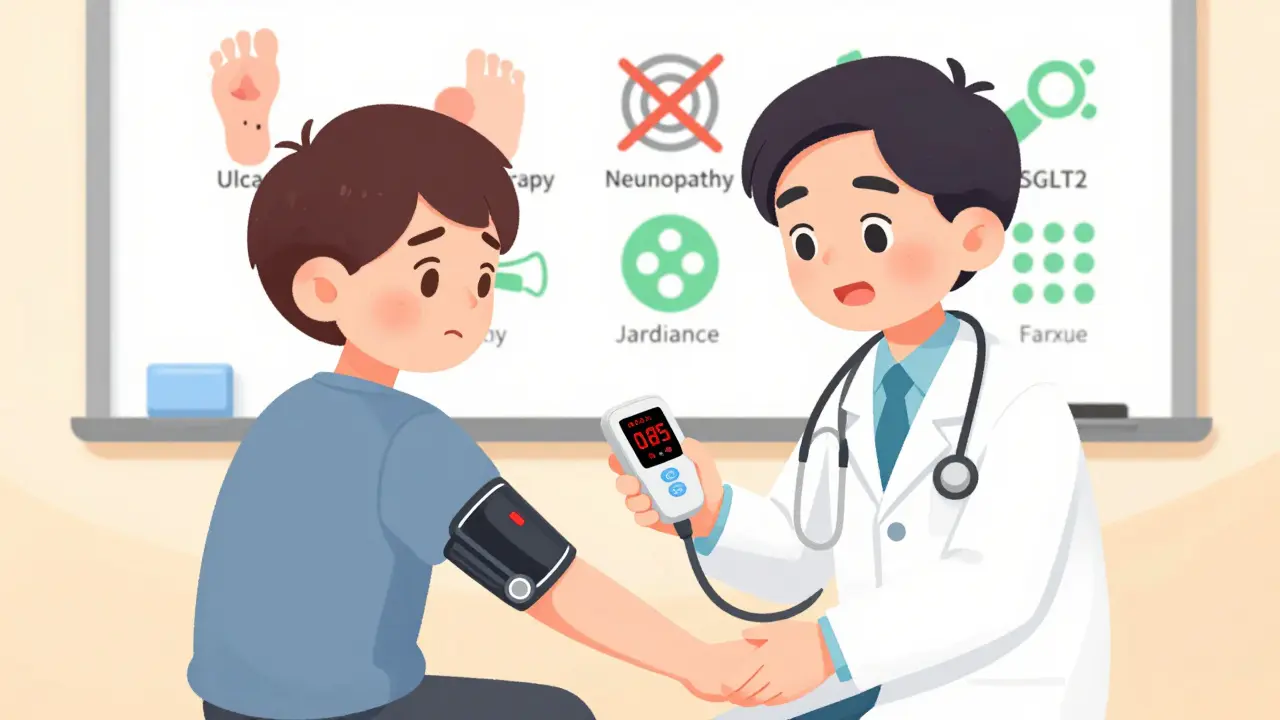
This is critical: the amputation risk isn’t the same for all SGLT2 inhibitors. Canagliflozin stands out. Studies on empagliflozin (Jardiance) and dapagliflozin (Farxiga) show no similar increase in amputation rates. In fact, dapagliflozin’s trial data suggested a possible reduction in amputation risk. A 2023 meta-analysis of over 74,000 patients confirmed this. Only canagliflozin had a statistically significant link to amputation (odds ratio of 1.6). Other drugs in the class? No signal. That’s not just a coincidence-it points to something unique about canagliflozin’s effects. Why might that be? Researchers suspect it’s tied to how strongly canagliflozin lowers blood pressure and body weight. These changes can reduce blood flow to the feet, especially in people who already have narrowed arteries or nerve damage. Other SGLT2 inhibitors don’t hit as hard in those areas, which may explain the difference.Who’s at Highest Risk?
Not everyone on canagliflozin will face this risk. But certain people are far more vulnerable:- Those with pre-existing peripheral artery disease (PAD)-affecting 20-30% of people with type 2 diabetes
- People with diabetic neuropathy-about half of all patients
- Anyone who’s had a prior foot ulcer or amputation (recurrence rates hit 40% within a year)
- Current smokers
- Those with absent or weak pulses in the feet
What Doctors Are Doing Differently Now
Since the warning came out, prescribing habits shifted. In 2017, canagliflozin made up 35% of SGLT2 prescriptions. By 2023, that dropped to 22%. But it didn’t vanish. Clinicians didn’t abandon it-they got smarter. Now, before prescribing canagliflozin, many doctors check the ankle-brachial index (ABI). This simple test measures blood pressure in the ankle compared to the arm. An ABI under 0.9 means poor circulation-a red flag. The American Diabetes Association’s 2025 guidelines now explicitly recommend this test before starting canagliflozin in anyone with cardiovascular risk factors. Also, medication guides are no longer an afterthought. In 2023, 68% of new canagliflozin prescriptions came with a detailed patient guide explaining foot risks-up from just 42% in 2017. That’s a big change in how the industry communicates risk.What You Should Do If You’re Taking Canagliflozin
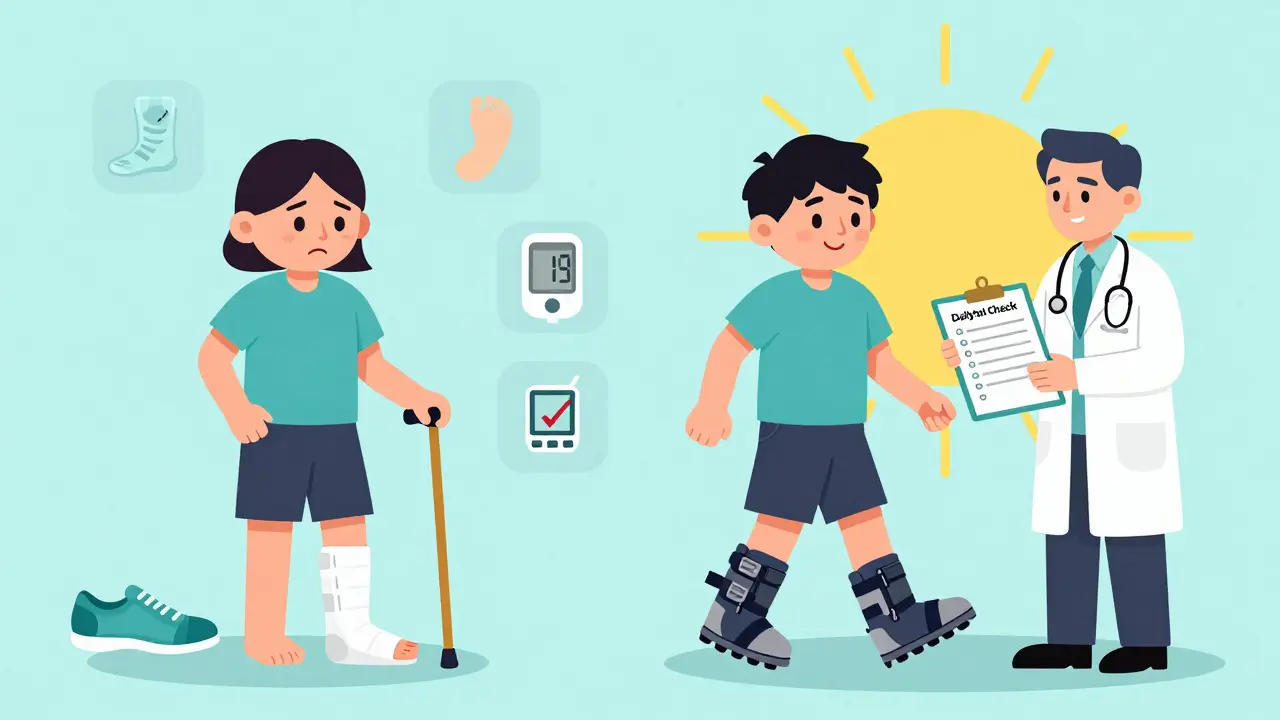
If you’re on this medication, here’s what you need to do:- Check your feet every day-look for redness, swelling, sores, blisters, or cuts, even if you don’t feel pain
- Report any new foot pain, warmth, or discharge to your doctor immediately
- Never ignore a minor wound. Diabetic foot ulcers can turn serious in days
- Ask your doctor for a foot exam at every visit. Don’t assume they’ll do it unless you remind them
- If you have any risk factors listed above, ask if switching to Jardiance or Farxiga makes sense
The Bigger Picture: Benefits Still Matter
Canagliflozin isn’t a bad drug. It reduces heart failure hospitalizations. It slows kidney disease progression. In the CREDENCE trial, it cut the risk of kidney failure by 30% in patients with diabetic kidney disease. That’s huge. For someone with advanced kidney damage, that benefit might mean the difference between dialysis and staying off it for years. The key is matching the drug to the right patient. It’s not about avoiding all risk-it’s about minimizing it through smart selection and careful monitoring.What’s Next?
Research is still evolving. The FOOT-STEP trial, set to finish in late 2026, is testing whether structured foot care-daily checks, proper footwear, regular podiatrist visits-can cut amputation rates in high-risk patients on canagliflozin. Early results are promising. Janssen, the maker of INVOKANA, is also testing a new extended-release version (INVOKANA XR). The theory? Lower peak blood levels might reduce the drop in blood pressure that could trigger circulation problems in the feet. It’s still in Phase 2, but if it works, it could change how we use this drug entirely.Bottom Line
Canagliflozin carries a real, documented risk of amputation-but only in specific patients. For most people without foot or circulation problems, the risk is low. For those with neuropathy, PAD, or prior ulcers, it’s too high to ignore. Don’t stop your medication without talking to your doctor. But do ask: Do I have any of the risk factors? Has my circulation been checked? Is there a safer alternative for me? This isn’t about fear. It’s about awareness. The goal isn’t to avoid all risk-it’s to make sure you’re not taking a risk you don’t need to.Is canagliflozin still prescribed today?
Yes, but more cautiously. In 2023, it accounted for 22% of SGLT2 inhibitor prescriptions, down from 35% in 2017. Doctors now avoid it in patients with poor circulation, neuropathy, or prior foot ulcers. It’s still used in people with type 2 diabetes and kidney disease who need its protective benefits, as long as foot risks are monitored.
How does canagliflozin compare to Jardiance and Farxiga for amputation risk?
Canagliflozin is the only SGLT2 inhibitor with a consistent, statistically significant link to increased amputation risk. Empagliflozin (Jardiance) and dapagliflozin (Farxiga) show no such signal in large trials. In fact, dapagliflozin’s data hints at a possible protective effect. If amputation risk is a concern, switching to one of these alternatives is a common and safe strategy.
What should I do if I notice a sore on my foot while taking canagliflozin?
Don’t wait. Contact your doctor or podiatrist immediately. Diabetic foot ulcers can worsen rapidly, especially if you have nerve damage. Early treatment-cleaning, offloading pressure, antibiotics if needed-can prevent infection and amputation. Never try to treat it yourself with over-the-counter products.
Are there any tests I should ask for before starting canagliflozin?
Yes. Ask for an ankle-brachial index (ABI) test to check for peripheral artery disease. Also, ensure your doctor examines your feet for signs of neuropathy (loss of sensation), poor pulses, or existing ulcers. If you have two or more risk factors-like smoking, prior ulcers, or absent pulses-canagliflozin is generally not recommended.
Can lifestyle changes reduce my risk while taking canagliflozin?
Absolutely. Quitting smoking, wearing properly fitted shoes, checking your feet daily, and seeing a podiatrist every 3-6 months can cut your risk dramatically. Good blood sugar control also helps protect nerves and blood vessels. Lifestyle isn’t just supportive-it’s essential when you’re on this medication.

Nilesh Khedekar
Man, I’ve been on this drug for two years and my A1c’s at 5.9-no foot issues, no drama. But my cousin in Mumbai lost two toes after six months? Same drug. Same diabetes. One had good shoes and daily checks, the other? Nah. It’s not the drug-it’s the neglect. Check your damn feet. Seriously. You think your phone’s gonna heal your ulcer? No. Your eyes will. Your discipline will. Not some pill.
January 16, 2026 AT 10:43
Jami Reynolds
Let me be perfectly clear: this entire narrative is a manufactured distraction orchestrated by Big Pharma to shift liability away from their own reckless clinical trial designs. The FDA didn’t ‘remove’ the warning-they were pressured by shareholder meetings and lobbying budgets. The CANVAS data was cherry-picked, the CREDENCE trial was underpowered, and the ‘meta-analysis’ you cite? Funded by a subsidiary of Janssen. The amputation risk isn’t ‘manageable’-it’s being buried under a mountain of corporate PR and misleading ‘benefits.’
January 16, 2026 AT 21:53
Nat Young
Here’s the real story nobody wants to admit: canagliflozin doesn’t cause amputations. It exposes them. People with PAD and neuropathy are already one step from the chop block. The drug just speeds up the inevitable by dropping BP and volume. But hey, if you’re gonna have a foot rot, why not do it while your kidneys are getting saved? It’s not a trade-off-it’s a calculus. And if you’re not running the numbers on your own risk profile, you’re not managing diabetes-you’re just hoping.
Also, the fact that Jardiance and Farxiga don’t show this? That’s not magic. It’s pharmacokinetics. Canagliflozin’s half-life is longer. Higher peak exposure. More osmotic diuresis. More hypotension. More ischemia. The rest? Just noise.
And before you say ‘but my friend’s fine’-congrats, you’re the outlier. Don’t mistake your luck for a general rule.
January 18, 2026 AT 03:30
Niki Van den Bossche
Isn’t it poetic? We’ve weaponized biology to save the soul of the pancreas-only to maim the very extremities that tether us to the earth. Canagliflozin doesn’t just lower glucose-it lowers our connection to gravity. It’s a metaphysical dismemberment disguised as metabolic optimization. We call it ‘benefit’ because we’re terrified of acknowledging that medicine, at its core, is a series of elegies for the parts we can no longer afford to keep.
And yet… we still wear shoes. Still walk. Still hope. Isn’t that the most human thing of all? To keep stepping forward, even when the ground beneath you is slowly dissolving?
January 20, 2026 AT 03:06
Jan Hess
I’ve been on Farxiga for three years and my feet are better than they’ve been in a decade. If you’re on canagliflozin and you’re worried-talk to your doc. Seriously. No shame. Ask for an ABI test. Start checking your feet every morning. It takes five minutes. That’s all. And if your doctor doesn’t bring it up? Push them. You’re not being annoying-you’re being smart. This stuff is fixable if you catch it early. Don’t wait for the horror story. Be the one who stops it before it starts.
January 20, 2026 AT 11:44
Haley Graves
Don’t let fear make you quit. Let awareness make you smarter. If you’ve got neuropathy and you’re on canagliflozin, you’re playing Russian roulette with your toes. But if you’ve got kidney disease and no foot issues? This drug might buy you five years off dialysis. That’s not a gamble-that’s a strategic move. Just make sure your podiatrist is on speed dial. And if your doctor isn’t checking your feet every visit? Find a new one. Your body isn’t a suggestion box. It’s your home. Protect it.
January 20, 2026 AT 20:52
Dan Mack
They removed the warning because they didn’t want to scare people away from the drug that makes them billions. Same thing happened with Vioxx. Same thing with fen-phen. The FDA is a revolving door. The ‘benefits’ are real-but so is the cover-up. And if you think your doctor’s gonna protect you? They’re paid by hospitals that get reimbursed for amputations. They’re incentivized to keep you on the drug. Don’t trust them. Trust your own feet. If they’re numb? Stop. Now.
January 22, 2026 AT 01:21
Sarah Mailloux
My uncle’s on INVOKANA and checks his feet every night with a mirror. No ulcers. No amputations. Just discipline. You don’t need fear. You need routine.
January 22, 2026 AT 01:28