
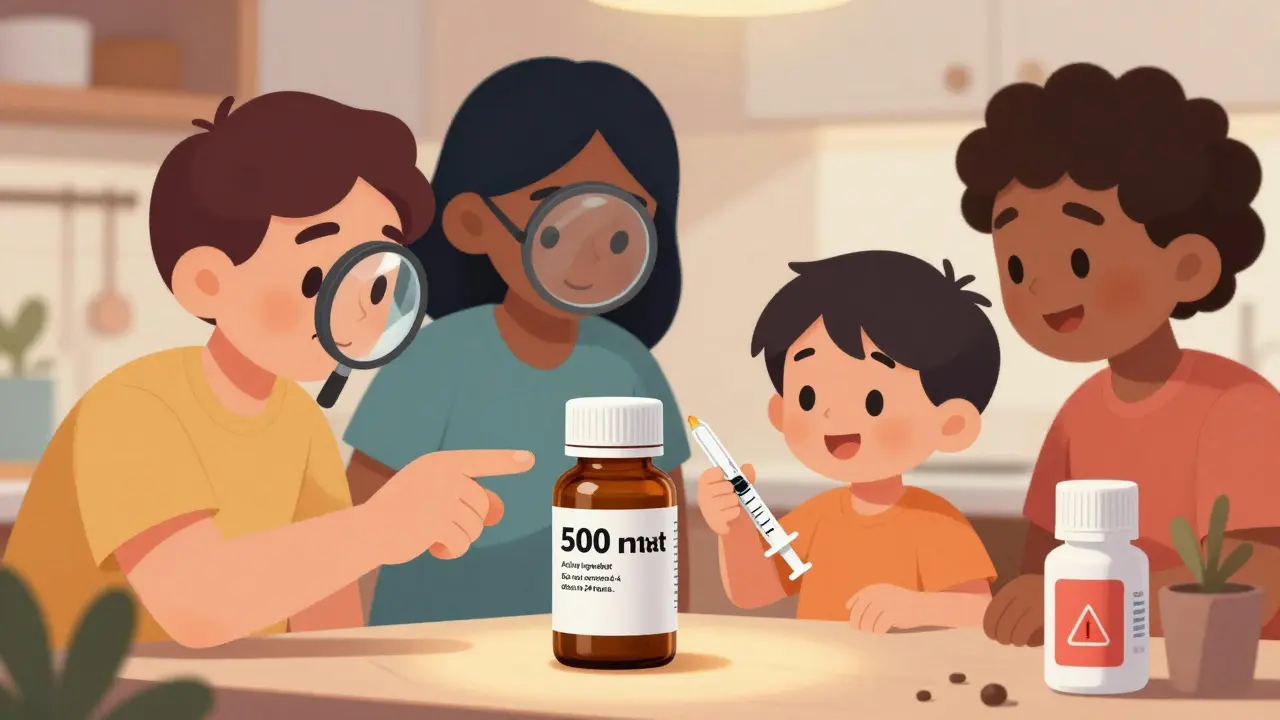
Every time you pick up a bottle of medicine-whether it's from a pharmacy or the shelf at the grocery store-you're holding a safety guide. But if you don't know how to read it, that guide might as well be written in another language. Misunderstanding a single line on a medication label can lead to taking too much, too little, or the wrong medicine altogether. And it happens more often than you think.
What’s Actually on the Label?
Medication labels aren’t just random text. They follow strict rules set by the U.S. Food and Drug Administration (FDA). For over-the-counter (OTC) drugs like pain relievers or cold medicine, the label must follow the Drug Facts format. That means seven key parts are always there, in this order:- Active Ingredient(s): This tells you what the medicine is made of. It lists the scientific name (like acetaminophen) and how much is in each dose (like 500 mg per tablet).
- Purpose: Why is this medicine here? Is it a pain reliever? An antihistamine? This section tells you what it’s supposed to do.
- Uses: What symptoms does it treat? Headache? Fever? Runny nose? If it says "relieves occasional sleeplessness," don’t use it for a toothache.
- Warnings: This is where you need to stop and read carefully. It tells you when NOT to take the medicine, what to avoid (like alcohol or other drugs), and signs of a bad reaction.
- Dosage: How much to take, how often, and for how long. It might say "take one tablet every 4 to 6 hours"-and always adds "do not exceed 4 doses in 24 hours."
- Inactive Ingredients: These are fillers, dyes, or flavorings. If you’re allergic to red dye #40 or gluten, this is where you check.
- Other Information: Storage tips, expiration date, and sometimes manufacturer details.
Prescription labels are different. They include your name, the pharmacy’s info, the prescriber’s name, the drug name, strength, quantity, and refill info. But the most important part? The directions. They often say things like "take one tablet by mouth twice daily with food" or "inject 1 mL subcutaneously every 7 days." If it’s unclear, ask the pharmacist. Don’t guess.
Why Dosage Isn’t Always as Simple as "Take Two"
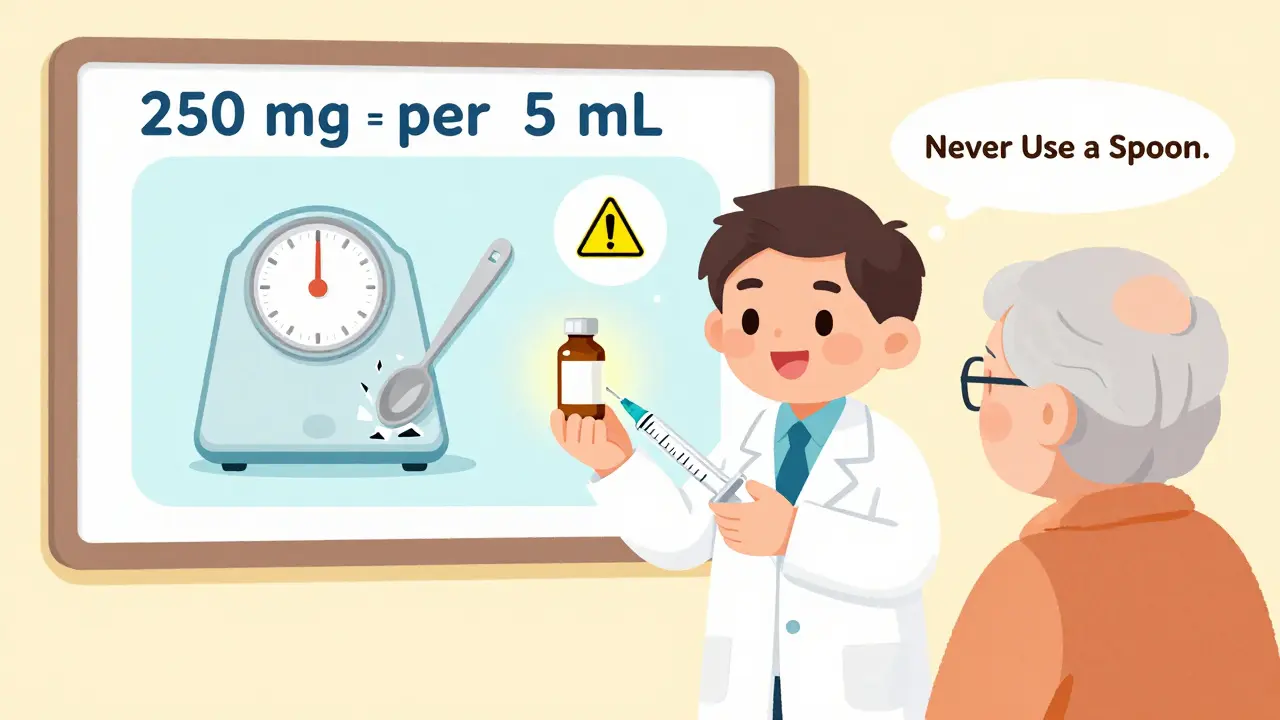
Most people think dosage means "take two pills." But it’s not that simple. For kids, it’s often based on weight. A 20-pound baby doesn’t need the same amount as a 60-pound child. If you don’t know your child’s weight in kilograms (kg), you can’t pick the right dose. Many liquid medicines for children are labeled as "X mg per mL" or "X mg per 5 mL." That means you have to calculate how much to give.Example: A child needs 150 mg of amoxicillin. The bottle says "250 mg per 5 mL." That’s 50 mg per mL. So you need 3 mL. Not 3 teaspoons. Not "a little less than a tablespoon." Use the syringe that came with the medicine. Never use a kitchen spoon. Studies show kitchen teaspoons vary from 2.5 mL to 7.3 mL. That’s a 200% difference. A single wrong spoon can mean an overdose.
Even adults get confused. Liquid medicines like cough syrup or antibiotics often come with concentrations like "350 mg per 5 mL." If your doctor says "take 700 mg," you need two full 5 mL doses-not just "half the bottle." One Reddit user shared a story where a patient took the entire 30 mL vial of amoxicillin because they thought it was one dose. They ended up in the ER.
The Hidden Danger: Double Dosing
One of the most common mistakes? Taking more than one medicine with the same active ingredient. You take Tylenol for a headache. Later, you grab a cold medicine because you’re congested. But that cold medicine also has acetaminophen. You just doubled your dose. And acetaminophen overdose is the leading cause of acute liver failure in the U.S.According to the Cleveland Clinic, 27% of emergency visits for medication errors happen because people didn’t realize two different pills contained the same drug. Always check the active ingredient on every label. If two medicines say "acetaminophen," "ibuprofen," or "pseudoephedrine," don’t take them together unless your doctor says so.
Warnings Aren’t Just Fine Print
The "Warnings" section is the most ignored-and the most important. It tells you:- If you have liver disease, kidney problems, or asthma, this medicine might be dangerous.
- If you’re pregnant or breastfeeding, some drugs aren’t safe.
- If you’re taking blood thinners, antidepressants, or statins, this medicine could interact badly.
- If the medicine causes drowsiness, don’t drive.
- If you develop a rash, swelling, or trouble breathing, stop taking it and call your doctor immediately.
A 2021 Express Scripts report found that 47% of people never read the warnings. That’s not just careless-it’s risky. A woman in her 60s took an OTC sleep aid while on her heart medication. The label warned against combining it with beta-blockers. She didn’t see it. She ended up with dangerously low blood pressure. It was preventable.
Expiration Dates Matter More Than You Think
You’ve probably seen a pill bottle with an expiration date of "09/2025" and thought, "It’s fine. It’s still in date." But here’s the truth: expiration dates aren’t arbitrary. The FDA requires manufacturers to test how long a drug stays effective and safe. After that date, the medicine might lose strength. Or, in rare cases, break down into harmful chemicals.OTC drugs usually last 2-3 years from manufacture. Prescription bottles? Pharmacies often set their own expiration date-usually one year after dispensing. That’s because once you open a bottle, moisture and air can degrade the medicine faster. If your prescription says "expire 06/2026," but you picked it up in March 2025, it’s still good. But if it’s been sitting in your medicine cabinet since 2023? Toss it.

How to Read a Label Like a Pro
Follow this simple four-step check every time you take medicine:- Check your name. Does it say your name on the bottle? If it says "Janet Smith" and your name is Maria, don’t take it.
- Match the drug name. Is the medicine on the label the same as what your doctor prescribed? "Metformin" isn’t "Metformin ER." They’re different.
- Confirm the strength. Your doctor prescribed 500 mg tablets. The bottle says 250 mg. Did they give you the wrong strength? Ask before you take it.
- Read the directions twice. "Take one tablet daily." Not "as needed." "Take with food." Not "on an empty stomach." If it says "do not exceed 2 doses in 24 hours," then two is the max. No exceptions.
For liquid medicines, always use the measuring tool that came with the bottle. If it’s missing, ask the pharmacy for a new one. Oral syringes are the most accurate. Dosing cups with metric markings (mL) are next best. Never use a kitchen spoon.
What’s Changing? The Future of Labels
The FDA is pushing for labels that are easier to understand. By 2024, many prescription bottles will have QR codes. Scan them with your phone and you’ll get a video showing exactly how to take the medicine, how to measure liquid doses, and what side effects to watch for. In 2021, a pilot program showed a 37% drop in errors when patients used these digital guides.Also, high-alert drugs-like insulin, blood thinners, and opioids-are getting color-coded caps and warning icons. Red means "high risk." Yellow means "check with your doctor." It’s not perfect yet, but it’s a step toward fewer mistakes.
By 2027, most developed countries will use the same label format. No more guessing if "Directions" means "take every 6 hours" or "take 3 times a day." It’ll be clear, consistent, and easy to read.
What to Do If You’re Still Confused
If you’re unsure about any part of the label-don’t wing it. Call your pharmacist. They’re trained to explain this stuff. You can also ask your doctor. Many clinics now give patients printed handouts that break down the label in plain language.And if you’re caring for an elderly parent or young child? Sit down with them and read the label together. Write down the dosage in big letters on a sticky note and put it on the bottle. Make it impossible to miss.
Medication safety isn’t about being perfect. It’s about being careful. One extra minute reading the label could save a life.
What should I do if I can’t read the label because the text is too small?
Ask your pharmacist for a larger-print version. Most pharmacies can print a secondary label with bigger text. You can also request a pill organizer with clear labels or use a magnifying glass. If you’re visually impaired, many pharmacies offer audio labels or phone-based instructions. Don’t guess-ask for help.
Can I split a pill if the dosage seems too high?
Only if the pill is scored (has a line down the middle) and your doctor or pharmacist says it’s okay. Some pills, like extended-release tablets or capsules, should never be split. Splitting them can change how the medicine works. Always check with your pharmacist before cutting any pill.
Why do some labels say "take on an empty stomach"?
Some medicines are absorbed better without food in your stomach. Others can cause nausea if taken with food. For example, antibiotics like amoxicillin are often taken with food to reduce stomach upset, while others like tetracycline must be taken on an empty stomach because food blocks absorption. Always follow the label exactly.
What if I miss a dose? Should I take two to make up for it?
Never double a dose unless the label or your doctor says so. For most medicines, if you miss a dose, take it as soon as you remember-but only if it’s within a few hours. If it’s almost time for the next dose, skip the missed one. Taking too much can be dangerous. Check the label’s instructions or call your pharmacist for guidance.
Are generic medicines labeled differently than brand names?
The active ingredient and dosage are exactly the same. The label format is also regulated by the FDA, so both generic and brand-name versions follow the same Drug Facts or prescribing guidelines. The only differences are usually the manufacturer’s name and inactive ingredients (like color or flavor). Always check the active ingredient to confirm it matches what you need.
If you’re ever unsure, stop and ask. Your health isn’t worth guessing.

Shruti Chaturvedi
I've seen so many older folks in my community take the wrong dose because they can't read the tiny print. Pharmacies should offer free magnifying labels or audio guides. It's not just about convenience-it's safety. I teach my neighbors to always ask for a second label with bigger text. No one should guess when their life's on the line.
March 11, 2026 AT 22:05
Katherine Rodriguez
Why are we even talking about this? In America we have laws. If the label's too small, sue the manufacturer. Stop being so fragile. People used to read fine. Now everyone wants a hand-holding app or a QR code. Just learn to read. Or don't take meds. Simple.
March 13, 2026 AT 05:01
Devin Ersoy
Let me tell you something about the FDA-they're not your friends. They're bureaucrats who think 'Drug Facts' is a gospel. But here's the kicker: most OTC labels are written by lawyers, not doctors. I once read a label that said 'may cause drowsiness' while the active ingredient was diphenhydramine. DUH. And don't get me started on 'inactive ingredients.' That's where the real poison hides-talc, FD&C Red 40, corn syrup solids. You think you're taking aspirin? Nah. You're taking a science experiment with a sticker on it.
March 13, 2026 AT 05:22
Scott Smith
I work in a pharmacy and I can confirm: the biggest danger isn't misunderstanding the label-it's assuming you understand it. People skim. They assume. They think 'every 6 hours' means 'when I remember.' That's how overdoses happen. We give out dosing syringes with every liquid prescription. If you lose it, come back. We have spares. Don't use a soup spoon. Ever. I've seen a 3-year-old given 10 mL of amoxicillin because Mom thought a spoon was a spoon. She didn't know mL existed. We saved her. But she shouldn't have been in danger to begin with.
March 15, 2026 AT 05:00
Sally Lloyd
QR codes on medicine bottles? That's not innovation. That's surveillance. Who's tracking what you're taking? Who's storing that data? And who's selling it? I read that pilot program. 37% fewer errors? Or 37% more data harvested? I don't trust corporations or the FDA. If they wanted to help, they'd make labels in plain language-not add tech that turns your medicine into a spy tool. I keep my pills in a locked box. No scans. No apps. Just paper and prayer.
March 15, 2026 AT 21:28
Emma Deasy
I must express, with the utmost gravity and solemnity, that the current state of pharmaceutical labeling is nothing short of a national scandal! The lack of standardized, legible, and comprehensible instructions is not merely inconvenient-it is an affront to human dignity! I have personally witnessed a man, a father, a pillar of his community, ingest an entire bottle of cough syrup because he mistook '5 mL' for '5 teaspoons'-a tragic, preventable, and utterly avoidable catastrophe! The FDA must be held accountable! We must demand immediate reforms! I have written my congressperson! I have written my senator! I have written the Pope! Someone must act!
March 17, 2026 AT 11:28
tamilan Nadar
In India, we don't have big labels or QR codes. We have pharmacists. We have grandmas who know which pill does what. We have neighbors who ask each other. We don't need apps. We need trust. And we need to stop treating medicine like a puzzle. If you're confused, ask. Always. No shame. My aunt took metformin for 12 years without ever reading the label. She asked the pharmacist every time she got a new bottle. That's how it's done.
March 19, 2026 AT 03:59
Adam M
You're overcomplicating this. Read the active ingredient. Don't double up. Use the syringe. That's it. Stop reading novels. Just follow the basics.
March 20, 2026 AT 14:07
Alex MC
I really appreciate how thorough this post is. Medication safety is one of those things nobody talks about until it's too late. I always keep a small notebook next to my pill organizer-write down the date, the dose, and whether I took it. It sounds silly, but it's saved me from mixing up my blood pressure meds. Small habits make a big difference. And yes, always ask your pharmacist. They're the unsung heroes of healthcare.
March 21, 2026 AT 22:16
rakesh sabharwal
The FDA's Drug Facts format is a gross oversimplification of pharmacokinetics. It reduces complex pharmacological interactions to a checklist designed for illiterates. Real medical literacy requires understanding half-life, bioavailability, and CYP450 metabolism. If you can't parse that, you shouldn't be self-medicating. The solution isn't bigger fonts-it's better education. Or better yet, let physicians prescribe and pharmacists dispense. Not Amazon and CVS.
March 23, 2026 AT 21:42
Serena Petrie
I just read this and thought-why are we still doing this? I mean, we have AI now. Why not just scan the bottle and let your phone tell you what to do?
March 24, 2026 AT 01:05
Buddy Nataatmadja
I used to work in a hospital pharmacy. The weirdest thing I saw? People taking their kid's liquid medicine because it tasted better. Like, a 45-year-old man taking children's ibuprofen because he didn't want to swallow a pill. I asked him why. He said, 'It's just sugar water with medicine in it.' I said, 'Sir, you're 45. You're supposed to take 650 mg. This has 160 mg per 5 mL. You'd need to drink 20 mL. That's four tablespoons. And you're not supposed to drink that much sugar in one go.' He just shrugged. We live in a weird world.
March 24, 2026 AT 20:11
mir yasir
The notion that dosage is determined by weight is a fallacy propagated by Western medicine. In Ayurvedic tradition, dosage is calibrated according to prakriti, agni, and dhatu balance-not arbitrary kilogram metrics. A 60-pound child may require less than a 40-pound child depending on their constitutional type. Modern labels ignore this wisdom. We are reducing medicine to physics while ignoring biology.
March 26, 2026 AT 00:05