
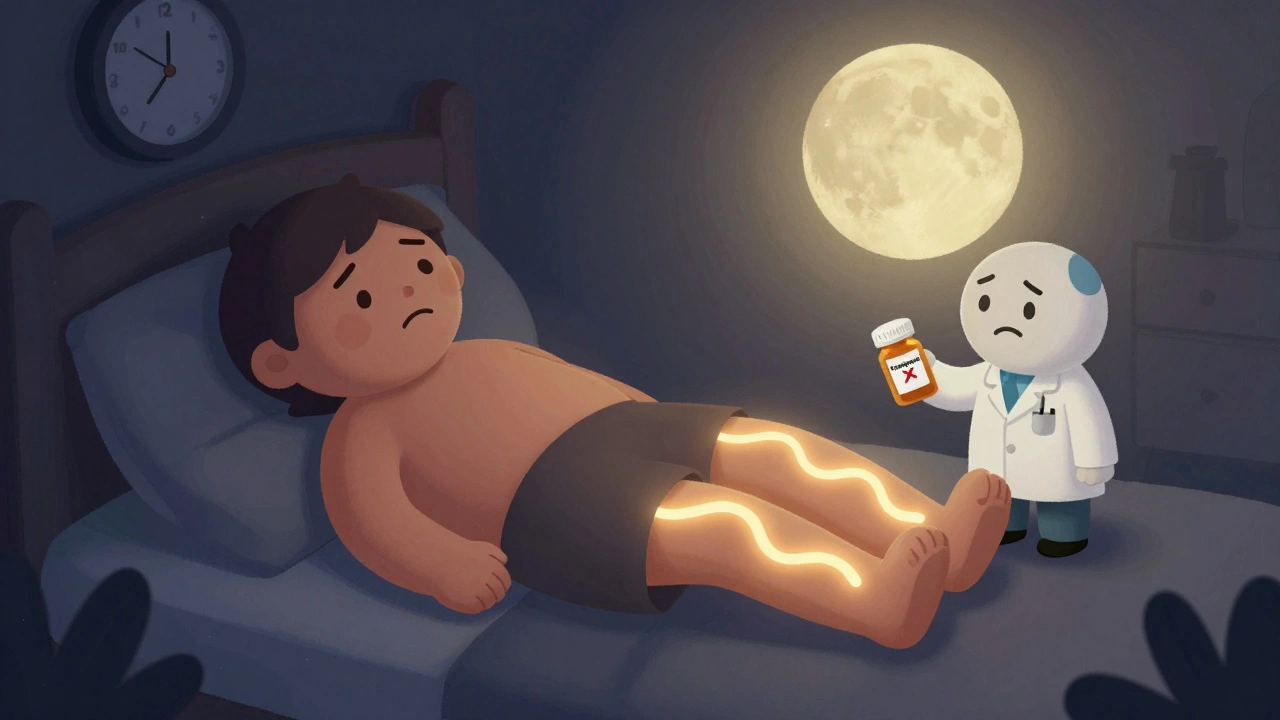
Restless Legs Syndrome (RLS) isn’t just about being fidgety. It’s a neurological condition that makes your legs feel like they’re crawling, tingling, or aching-especially when you’re trying to relax or sleep. For many, it’s not just annoying; it’s debilitating. And for years, the go-to solution was dopamine-boosting drugs like pramipexole and ropinirole. But here’s the truth: those medications, once praised as miracle cures, are now considered risky for long-term use. The medical community has turned a corner, and the advice has changed dramatically.
What Happened to Dopaminergic Medications?
Back in the early 2000s, drugs like Mirapex (pramipexole) and Requip (ropinirole) were hailed as breakthroughs for RLS. They worked fast. You took one pill, and within an hour, the creepy-crawly sensations in your legs faded. For people suffering nightly, it felt like a lifeline. But the relief came with a hidden cost.
By 2018, researchers started seeing a pattern. Patients who took these drugs daily for more than a year didn’t just get better-they got worse. Their symptoms started earlier in the day. Instead of showing up at bedtime, they’d kick in at 2 p.m. The discomfort spread from legs to arms. The intensity climbed. Nightly episodes jumped from three or four times a week to almost every night. This wasn’t a fluke. It was augmentation.
Augmentation isn’t a side effect. It’s a disease progression caused by the treatment itself. A 2022 study in Sleep Medicine Reviews found that 7-12% of patients on dopamine agonists developed augmentation each year. After five years, up to 80% of long-term users experienced it. That’s not rare. That’s the norm.
Why Do Dopamine Drugs Cause Augmentation?
RLS is linked to low iron levels in the brain. Iron helps dopamine work properly. When dopamine is artificially boosted with pills, the brain’s natural balance breaks down. Instead of calming the nerves, too much dopamine starts overstimulating them. The result? Symptoms get worse, not better.
Dr. John Winkelman from Massachusetts General Hospital, who helped redefine RLS treatment guidelines, put it bluntly: “Dopamine agonists, once considered the first-line treatment for restless legs syndrome, are no longer recommended because of their long-term complications, particularly augmentation.”
The American Academy of Sleep Medicine updated its guidelines in December 2024. Dopamine agonists are no longer first-line. They’re second-line-reserved only for people with rare, infrequent symptoms (less than three nights a week) who need quick relief. Even then, doses are capped at 0.5 mg for pramipexole and 3 mg for ropinirole. Daily use is limited to six months.
What’s Replacing Dopamine Agonists?
The new standard? Alpha-2-delta ligands. These are medications originally designed for seizures and nerve pain-but they work surprisingly well for RLS. The two main ones are gabapentin enacarbil (Horizant) and pregabalin (Lyrica).
Unlike dopamine drugs, they don’t cause augmentation. They take longer to kick in-days to weeks-but their effect lasts. A 2023 meta-analysis in JAMA Neurology showed that after 12 weeks, pregabalin and pramipexole reduced RLS symptoms by nearly the same amount. But at one year? Pregabalin kept working. Pramipexole’s effectiveness dropped by 35% due to augmentation.
Gabapentin enacarbil is FDA-approved specifically for RLS. It’s taken once daily at 600 mg. Pregabalin is used off-label at 75-300 mg daily. Both can cause dizziness, weight gain, or fatigue, but these side effects are usually mild and improve over time. Patient satisfaction scores on Drugs.com show pregabalin rated 7.8/10 for effectiveness. Pramipexole? Only 6.2/10.

Other Options Beyond Medication
Medication isn’t the only path. Many people find relief by adjusting lifestyle habits.
- Caffeine: 80% of RLS patients consume caffeine daily. Cutting it out-even just in the afternoon-can reduce symptoms by 20-30%.
- Alcohol: It worsens RLS in 65% of people. A glass of wine at dinner might seem relaxing, but it can trigger worse symptoms later.
- Sleep hygiene: Going to bed and waking up at the same time every day helps regulate the nervous system. Even small improvements in sleep routine make a difference.
- Iron supplements: If your ferritin level is below 75 mcg/L, oral iron (100-200 mg elemental iron daily) can improve symptoms by 35% in 12 weeks. A simple blood test can tell you if you’re deficient.
For those who need stronger relief, low-dose opioids like oxycodone (5 mg) are an option. They’re effective for 50-70% of users. But they come with risks. A 2021 study found only 0.8% of RLS patients developed misuse when kept under 30 mg morphine equivalent daily. Still, doctors avoid them in people with a history of substance use.
What to Do If You’re Already on Dopamine Medication
If you’ve been on pramipexole or ropinirole for more than six months and notice your symptoms are getting worse or starting earlier, you’re not alone. And you’re not failing. This is a known outcome of the medication-not your fault.
The fix isn’t to crank up the dose. That’s the trap. Dr. Winkelman says: “Will Rogers said, ‘If you find yourself in a hole, stop digging.’ This is good advice for doctors who are giving these medicines: Stop increasing the dose.”
Here’s what works:
- Don’t stop cold turkey. Taper slowly-reduce your dose by 25% every 1-2 weeks.
- Start an alpha-2-delta ligand like pregabalin or gabapentin enacarbil during the taper. This prevents rebound symptoms.
- Get your iron levels checked. If low, start supplementation.
- Eliminate caffeine after noon. Cut alcohol.
A 2023 study in Sleep Medicine showed that 85% of patients successfully switched from dopamine agonists to gabapentin enacarbil without severe withdrawal or worsening symptoms when done properly.

Why the Shift in Treatment Matters
The market has already moved. In 2010, dopamine agonists made up 75% of new RLS prescriptions. By 2024, that number dropped to 20%. Alpha-2-delta ligands now account for 65% of new prescriptions. In Europe, 85% of doctors start with these drugs. In the U.S., it’s 70%.
Regulators are catching up. The FDA added black box warnings to dopamine agonists in 2022, highlighting augmentation risk. The European Medicines Agency now requires product labels to state maximum treatment durations.
Even the Restless Legs Syndrome Foundation updated its guidelines in June 2023: “Although once considered a first-line therapy, dopaminergic medications are now second-line therapy due to augmentation.”
What’s Next for RLS Treatment?
Research is moving beyond dopamine. Three phase 3 trials are underway for 2025-2027:
- A new iron chelator called Fazupotide, designed to fix brain iron deficiency at the root.
- A selective dopamine receptor agonist that targets only the specific brain area involved in RLS-without triggering augmentation.
- Transcranial magnetic stimulation, a non-drug therapy that uses magnetic pulses to calm overactive nerves.
Analysts predict dopamine agonist sales for RLS will drop from $360 million in 2024 to just $120 million by 2030. Meanwhile, alpha-2-delta ligands are expected to grow from $540 million to $890 million.
The message is clear: RLS treatment has evolved. What worked ten years ago can hurt you now. The goal isn’t just to quiet your legs at night-it’s to avoid making things worse over time.
Are dopamine agonists still used for Restless Legs Syndrome?
Yes, but only as a second-line option. Dopamine agonists like pramipexole and ropinirole are no longer recommended as first-line treatment due to the high risk of augmentation. They’re now reserved for people with infrequent symptoms (less than three nights a week) and short-term use (no more than six months). Long-term daily use is strongly discouraged.
What is augmentation in Restless Legs Syndrome?
Augmentation is when RLS symptoms worsen because of dopamine medication. Instead of appearing only at night, symptoms start earlier in the day-sometimes as early as mid-afternoon. The discomfort becomes more intense, spreads to arms or other body parts, and happens more frequently-often every night. It’s not a sign the drug is working better; it’s a sign it’s causing harm.
What are the best alternatives to dopamine agonists for RLS?
The current first-line treatments are alpha-2-delta ligands: gabapentin enacarbil (Horizant) and pregabalin (Lyrica). These drugs don’t cause augmentation and provide lasting symptom relief. Gabapentin enacarbil is FDA-approved for RLS at 600 mg daily. Pregabalin is used off-label at 75-300 mg daily. Both may cause dizziness or weight gain, but these side effects are usually manageable.
Can lifestyle changes help with Restless Legs Syndrome?
Absolutely. Cutting out caffeine after noon reduces symptoms in most people. Avoiding alcohol, which worsens RLS in 65% of users, also helps. Improving sleep hygiene-going to bed and waking up at the same time daily-can reduce symptom severity by 20-30%. For those with low iron levels (ferritin under 75 mcg/L), taking 100-200 mg of elemental iron daily can improve symptoms by 35% in 12 weeks.
How do I safely stop taking dopamine agonists for RLS?
Never stop abruptly. Work with your doctor to reduce your dose by 25% every 1-2 weeks. Start an alpha-2-delta ligand like pregabalin or gabapentin enacarbil during the taper to prevent rebound symptoms. Monitor for worsening symptoms and adjust the new medication as needed. Studies show 85% of patients successfully transition without major issues when done gradually with proper support.
Is it safe to use opioids for Restless Legs Syndrome?
Low-dose opioids like oxycodone (5 mg) can be effective for severe RLS that doesn’t respond to other treatments. Studies show 50-70% of patients get relief. The risk of misuse is low-only 0.8% in one study-when doses are kept under 30 mg morphine equivalent daily and used only for RLS. But they’re not recommended for people with a history of substance use disorders. Opioids are a last-resort option, not a first choice.
Final Thoughts
RLS doesn’t have to be a life sentence on risky medication. The old model-take a pill, feel better, keep taking it-is outdated. The new model is smarter: treat the root cause, avoid drugs that make things worse, and use safer alternatives that work over time. If you’ve been on dopamine agonists for more than six months and feel like your symptoms are creeping up earlier or spreading, it’s time to talk to your doctor. You don’t have to keep digging. There’s a better way.
kelly mckeown
i’ve been on ropinirole for 3 years and didn’t realize it was making things worse until my legs started tingling at 3pm. i thought i was just getting worse… turns out the medicine was the problem. thanks for this post, it’s like someone finally explained what was happening.
December 2, 2025 AT 21:27
Tom Costello
As someone who’s seen this play out in clinic after clinic, it’s frustrating how long it took for guidelines to catch up. Dopamine agonists were marketed like miracle pills, but the data was there-quietly, in the back of journals. Now we’re seeing patients who’ve been on them for a decade and have no idea why their symptoms exploded. The shift to alpha-2-delta ligands is long overdue.
December 3, 2025 AT 09:46
dylan dowsett
Wait-so you’re saying dopamine agonists are dangerous?!!? I’ve been taking Mirapex for 8 years and I’m fine! You’re just scaremongering! I’ve got a 98% success rate with this drug-what do YOU know?!!? Your ‘study’ probably came from some journal that doesn’t even have an impact factor!!
December 4, 2025 AT 03:21
Susan Haboustak
It’s not just about augmentation-it’s about the fact that you’re poisoning your brain’s natural dopamine regulation. You’re not treating RLS. You’re rewiring your basal ganglia to depend on a chemical crutch. And now you’re blaming the symptoms on ‘stress’ or ‘aging’? No. It’s the drug. And if you’re still on it after six months, you’re not managing your condition-you’re enabling a slow neurological collapse.
December 5, 2025 AT 21:26
Chad Kennedy
so like… i take pramipexole and it works. why should i stop? it’s not like i’m addicted or anything. just sayin’.
December 6, 2025 AT 11:16
Siddharth Notani
Thank you for this comprehensive overview. 🙏 I have been managing RLS for 7 years and switched to pregabalin last year after augmentation. The change was gradual but profound. My sleep quality improved, and I no longer wake up with burning sensations in my arms. Iron supplementation (ferritin 92 mcg/L) made a noticeable difference too. 🌱
December 6, 2025 AT 12:52
Cyndy Gregoria
Listen. If you’ve been on dopamine meds longer than six months, you’re playing Russian roulette with your nervous system. I know because I did it. I thought ‘more pills = better sleep.’ Nope. I ended up feeling like my legs were full of ants 12 hours a day. I switched to gabapentin enacarbil. Took 3 weeks. Now I sleep like a baby. No regrets. Don’t wait until it’s too late. Your body isn’t broken-it’s just been lied to.
December 7, 2025 AT 08:44
Akash Sharma
This is incredibly informative, and I appreciate the depth of the research cited. I’ve been curious about the mechanism behind augmentation for years-especially why dopamine, which is supposed to calm motor activity, ends up exacerbating it. The idea that artificial dopamine overload causes receptor downregulation and paradoxical hyperexcitability in the spinal cord and basal ganglia makes a lot of sense, especially when considering iron’s role as a cofactor in tyrosine hydroxylase activity. I wonder, though, if there’s any emerging data on whether genetic polymorphisms in the DRD2 or SLC6A3 genes influence susceptibility to augmentation? That might explain why some patients develop it after 18 months while others tolerate 5+ years without issue. Also, has anyone looked into whether circadian rhythm disruption interacts with dopamine agonist pharmacokinetics? Because the timing of symptom onset shifting from night to afternoon feels like more than just pharmacological tolerance-it might be a circadian misalignment triggered by chronic dopaminergic stimulation. Just thinking out loud here.
December 7, 2025 AT 17:25