
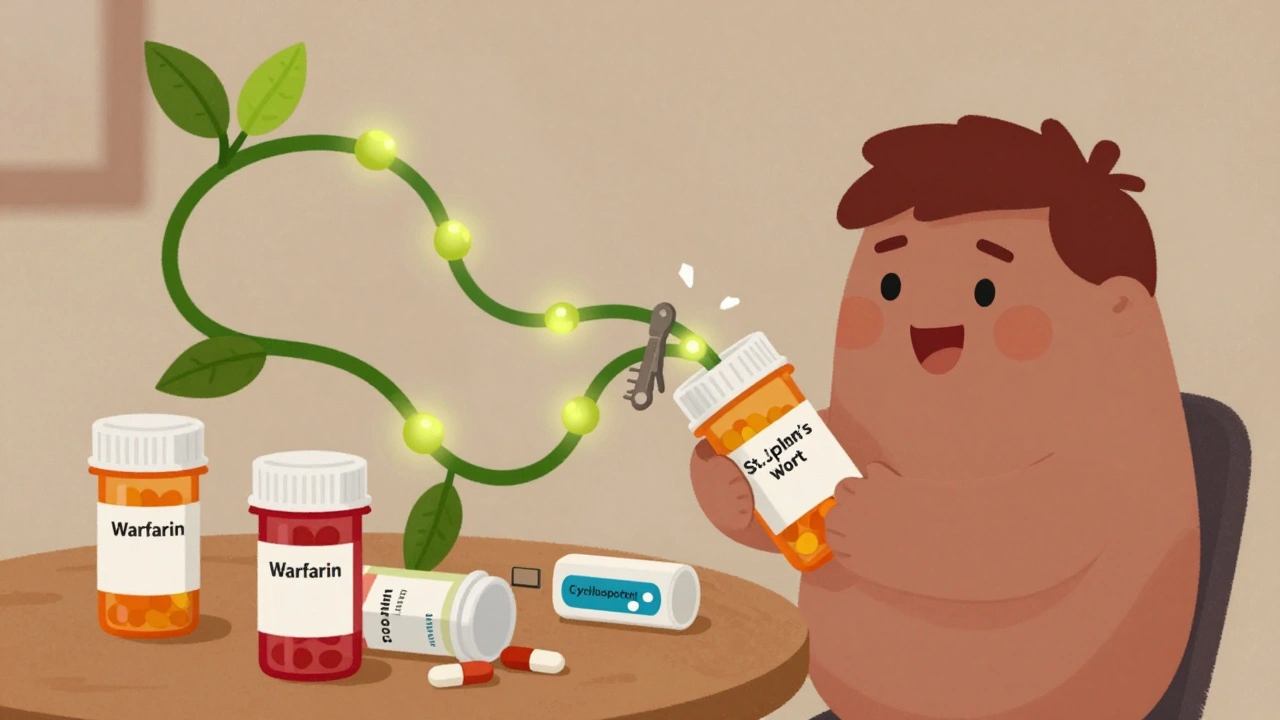
Many people turn to St. John’s Wort because it’s natural, affordable, and often marketed as a safe alternative to antidepressants. But here’s the truth: St. John’s Wort isn’t harmless just because it comes from a plant. In fact, it can quietly sabotage your prescription medications - sometimes with life-threatening results.
If you’re taking warfarin, birth control, HIV meds, antidepressants, or even cholesterol drugs, St. John’s Wort could be making them useless. Or worse - causing dangerous side effects you never saw coming.
How St. John’s Wort Changes How Your Body Processes Medications
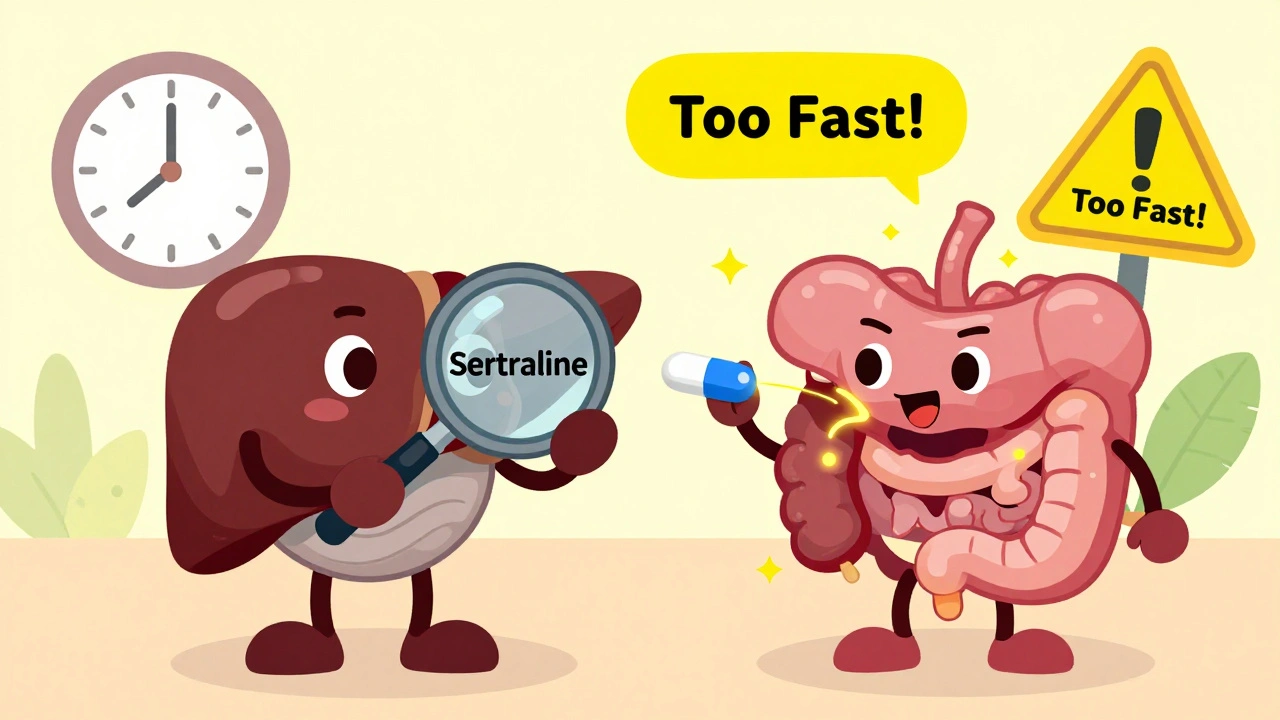
St. John’s Wort doesn’t just float through your system. It actively rewires how your liver and gut handle drugs. Its main active ingredient, hyperforin, turns on enzymes - especially CYP3A4 and CYP2C9 - that break down medications faster than normal. It also kicks up P-glycoprotein, a transporter that shoves drugs out of your cells before they can do their job.
This isn’t a slow, subtle change. After just two weeks of taking 900 mg daily, these enzymes can become 40% more active. That means your body clears drugs like warfarin, cyclosporine, or birth control pills up to 50% faster. Your blood levels drop. The drug stops working. And you don’t always notice until it’s too late.
Think of it like this: Your medication is a key trying to unlock a door. St. John’s Wort is a thief who stole the key, melted it down, and replaced it with a weaker copy. The lock still turns - but it won’t keep you safe.
The 12 Medications Most at Risk
St. John’s Wort doesn’t play favorites. It messes with a wide range of drugs - but some are far more dangerous to combine. Here are the top 12 classes you need to know about:
- Anticoagulants - Warfarin and phenprocoumon. One case showed INR dropping from 2.5 to 1.3 in just seven days. That’s a blood clot risk.
- Immunosuppressants - Cyclosporine and tacrolimus. A transplant patient lost 40% of their drug levels - nearly triggering organ rejection.
- HIV Medications - Protease inhibitors like saquinavir and non-nucleoside reverse transcriptase inhibitors like efavirenz. Levels can crash by 50%. That means the virus can rebound.
- Antidepressants - SSRIs like sertraline, fluoxetine, and even nefazodone. Combine them with St. John’s Wort and you risk serotonin syndrome: agitation, rapid heart rate, fever, seizures - possibly fatal.
- Oral Contraceptives - Ethinyl estradiol levels drop 25-35%. There are documented cases of pregnancy despite perfect pill use.
- Anticonvulsants - Phenytoin, carbamazepine. Reduced levels mean breakthrough seizures.
- Digoxin - Levels drop 25%. Can cause heart failure to worsen.
- Theophylline - Used for asthma. Levels fall 30%. Risk of respiratory failure.
- Benzodiazepines - Alprazolam (Xanax), diazepam. Up to 40% reduction in effectiveness. Anxiety returns with a vengeance.
- Statins - Atorvastatin and simvastatin lose 30-40% potency. Cholesterol spikes. Pravastatin and fluvastatin are safer - but only because they’re not metabolized the same way.
- Opioids - Oxycodone, fentanyl. Reduced pain control. Risk of withdrawal or overdose if St. John’s Wort is stopped suddenly.
- Proton Pump Inhibitors - Omeprazole, pantoprazole. Lowered levels mean acid reflux comes back harder.
That’s not a short list. That’s a minefield. And most people don’t even know they’re walking through it.
Real Stories: When ‘Natural’ Goes Wrong
One woman in Perth took St. John’s Wort for low mood. She was on birth control and didn’t think twice. Three weeks later, she had breakthrough bleeding. A pregnancy test two weeks after that? Positive. She wasn’t careless - she followed every rule. But her body didn’t absorb the pill anymore.
A man on warfarin for a mechanical heart valve started St. John’s Wort after reading online reviews. His INR, normally steady at 2.8, dropped to 1.5. He didn’t feel different. But his doctor found a clot forming in his valve. He needed emergency surgery.
A transplant patient in Melbourne started St. John’s Wort for depression after his liver transplant. His cyclosporine levels fell 40%. His doctor told him he was hours away from rejection. He stopped the herb immediately - but his body still took two weeks to reset.
These aren’t rare outliers. They’re documented cases. And they’re happening because people assume herbal means safe.
Why You Don’t Tell Your Doctor
Here’s the biggest problem: 41% of people taking prescription drugs don’t tell their doctors they’re using St. John’s Wort. Why? Because they don’t think of it as medicine.
They say, “I just take a little herb for my mood.” They don’t call it a drug. They don’t write it down. They don’t mention it at checkups.
But your doctor needs to know. Not because they’re judging - because they’re trying to keep you alive.
Ask yourself: If you were on insulin, would you skip telling your doctor about a new supplement? Of course not. St. John’s Wort is just as powerful - just less obvious.
What You Should Do Instead
If you’re thinking about trying St. John’s Wort:
- Stop. Talk to your doctor first. Not your friend. Not your pharmacist. Your prescriber. Bring the bottle.
- Don’t assume it’s safe just because it’s on a shelf. The FDA doesn’t test supplements for safety or interactions like it does for drugs.
- If you’re already taking it, don’t quit cold turkey. Stopping suddenly can cause withdrawal symptoms or make your original condition flare up. Work with your doctor to taper safely.
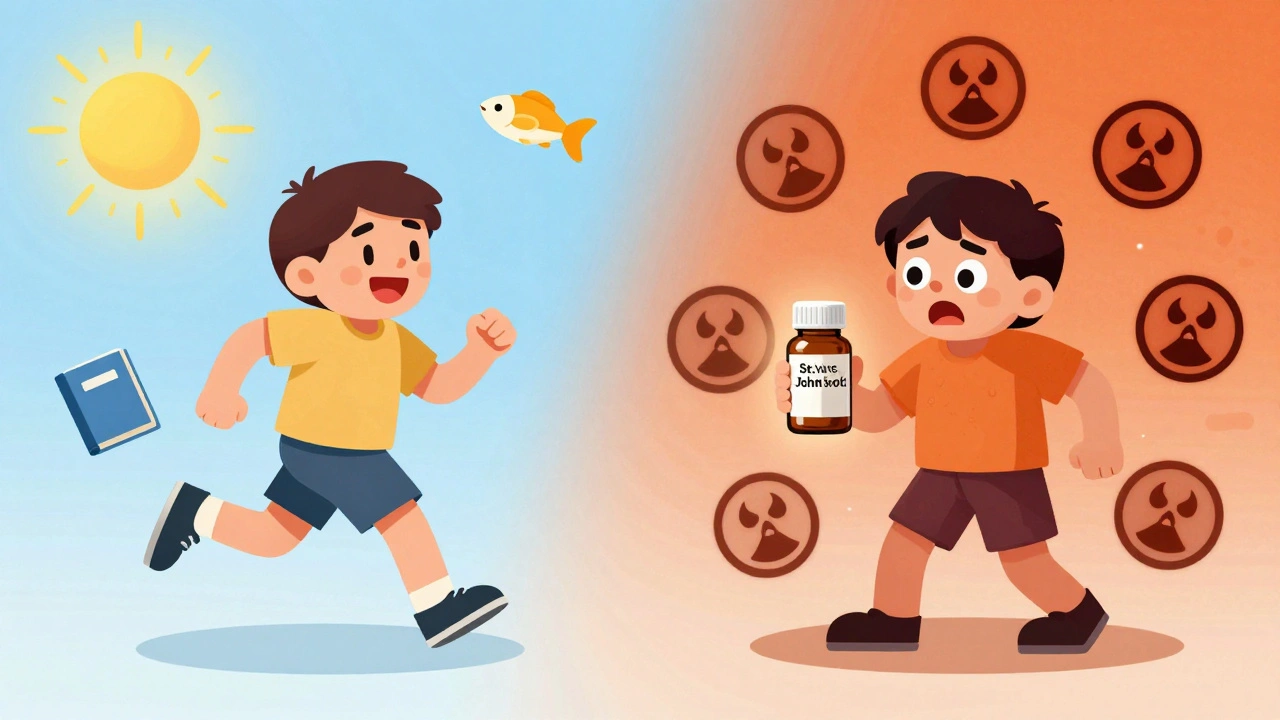
- Ask about alternatives. There are other natural options for mild depression - like exercise, light therapy, or cognitive behavioral therapy - that don’t interfere with meds.
- Check your labels. Since 2019, U.S. supplement labels must say: “Ask a doctor before use if you are taking prescription drugs.” If yours doesn’t, it’s not trustworthy.
If you’re already on a high-risk medication and took St. John’s Wort without knowing:
- Get your blood tested - INR for warfarin, drug levels for cyclosporine or anticonvulsants.
- Wait at least two weeks after stopping St. John’s Wort before starting a new drug - the enzyme effects linger.
- Keep a list of everything you take - vitamins, herbs, teas, even CBD. Bring it to every appointment.
The Bigger Picture: Why This Keeps Happening
St. John’s Wort is the fifth most-used herbal supplement in the U.S. - 4.8 million adults take it. The global market hit $287 million in 2022. People want relief. They want something gentle. They want control.
But the industry sells it like a wellness tea - not a potent drug. Labels say “natural,” “gentle,” “safe.” No bold warnings. No clear warnings about warfarin or birth control. You have to dig to find the risks.
Australia requires warning labels on all St. John’s Wort products since 2018. Germany and Sweden require prescriptions. The U.S. doesn’t. That’s why so many Americans are caught off guard.
And here’s the kicker: Research in 2023 showed that extracts with less than 0.3% hyperforin may be safer. But those aren’t widely available. Most products you buy still pack the full punch.
Bottom Line: Natural Doesn’t Mean Safe
St. John’s Wort isn’t evil. It’s powerful. And power without understanding is dangerous.
If you’re on any prescription medication - especially for mental health, heart disease, transplants, HIV, or birth control - don’t touch St. John’s Wort without talking to your doctor. Not tomorrow. Not next week. Now.
There are safer ways to manage mild depression. Therapy, sunlight, movement, sleep - they work. And they don’t risk your life.
Herbs aren’t the enemy. Ignorance is.
Can St. John’s Wort interact with antidepressants even if I’m not on a high dose?
Yes. Even low doses of SSRIs like sertraline or fluoxetine can combine dangerously with St. John’s Wort. The risk isn’t about dosage - it’s about chemistry. Both increase serotonin in the brain. Together, they can trigger serotonin syndrome, which can cause high fever, seizures, irregular heartbeat, and even death. This has happened in Australia with patients taking just 300 mg of St. John’s Wort daily alongside standard antidepressants.
How long does St. John’s Wort stay in your system after you stop taking it?
The enzyme-inducing effects of hyperforin can last up to two weeks after you stop taking St. John’s Wort. That means if you stop the herb and then start a new medication - like warfarin or cyclosporine - your body may still break it down too fast. Doctors recommend waiting at least 14 days before starting any drug that’s metabolized by CYP3A4 or P-glycoprotein.
Is there a safe type of St. John’s Wort I can take with my meds?
There’s no safe version if you’re on prescription drugs. Even products labeled as “low-hyperforin” aren’t regulated consistently, and most store-bought supplements still contain enough to cause interactions. The European Food Safety Authority says no safe threshold exists for patients on medication due to individual differences in metabolism. If you’re on any prescription drug, avoid it entirely.
What should I do if I accidentally took St. John’s Wort with my medication?
Stop taking it immediately. Contact your doctor or pharmacist and tell them exactly what you took and when. For high-risk drugs like warfarin or cyclosporine, ask for a blood test within 3-5 days. Don’t wait for symptoms. Many people don’t feel anything until it’s too late. Keep a record of what you took and when - it helps your provider make faster decisions.
Can I take St. John’s Wort if I’m not on any medications?
If you’re not on any prescription drugs, vitamins, or other supplements, the risk is lower - but not zero. St. John’s Wort can still cause side effects like increased sun sensitivity, digestive upset, dizziness, or anxiety. And if you start taking any new medication later - even an OTC painkiller - the interaction risk kicks in. Always check with a health professional before starting any new supplement.
Are there any herbal alternatives to St. John’s Wort for depression?
Yes. Exercise, sunlight exposure, and cognitive behavioral therapy (CBT) are proven to help mild depression without interacting with medications. Omega-3 fatty acids (from fish oil) and saffron have shown some promise in studies, with far fewer interaction risks. But even these should be discussed with your doctor - especially if you’re on blood thinners or have a medical condition.
Next Steps: Protect Yourself
Don’t guess. Don’t assume. Don’t rely on internet reviews.
Take a minute right now and look at your medicine cabinet. What supplements are you taking? Write them down. Then call your doctor or pharmacist and say: “I’m on [list your meds]. I’m also taking [list your supplements]. Are any of these unsafe together?”
If you’re already on St. John’s Wort and a prescription drug - don’t panic. But don’t wait. Get checked. Your life might depend on it.
Karl Barrett
St. John’s Wort is the perfect example of why pharmacology isn’t just about molecules-it’s about systems. Hyperforin’s induction of CYP3A4 and P-gp isn’t some minor metabolic hiccup; it’s a systemic reprogramming of drug disposition kinetics. You’re not just reducing plasma concentrations-you’re altering the entire pharmacokinetic profile, which means even therapeutic drug monitoring becomes unreliable. And the fact that this effect persists for two weeks post-discontinuation? That’s not a footnote. That’s a clinical red flag that gets ignored because people think ‘natural’ = ‘negligible.’
It’s like giving someone a dimmer switch for their insulin pump and assuming they’ll notice when the light dims. The body doesn’t care if it’s a plant or a pill-it only responds to biochemical signals. We need better labeling, better education, and frankly, a cultural reckoning with how we fetishize ‘natural’ remedies without understanding their pharmacodynamic weight.
December 3, 2025 AT 06:56
Jake Deeds
Oh wow, I’m so glad someone finally said it. I’ve been screaming into the void for years about how people treat herbs like they’re tea bags and not potent enzyme modulators. I mean, really? You’d never just grab a bottle of warfarin and start taking it because ‘it’s natural’-but St. John’s Wort? Oh, that’s fine, right? It’s from a flower. Cute. 🙄
And don’t even get me started on the supplement industry. They sell this stuff next to kale chips and artisanal kombucha like it’s a mood-enhancing spa treatment. Meanwhile, someone’s INR just tanked and they’re wondering why their blood won’t clot. It’s not just negligence-it’s a moral failure of public health literacy.
December 4, 2025 AT 17:14
val kendra
Just stopped my St. John’s Wort after reading this. I was on birth control and didn’t think twice. Now I’m getting tested. Don’t be like me. Talk to your doc. Seriously. Your body isn’t a lab experiment.
December 5, 2025 AT 23:42
George Graham
I’ve worked in primary care for 18 years and this is the #1 thing patients hide. Not opioids. Not CBD. Not even melatonin. It’s St. John’s Wort. They say ‘I just take it for my nerves’ like it’s chamomile. But the truth? Half the time, they’re self-medicating because they’re scared to tell their doctor they’re depressed.
We need to stop shaming people for trying to feel better. But we also need to stop pretending herbal supplements are harmless. The real tragedy isn’t the interaction-it’s that people feel they have to choose between stigma and safety. Maybe if we normalized talking about mental health like we do about cholesterol, fewer people would risk their lives with unlabeled herbs.
December 7, 2025 AT 21:19
Elizabeth Crutchfield
i had no idea this was a thing. i took sjw for like 3 months last year and im on lisinopril. should i be worried?? my head feels weird sometimes now. idk if its the med or what. maybe i should go get blood work??
December 9, 2025 AT 15:47
Ben Choy
This is such an important post. I’ve seen too many people in my community-especially older folks-grabbing herbal supplements because they ‘don’t want chemicals.’ But the truth? The chemicals in herbs are just as real. More real, sometimes. 🙏
I’m a pharmacist and I always ask patients: ‘What else are you taking?’ Not just meds. Supplements. Teas. Essential oils. Even turmeric can mess with blood thinners. We need more awareness, not more fear. And we need to stop making people feel dumb for trying to help themselves.
Thank you for writing this. I’m sharing it with everyone I know.
December 10, 2025 AT 17:19
Rachel Bonaparte
Let’s be real. This isn’t about St. John’s Wort. This is about corporate greed and the complete collapse of regulatory oversight. The FDA doesn’t regulate supplements because Big Pharma lobbied them into silence. Why? Because if they regulated herbs like drugs, they’d lose billions. Who profits? The supplement companies selling $30 bottles of ‘natural mood boosters’ that are just dried leaves with 0.5% hyperforin. Meanwhile, people are dying because they trusted a label that said ‘Gentle & Safe.’
And don’t even get me started on the fact that Germany and Sweden require prescriptions. Why? Because they’re not stupid. The U.S. lets anyone sell this like candy. It’s not ignorance-it’s systemic corruption. And the fact that you have to dig for warnings? That’s not negligence. That’s malice.
Next time you see a ‘natural’ supplement, ask: Who benefits if I take this? And who profits if I die? The answer is always the same: the same people who sold you the bottle.
December 12, 2025 AT 01:52
Scott van Haastrecht
Pathetic. People die because they’re too lazy to read a label or talk to a doctor. You don’t get to be ‘natural’ and then act surprised when your liver starts eating your meds. This isn’t a tragedy-it’s a predictable consequence of dumbass culture. You want to self-medicate? Fine. But don’t act like you’re some enlightened soul when you’re just a walking pharmacokinetic disaster.
And for the love of god, stop calling this ‘wellness.’ It’s not wellness. It’s chemical roulette with your life. If you’re on a prescription, you’re not a ‘spiritual seeker.’ You’re a patient. Act like it.
Also, the fact that this post even needs to exist is proof we’ve lost our damn minds.
December 13, 2025 AT 02:21