

DVT Risk Assessment Tool
Assess Your Travel DVT Risk
This tool estimates your risk of developing a deep vein thrombosis (DVT) during travel based on your health factors and travel circumstances. It's designed for people taking blood thinners who are planning international travel.
Traveling internationally while on blood thinners doesn’t have to be scary - but it does require planning. If you’re taking warfarin, rivaroxaban, apixaban, or any other anticoagulant, your biggest concern isn’t just getting through airport security. It’s avoiding a deep vein thrombosis (DVT) during long flights or car rides. The good news? Most people on anticoagulants can travel safely. The bad news? Many don’t know how to do it right.
Why Travel Increases Your Risk of Blood Clots
Sitting still for more than four hours - whether on a plane, train, or car - slows blood flow in your legs. That’s enough to trigger a clot in some people. This isn’t about economy class. It’s about immobility. The term "economy class syndrome" was used in the 1970s, but doctors now know it’s not the seat size that matters. It’s how long you stay seated without moving. For someone on anticoagulants, the risk isn’t just about getting a clot. It’s about balancing two dangers: too much clotting vs. too much bleeding. If you skip a dose, your blood thickens. If you take extra pills to "be safe," you could bleed internally. Both are life-threatening.Who’s at Highest Risk During Travel?
Not everyone on blood thinners needs the same level of caution. The CDC and American College of Chest Physicians (ACCP) say you’re at higher risk if you have one or more of these:- Age over 40 (risk goes up 10% every decade after 40)
- BMI of 30 or higher
- Had surgery or a major injury in the last 3 months
- Been diagnosed with cancer
- Have heart failure or chronic lung disease
- Had a previous blood clot
- Have a family history of clots or inherited clotting disorders like Factor V Leiden
- Are pregnant or in the first 3 months after giving birth
What to Do Before You Leave
Don’t change your medication without talking to your doctor. The ACCP and American Society of Hematology both warn against taking extra aspirin or adding another blood thinner just because you’re flying. It won’t help - and it could hurt you. If you take warfarin, get your INR checked 1-2 weeks before you leave. Your target INR depends on why you’re on the drug:- 2.0-3.0 for atrial fibrillation
- 2.5-3.5 for mechanical heart valves
What to Pack
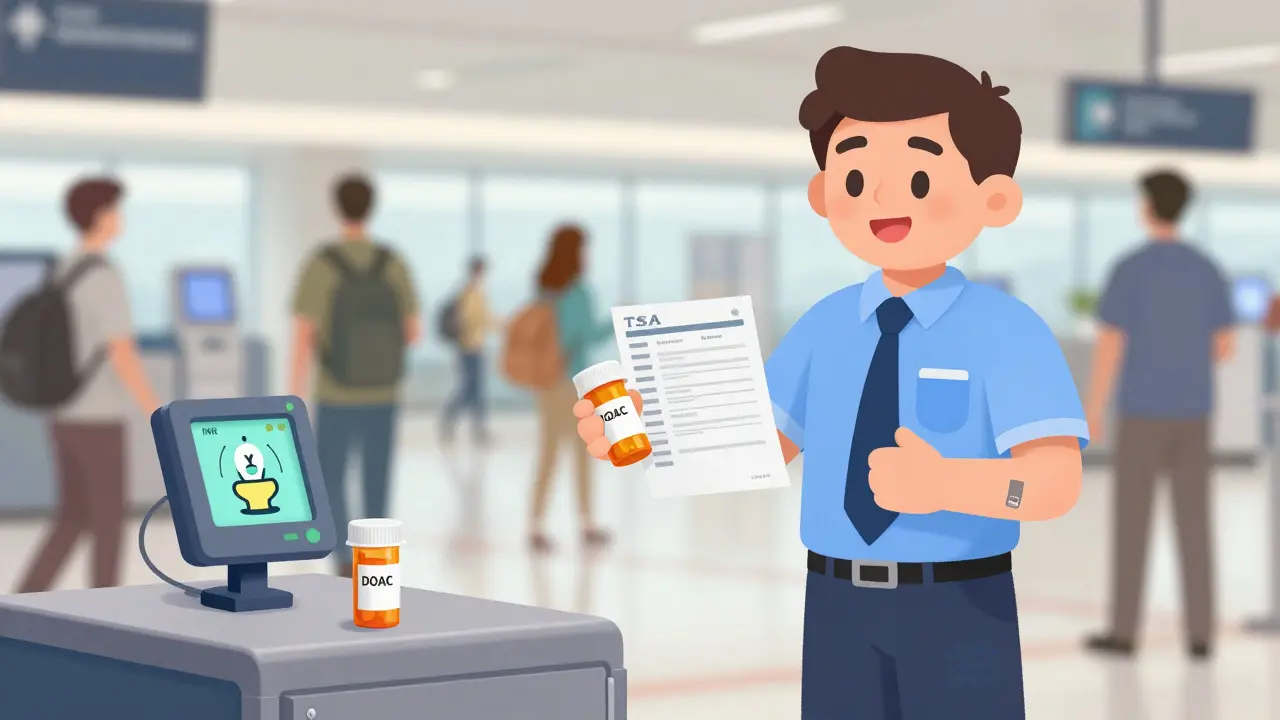
Don’t just throw your meds in your suitcase. Here’s what you need:- Original prescription bottles with your name and the doctor’s contact info
- A printed list of all your medications, doses, and why you take them
- Your most recent INR result (if on warfarin)
- A copy of your travel insurance and emergency contacts at your destination
- Compression stockings (15-30 mmHg pressure, below the knee)
- Water bottle (not alcohol or soda)
What to Do During Your Trip
Move every 2-3 hours. Walk the aisle on the plane. Stretch your legs at rest stops. Even small movements help. If you can’t get up, do seated calf exercises: lift your heels while keeping toes on the floor, then lift your toes while keeping heels down. Repeat 10 times every 30 minutes. Wear compression stockings. They’re not optional for high-risk travelers. They reduce swelling and improve circulation. Make sure they fit properly - too tight can cut off blood flow, too loose won’t help. Drink water. Dehydration makes your blood thicker. Avoid alcohol and sugary drinks. They dry you out and increase clot risk. Choose an aisle seat if you can. It’s easier to get up and move around.What to Watch For - Signs of Trouble
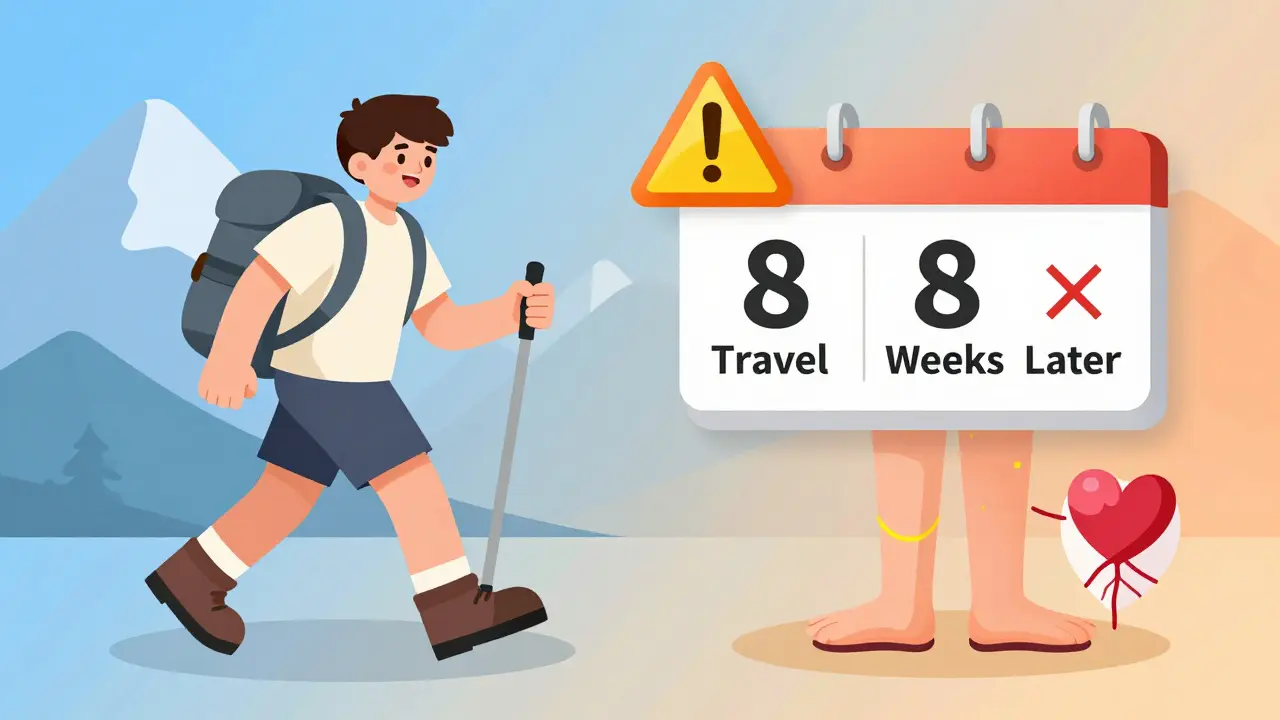
Clots don’t always show up during travel. They can develop up to eight weeks after you return. Know the warning signs:- Swelling, pain, or warmth in one leg (72% of DVT cases show this)
- Chest pain that gets worse when you breathe
- Sudden shortness of breath
- Unusual bruising or bleeding - gums, nose, urine, stool
DOACs vs. Warfarin: Which Is Better for Travel?
Here’s a quick comparison:| Feature | DOACs (e.g., Rivaroxaban, Apixaban) | Warfarin |
|---|---|---|
| Time to work | 2 hours | 4-5 days |
| Monitoring needed | No | Yes (INR tests) |
| Diet restrictions | Minimal | High (vitamin K foods) |
| Cost (30-day supply) | $575 (rivaroxaban) | $4 (warfarin) |
| Travel convenience | High (oral, no refrigeration) | Low (requires INR checks) |
When Can You Fly After a Blood Clot?
This is confusing because guidelines don’t all match. The IATA Medical Manual says you can fly once you’re asymptomatic and stable on anticoagulants. That’s it. No timeline. But Cambridge University Hospitals advises against long trips within four weeks of a DVT or PE. Dr. Susan Coogan from UT Physicians says: "If you’re still sore, still swollen, still tired - don’t fly. Wait until you feel normal again." Bottom line: If you had a clot recently, talk to your doctor. Don’t rely on airline policies. Your health comes first.What If You’re Traveling to a Country Without Your Meds?
This happens. DOACs aren’t available everywhere. If you’re going to a low-income country, check ahead. Call the embassy. Ask your pharmacy if they can ship extra pills. Bring at least a 20% surplus. If you run out, don’t skip doses. Call a local hospital or clinic. Bring your prescription and INR records. Many countries can prescribe warfarin even if they don’t stock DOACs.Final Advice: Don’t Panic. Just Prepare.
The absolute risk of a travel-related clot is low - about 1 in 4,656 flights for healthy people. But for someone with multiple risk factors, it jumps to 1 in 1,000. That’s why preparation matters. You don’t need to cancel your trip. You just need to be smart:- Take your meds on time - no skipping, even if you’re tired or jet-lagged
- Move often, even if it’s just ankle circles
- Drink water, not wine
- Wear compression stockings if you’re high-risk
- Know the signs of a clot and a bleed
- Carry your medical info
Can I fly if I just had a blood clot?
You can fly once you’re asymptomatic and stable on anticoagulants, according to IATA. But many doctors recommend waiting at least 4 weeks after a DVT or pulmonary embolism to reduce the risk of recurrence. If you’re still swollen, in pain, or short of breath, wait until you feel better. Always check with your doctor before flying after a clot.
Should I take aspirin before my flight to prevent clots?
No. The American College of Chest Physicians and other major guidelines strongly advise against using aspirin or adding extra anticoagulants for travel if you’re already on therapeutic blood thinners. Aspirin doesn’t prevent clots effectively in this group, and adding more medication increases your risk of dangerous bleeding. Stick to your prescribed dose and focus on movement and compression stockings.
Do I need to check my INR before traveling if I’m on warfarin?
Yes. Get your INR tested 1-2 weeks before departure. Your target range is usually 2.0-3.0 for atrial fibrillation, or 2.5-3.5 for mechanical heart valves. If your INR is too low, your blood is too thick. Too high, and you risk bleeding. If your INR is unstable or your trip is longer than two weeks, consider bringing a personal INR monitor like the Roche CoaguChek® Mobile.
Are compression stockings really necessary?
For high-risk travelers - those with a history of clots, recent surgery, cancer, or obesity - yes. Below-knee graduated compression stockings (15-30 mmHg pressure) are recommended by the CDC and ACCP. They help blood flow in your legs and reduce swelling. They’re not a substitute for movement, but they’re a proven, low-risk tool that works.
What if I’m on a DOAC and I can’t find my medication abroad?
Bring extra pills - at least 20% more than you need. Some countries don’t stock DOACs like apixaban or rivaroxaban. If you run out, contact a local hospital or clinic with your prescription and medical records. Warfarin is more widely available worldwide. Your doctor can help you switch temporarily if needed, but never stop your medication without guidance.
Can I drink alcohol while traveling on blood thinners?
Limit it. Alcohol dehydrates you, which thickens your blood and increases clot risk. It can also interfere with warfarin, making your INR unpredictable. If you drink, stick to one drink and drink plenty of water. Avoid binge drinking. Your goal is to stay hydrated, not intoxicated.
How long after travel can a clot still develop?
Up to eight weeks. Many people assume the risk ends when they land. But clots can form days or weeks after returning home. Watch for leg swelling, chest pain, or shortness of breath during this time. Don’t ignore symptoms just because you’re back home.
Is it safe to travel if I have cancer and am on blood thinners?
Yes - but with extra caution. Cancer increases clot risk significantly. You’re in the highest-risk group. Talk to your oncologist and hematologist before traveling. You may need additional precautions like compression stockings, more frequent movement, and possibly prophylactic anticoagulation. Never skip doses. Stay hydrated. Know the warning signs. Travel is possible, but it requires a detailed plan.


Janette Martens
i got my warfarin scrip from the VA n i just bring my coagchek everywhere. no way im flying without checkin my inr. also compression socks are a must. i wear mine even on road trips. dont be that guy who gets a pe in tokyo cause u thought u were invincible.
ps: why is everyone still usin warfarin? doac's are way easier.
December 29, 2025 AT 12:10
Marie-Pierre Gonzalez
Thank you for this comprehensive guide. As a nurse who travels frequently for work, I can attest that the advice here is not only accurate but life-saving. I always carry my medications in their original bottles, along with a printed summary from my physician. I also ensure I have a 20% surplus of DOACs-especially since I’ve been to countries where apixaban was unavailable. Hydration and movement are non-negotiable. I even set a timer on my phone to remind me to stretch every 90 minutes. Your post has validated my routine-and I hope others take it seriously.
December 30, 2025 AT 22:01
Louis Paré
lol at the whole 'don't change your meds' thing. if you're on warfarin and your INR is stable, you're basically a walking lab experiment. DOACs are the future. Why are we still clinging to 1950s medicine? Also, 'wear compression socks'-sure, if you're a 65-year-old with a history of clots. But for most people? It's just a fashion statement wrapped in pseudoscience. The real fix is not sitting still. Move. Or don't fly. Simple.
December 31, 2025 AT 05:42
Gran Badshah
bro i went to india last year on rivaroxaban and they didnt have it anywhere. had to go to a private hospital in delhi with my bottle and prescription. they gave me warfarin and told me to take it at 5mg daily. i was terrified but it worked. dont trust the internet, go to a doc in person. also, dont drink lassi with alcohol. that combo is death.
December 31, 2025 AT 23:44
James Hilton
So you're telling me I can't have a margarita in Cancun?
Thanks for the info, I guess. But honestly? If you're on blood thinners and you're scared to fly, maybe don't fly. Or just stay home and watch Netflix. I mean, what's the point of travel if you're just gonna be a walking medical checklist?
January 1, 2026 AT 16:12
ANA MARIE VALENZUELA
This post is dangerously incomplete. No mention of renal function? DOACs are cleared by kidneys. If you're over 70 and have CKD, you're playing Russian roulette. Also, 'drink water' is not advice-it's a platitude. Where's the data on hydration levels vs. clot risk? And why is no one talking about the fact that 78% of DVTs happen post-travel? This reads like a brochure from a pharmaceutical rep.
January 2, 2026 AT 13:23
Bradly Draper
I had a clot after a 12-hour flight last year. I didn't know anything until my leg swelled up like a balloon. This post saved me. I now wear socks, drink water, and move every hour. I even do toe curls in my seat. It's not glamorous, but it works. Thanks for the real talk.
January 4, 2026 AT 03:23
Payton Daily
Let me break this down for you like you're five.
1. Sitting = bad.
2. Blood = thickens.
3. Clots = bad.
4. Moving = good.
5. Water = good.
6. Alcohol = bad.
7. Socks = good.
8. Pills = take on time.
9. Don't be dumb.
That's it. The rest is just noise. If you can't remember this, maybe you shouldn't leave the house. Or at least don't fly. Stay in your basement. It's safer.
January 6, 2026 AT 02:22
Kelsey Youmans
Thank you for the meticulous and clinically sound guidance. As a physician who frequently advises patients on anticoagulant therapy, I commend the accuracy of the recommendations, particularly the emphasis on not altering medication regimens without consultation. The distinction between DOACs and warfarin is clearly articulated, and the inclusion of practical travel logistics-such as carrying original prescriptions and ensuring medication surplus-is invaluable. I will be sharing this resource with my patients. Travel is a privilege, and with proper preparation, it remains a safe one.
January 6, 2026 AT 05:54