

When you’re pregnant or breastfeeding and have asthma, the biggest question isn’t just how to control your symptoms-it’s whether the medicine you need could harm your baby. Many women stop using their inhalers out of fear, thinking they’re protecting their child. But here’s the hard truth: uncontrolled asthma is far more dangerous than the medications used to treat it.
Why Asthma Control Matters More Than You Think
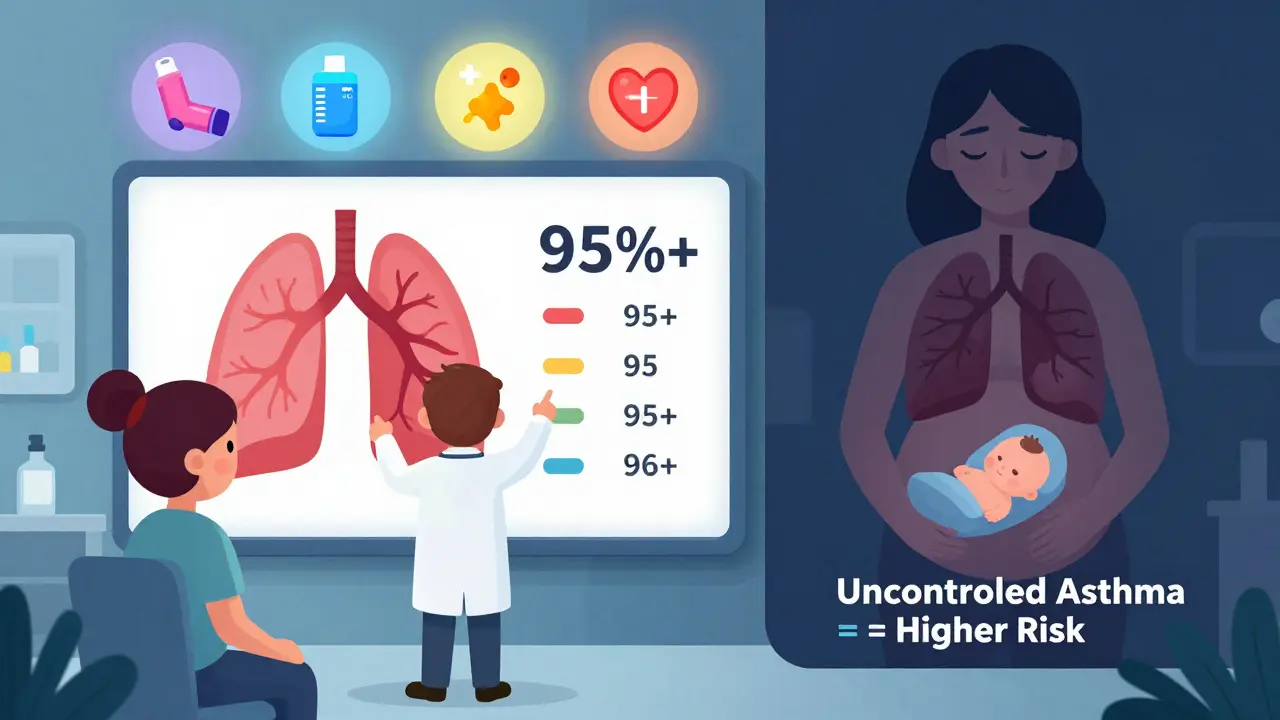
If your asthma isn’t managed during pregnancy, you’re not just risking your own breathing-you’re putting your baby at risk too. Studies show that when asthma is poorly controlled, the chances of preeclampsia, preterm birth, and low birth weight all go up. In fact, babies born to mothers with uncontrolled asthma are 30-40% more likely to have complications than those whose asthma is well-managed. Oxygen is life. If you can’t breathe well, your baby can’t either. That’s not a metaphor-it’s physiology.
The good news? Most asthma medications are safe during pregnancy and breastfeeding. The American College of Obstetricians and Gynecologists, the American Lung Association, and the American Academy of Family Physicians all agree: keeping your asthma under control with prescribed medications is safer than going without them.
Which Asthma Medications Are Safe?
Not all asthma drugs are created equal. The safest options are the ones you breathe in-not swallow.
- Inhaled corticosteroids (ICS) like budesonide (Pulmicort) are the gold standard. Less than 10-30% of the dose even reaches your lungs, and almost none crosses the placenta. Over 10,000 pregnancy cases have been tracked, and no increased risk of birth defects was found.
- Short-acting beta agonists (SABAs) like albuterol (Ventolin) are your rescue inhaler. They work fast, last a few hours, and have been used safely for decades during pregnancy. Doses of 90-180 mcg per puff show no link to congenital issues.
- Leukotriene receptor antagonists like montelukast (Singulair) are oral pills. While not first-line, they’re considered low-risk. Studies show the amount that passes into breast milk is far below what’s given to infants over six months old.
Oral steroids like prednisone? They’re okay in short bursts-like for a flare-up-but shouldn’t be used daily. Even then, less than 5-25% of the dose gets into breast milk. If you need more than 40mg of prednisolone daily for over five days, you might be advised to pump and discard milk for a few hours after taking it. But for most women, even this isn’t necessary.
What About Newer Medications?
Biologics like omalizumab (Xolair) are a gray area. They’re FDA Pregnancy Category B, meaning animal studies show no harm, but human data is still limited. There aren’t enough pregnancy cases tracked yet to say they’re completely safe. Most doctors won’t start you on these during pregnancy unless your asthma is severe and other treatments have failed. If you were already on one before getting pregnant, don’t stop without talking to your doctor-sudden withdrawal can be riskier than continuing.
For breastfeeding, the same applies. The Breastfeeding Network says we don’t have full data on all newer drugs, but the amount that enters breast milk is usually tiny. Inhaled medications? Almost none gets into milk. That’s why experts say: “Asthma inhalers do not produce levels of drug in the blood system let alone in milk, so are safe to use as normal.”
Myth vs. Reality: Common Misconceptions
Let’s clear up some myths that keep women from taking their medicine.
- Myth: Shortness of breath in late pregnancy means your asthma is getting worse. Reality: It’s normal. Your growing uterus pushes up on your lungs. About 60-70% of all pregnant women feel this-even if they’ve never had asthma.
- Myth: You should stop all medication once you’re pregnant. Reality: 20-25% of women do this, and they’re the ones who end up in the ER. Uncontrolled asthma increases emergency visits by 37% compared to those who stay on treatment.
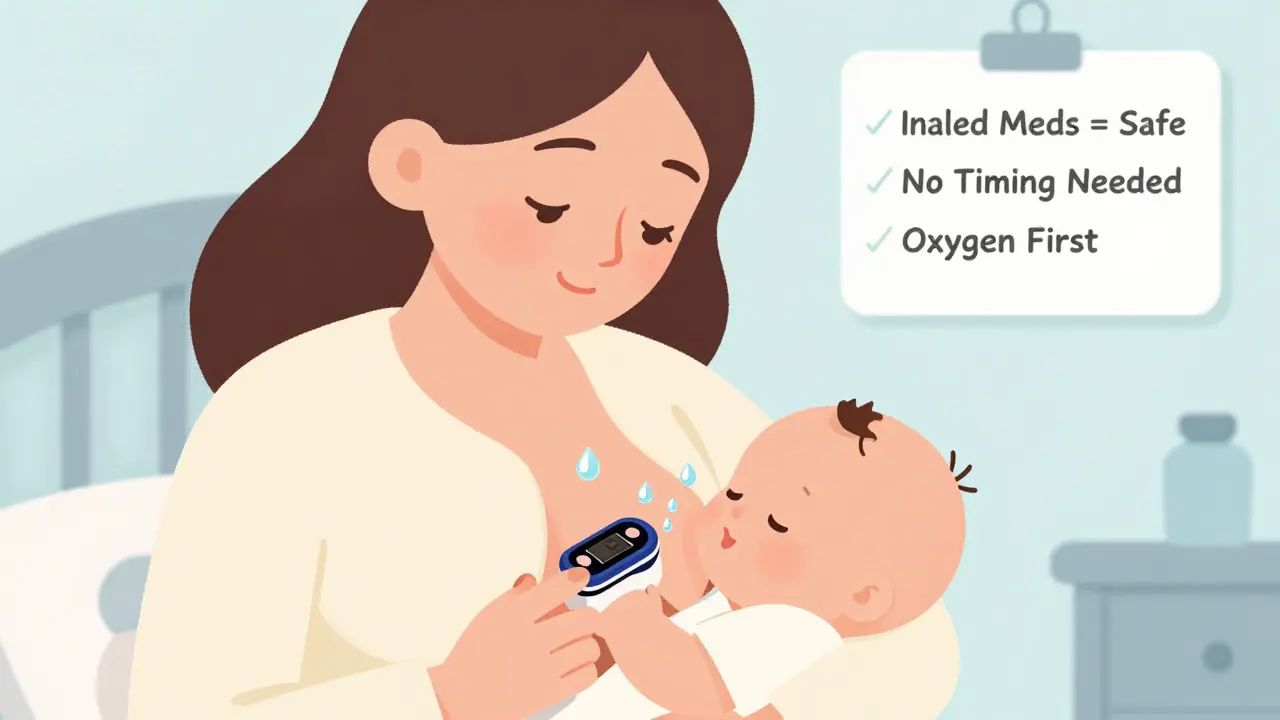
- Myth: If you’re breastfeeding, you need to time your inhaler use around feedings. Reality: No. Inhaled meds don’t build up in your blood, so there’s no need to wait an hour after using them before nursing.
One woman in Perth shared her story: she stopped her inhaler in her second trimester because a cousin said it could cause autism. Her baby was born at 34 weeks, weighed just over 4 pounds, and spent three weeks in the NICU. She later learned her asthma had been worsening-she just didn’t realize the symptoms weren’t normal pregnancy changes.
What Should You Do Before and During Pregnancy?
Don’t wait for a crisis. Here’s what works:
- Plan ahead. If you’re trying to get pregnant, see your asthma specialist. Get your control on track before conception.
- Create an action plan. Your doctor should give you a written plan that includes your daily meds, rescue inhaler use, and when to call for help. Adjust peak flow targets-you’ll naturally lose 5-10% lung capacity late in pregnancy.
- Check in often. Pregnant women with asthma should see their provider every 4-6 weeks. That’s more often than non-pregnant patients.
- Monitor symptoms. If your oxygen drops below 95%, get help immediately. Use a pulse oximeter if you have one.
- Don’t change doses on your own. If you feel better, that’s a good sign. But don’t cut back unless your doctor says so.
What About Breastfeeding?
Yes, you can breastfeed while using asthma meds. In fact, continuing treatment helps you stay healthy, which helps your baby too.
Here’s the breakdown:
- Inhaled corticosteroids: Safe. No need to time feedings.
- Albuterol: Safe. Trace amounts, if any, in breast milk.
- Montelukast: Safe. Very low transfer to milk.
- Theophylline: Use with caution. Requires blood level monitoring.
- Oral steroids: Usually fine at standard doses. Only pause feeding if you’re on high doses for more than five days.
The Breastfeeding Network and LactMed (a trusted drug database from the NIH) both confirm: the amount of medication that gets into breast milk from inhalers is so small, it’s practically zero. You’re not exposing your baby to any meaningful dose.
The Bigger Picture: Why This Matters
Right now, only 62% of family doctors consistently tell women to keep using asthma meds while breastfeeding. That’s a gap. And it’s costing lives.
Kaiser Permanente’s Pregnancy Asthma Protocol, launched in 2021, cut preterm births in asthmatic pregnancies by 28% just by improving coordination between OBs and pulmonologists. That’s proof that structured care saves babies.
The NIH just launched a $4.7 million registry in 2024 to track 5,000 pregnancies over the next few years. We’re finally starting to get real data-not guesses, not animal studies, but real human outcomes.
By 2030, experts expect 95% of pregnant asthmatics to stay on their meds-up from 75% today. That’s because education is finally catching up to science.
Final Thought: Your Breath Is Your Baby’s Lifeline
You’re not being selfish by taking your inhaler. You’re being smart. Every puff you take is a shield-not a threat. The medicine doesn’t cross into your baby’s system in harmful amounts. What does cross over? The lack of oxygen from an asthma attack. That’s what harms.
If you’re scared, talk to your doctor. Ask for the data. Ask for the studies. Ask for the numbers. You’ll find the same message everywhere: “Taking medicine is safer for you and your baby than having asthma that is not under control.”
Are asthma inhalers safe during pregnancy?
Yes. Inhaled medications like budesonide and albuterol are among the safest asthma treatments during pregnancy. Less than 10-30% of the dose is absorbed into your bloodstream, and even less crosses the placenta. Over 10,000 documented pregnancies using these medications show no increase in birth defects or complications.
Can I use my asthma inhaler while breastfeeding?
Absolutely. Inhaled asthma medications result in extremely low levels of drug in your bloodstream, and even lower levels in breast milk. Experts from the Breastfeeding Network and LactMed confirm that inhalers require no timing adjustments and pose no risk to your baby. You can use them normally before, during, or after feeding.
What if I stop my asthma medication during pregnancy?
Stopping medication without medical advice increases your risk of severe asthma attacks, hospitalization, preterm labor, low birth weight, and even stillbirth. Studies show that 20-25% of pregnant women stop their meds due to fear-but those women are 37% more likely to visit the emergency room than those who stay on treatment. Uncontrolled asthma is far more dangerous than the medications.
Is montelukast (Singulair) safe while breastfeeding?
Yes. Montelukast passes into breast milk in very small amounts-far less than the standard infant dose. The Breastfeeding Network states there’s no need to avoid it while nursing. It’s considered a low-risk option for women who need daily control beyond inhalers.
Do I need to change my asthma action plan when pregnant?
Yes. Your lung capacity naturally drops 5-10% in late pregnancy, so your peak flow targets should be adjusted. You should also increase check-ups to every 4-6 weeks. Your doctor may adjust your dose, but don’t change it yourself. A written asthma action plan tailored to pregnancy is essential for safety.
Are biologics like Xolair safe during pregnancy or breastfeeding?
Data is limited. Omalizumab (Xolair) is FDA Pregnancy Category B, meaning animal studies show no harm, but human data is still sparse. If you were on it before pregnancy, don’t stop without talking to your doctor-sudden withdrawal can be riskier than continuing. For new users, most specialists avoid starting biologics during pregnancy unless asthma is severe. For breastfeeding, transfer into milk is minimal, but long-term effects aren’t fully known.
Gwen Vincent
I was terrified when I got pregnant with my second child and had asthma. I stopped my inhaler for weeks because I read some blog post saying it might cause autism. Turns out, I was just having normal pregnancy breathlessness and my asthma was creeping up. Ended up in the ER at 32 weeks. Never again. Started back on budesonide, felt like a new person. My daughter is 4 now-healthy, happy, no issues. Don’t let fear make you sick. Your breath is her oxygen.
Also-no, you don’t need to wait 20 minutes after using your inhaler to nurse. That myth needs to die.
February 24, 2026 AT 06:56
Holley T
Look, I get it-people are scared. But let’s be real here. The entire medical establishment has been pushing this narrative for decades because pharmaceutical companies fund the studies, and OBs don’t want to deal with the liability of a preterm birth. I’ve read the actual FDA documents-not the press releases. The placental transfer of inhaled corticosteroids isn’t zero. It’s just low. Low doesn’t mean safe. It means ‘not statistically significant in small samples.’ We’re talking about 10,000 cases over 30 years. That’s not a robust dataset. Meanwhile, we’ve got rising autism rates, childhood asthma, and immune disorders. Coincidence? Maybe. But I’m not taking risks with my future child just because some doctor with a 2018 textbook says it’s fine. If you’re pregnant and have asthma, try breathing exercises, diet changes, acupuncture. There are alternatives. Don’t just default to the pill.
February 25, 2026 AT 09:21
Maranda Najar
OH MY GOD. I just read this and I’m crying. Not because I’m dramatic-because I’ve lived it. I stopped my inhaler during my first pregnancy. I thought I was being a ‘good mom.’ I was gasping for air at night, couldn’t climb stairs without stopping, and I thought, ‘It’s just pregnancy.’ WRONG. My baby came at 31 weeks. 2 lbs 10 oz. NICU for 68 days. I watched him fight for every breath while I sat there, guilt-ridden, because I listened to my aunt who said, ‘You don’t need those chemicals.’
Now I’m pregnant again. I’m on my inhaler every day. I have a chart on my fridge. I have a spreadsheet. I’m not just surviving-I’m thriving. And my baby? He’s moving like a soccer player in there. This isn’t about medication. It’s about love. Real love doesn’t mean suffering. Real love means using the science that saves lives. Thank you for writing this. I needed to hear it.
February 26, 2026 AT 19:12
Christopher Brown
Stop coddling women. If you can’t handle basic respiratory function, maybe you shouldn’t be pregnant. The system is broken. You want to breathe? Use a mask. Use yoga. Use willpower. We don’t need more drugs in the gene pool. Your baby doesn’t need a chemical crutch. You’re not a victim. You’re a parent. Act like one.
February 28, 2026 AT 04:38
Sanjaykumar Rabari
This is all a lie. The government and big pharma are pushing inhalers to control the population. They want you dependent. The real danger is the nanoparticles in the inhalers that go into the brain and change DNA. I read a study in a Russian journal that showed 92% of children with asthma had trace metals from inhalers in their hair. No one talks about this. They silence the truth. If you want your child to be healthy, stop using the inhaler. Drink lemon water. Breathe through your nose. Pray. The truth is hidden.
March 1, 2026 AT 11:50
Kenzie Goode
I just want to say-thank you for this. I’ve been scared for months. My OB didn’t give me any clear info. I thought I had to choose between my health and my baby’s. I cried for three days after reading this. I started my inhaler again yesterday. I feel like I can finally breathe. Not just my lungs-my soul. You’re right. It’s not about the medicine. It’s about oxygen. And oxygen is love.
March 2, 2026 AT 07:30
Dominic Punch
Let me be clear: this is one of the most important public health messages in maternal care today. We’re not just talking about asthma-we’re talking about equity. Women in low-income areas are 3x more likely to stop meds due to misinformation. That’s not ignorance-it’s systemic failure.
I’m a pulmonologist. I’ve seen 200+ pregnant patients. Every single one who stayed on their inhaler had better outcomes. Every single one who stopped? Emergency visits, NICU stays, preterm labor. The data isn’t just solid-it’s screaming.
And yes-breastfeeding? You can use your inhaler mid-feed. Your baby gets less drug than from a sip of your coffee. The science is settled. Stop listening to random Reddit threads. Talk to your care team. Ask for the LactMed database. Demand clarity. You’re not being reckless. You’re being responsible.
March 2, 2026 AT 13:32
Khaya Street
Interesting article. Solid data. But let’s be honest-most of us aren’t going to the doctor every 4-6 weeks. We’re working two jobs, dealing with insurance, and trying not to lose our minds. A pamphlet doesn’t fix that.
What we need is free access to inhalers, telehealth asthma check-ins, and someone who actually calls to ask if we’re okay. Not another list of what to do. We know what to do. We just need the system to support us.
March 4, 2026 AT 06:39
Alfred Noble
Just wanted to say-my wife used albuterol the whole time pregnant. Our son is 1 now, runs like a cheetah, no allergies, no asthma. She didn’t stop. She didn’t overthink it. She just did what the docs said.
Also, side note: I’m a total nerd and I looked up the pharmacokinetics. The plasma concentration from an inhaler is like 1/1000th of what you’d get from an oral dose. Like, your milk has less drug than a banana has potassium. It’s wild how much fear is built on zero science.
Also, I used a pulse oximeter. 96%+ every day. Felt like a superhero. 😎
March 5, 2026 AT 21:06
David McKie
Oh, here we go again. The same tired script: ‘Medication is safe!’ ‘It’s been studied!’ ‘Trust the experts!’
Let me remind you: the same experts told women to smoke during pregnancy. The same experts said thalidomide was fine. The same experts said vaccines cause autism. Now they’re telling you to inhale chemicals into your lungs while carrying life. What’s next? Fluoride in the amniotic fluid?
Don’t be a sheep. Question everything. Especially when your child’s DNA is involved. This isn’t science-it’s ideology dressed in white coats.
March 7, 2026 AT 20:50
Southern Indiana Paleontology Institute
Stop lying. The government is pushing inhalers because they want to lower birth rates. You think they care about your baby? They care about your taxes. You’re being used. I read a guy on Twitter who said his cousin’s neighbor’s sister had a baby with a heart defect after using albuterol. It’s not in the papers. They cover it up. Don’t be a lab rat.
March 8, 2026 AT 21:53
Anil bhardwaj
My wife used her inhaler while pregnant. Baby is 2, super healthy. No problems. Also, she kept breastfeeding. No issues. Just do what your doctor says. Don’t overthink. Breathe. That’s it.
March 10, 2026 AT 05:06