
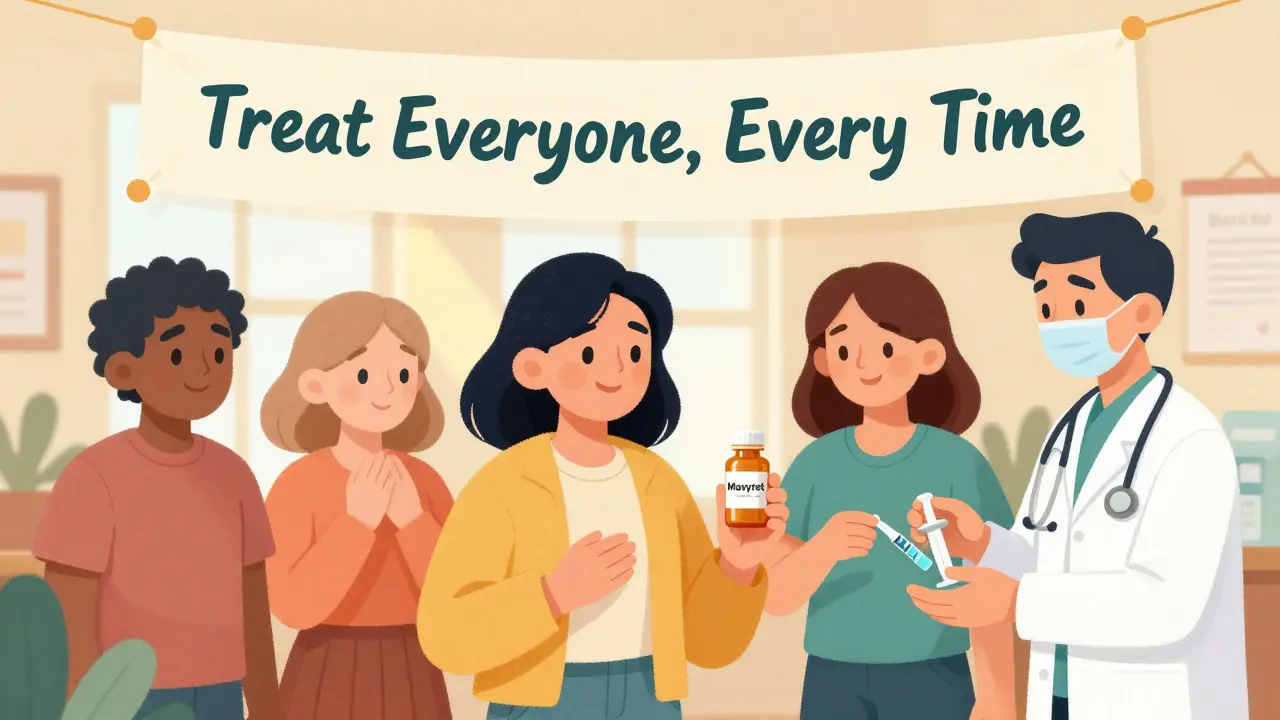
When you hear that hepatitis C can be cured in just 8 to 12 weeks, it sounds almost too good to be true. And for many, it is. But for others-especially people who still inject drugs, use methamphetamine, or live in unstable housing-getting cured is only the beginning. The real challenge? Staying cured. HCV reinfection isn’t rare. It’s happening right now, in cities and towns across the world, and it’s not because the drugs don’t work. It’s because the system hasn’t caught up.
Why HCV Keeps Coming Back
The hepatitis C virus (HCV) is no longer the death sentence it once was. Since direct-acting antivirals (DAAs) arrived in 2014, cure rates have jumped from under 50% to over 95%. Drugs like glecaprevir/pibrentasvir (Mavyret) and sofosbuvir/velpatasvir (Epclusa) wipe out the virus in most people, with few side effects and no needles involved. But cure doesn’t mean immunity. You can get HCV again-even after you’ve been cured. Reinfection happens fastest in the first six months after treatment. The risk is highest among people under 30, those who still inject drugs, and people using methamphetamine. Studies show injecting drug users are more than three times as likely to get reinfected compared to those who don’t. And it’s not just about sharing needles. Contaminated cookers, filters, or even water can spread the virus. In some places, up to 40% of people who were cured of HCV end up infected again within two years.Retreatment Works-If You Can Get It
Here’s the good news: if you get reinfected, you can be cured again. Just like the first time. The same drugs that worked before work again. The CDC, WHO, and leading liver specialists all agree: treat everyone, every time. No judgment. No waiting. No "you should’ve quit drugs first" rules. For most reinfections, an 8-week course of glecaprevir/pibrentasvir is the go-to. It’s simple, effective, and well-tolerated. If you had a relapse-meaning the virus came back after treatment-doctors might add ribavirin or switch to sofosbuvir/velpatasvir/voxilaprevir (SOF/VEL/VOX) for 12 weeks. Resistance testing is only needed for relapses, not reinfections. That’s important: if you got HCV again because you were exposed to the virus, you don’t need fancy tests. Just treat it. And now, there’s a new option. In June 2025, the FDA approved Mavyret specifically for acute HCV infection-the first DAA ever approved for early-stage disease. In trials, it cured 96% of people in just 8 weeks. For someone who just got infected, this means faster, simpler care. Even shorter treatments are being tested. The PURGE-C trial found that 4 weeks of glecaprevir/pibrentasvir cured 84% of people with very new HCV infections. That’s not quite as good as 8 weeks, but for someone who can’t make it back for follow-up visits, it’s life-changing. And here’s the kicker: if the 4-week treatment didn’t work, they could still be cured with a full 8-week course later. No damage done.Harm Reduction Isn’t Optional-It’s Essential
You can’t cure your way out of an epidemic if the conditions that spread the virus are still there. That’s why harm reduction isn’t a side note-it’s the backbone of real progress. Needle and syringe programs (NSPs) that give out at least 200 clean needles per person per year cut HCV transmission by more than half. Methadone and buprenorphine (opioid agonist therapy) reduce new infections by 50%. These aren’t just "nice to have" services. They’re proven, cost-effective, and life-saving. Yet, in many places, people are turned away from HCV treatment because they’re still using drugs. A 2024 survey of over 1,200 people who inject drugs found 68% had been denied care because of their drug use. That’s not just cruel-it’s counterproductive. Every time someone is denied treatment, the virus spreads further. The best results come from integrated care. In Boston, clinics that offered HCV treatment the same day as opioid agonist therapy saw 82% of patients stick with treatment. In San Francisco, people who had to jump between addiction clinics and liver specialists often dropped out. When care is split, people fall through the cracks.
What Comes After the Cure
Getting cured doesn’t mean you’re done. Your immune system doesn’t bounce back fully. Studies show T-cells-your body’s virus-fighting soldiers-stay partially exhausted even after the virus is gone. That’s why you’re still vulnerable to reinfection. Your body doesn’t remember how to fight HCV the way it does with vaccines like hepatitis B or measles. That’s why surveillance matters. If you’re at risk, get tested every 3 months for the first 6 months after treatment. A simple blood test for HCV RNA can catch reinfection early. And if it comes back, treat it again. No stigma. No delay. Also, don’t forget hepatitis B. Before starting any HCV treatment, you must be tested for HBV. If you have both, treating HCV can trigger a dangerous flare-up of hepatitis B. Between 2019 and 2024, the FDA recorded 12 cases of HBV reactivation linked to DAA treatment. It’s rare, but it’s preventable.The Big Picture: Can We Really Eliminate HCV?
The World Health Organization wants to eliminate HCV as a public health threat by 2030. That means cutting new infections by 90% and reducing deaths by 65%. Right now, 58 million people live with HCV. About 1.5 million get infected every year. The tools are here. We have the drugs. We have the harm reduction strategies. We have the data. But only 38% of countries offer needle programs at the level needed. In the U.S., only 32 states now allow same-day HCV treatment for people who inject drugs. The rest still require sobriety, housing, or paperwork before care. The math is simple: if we treat fewer than 15% of eligible people each year and don’t expand needle programs to cover over 60% of people who inject drugs, we won’t hit the 2030 goal. And if we keep turning people away because of their drug use, we’re not just failing them-we’re letting the virus spread.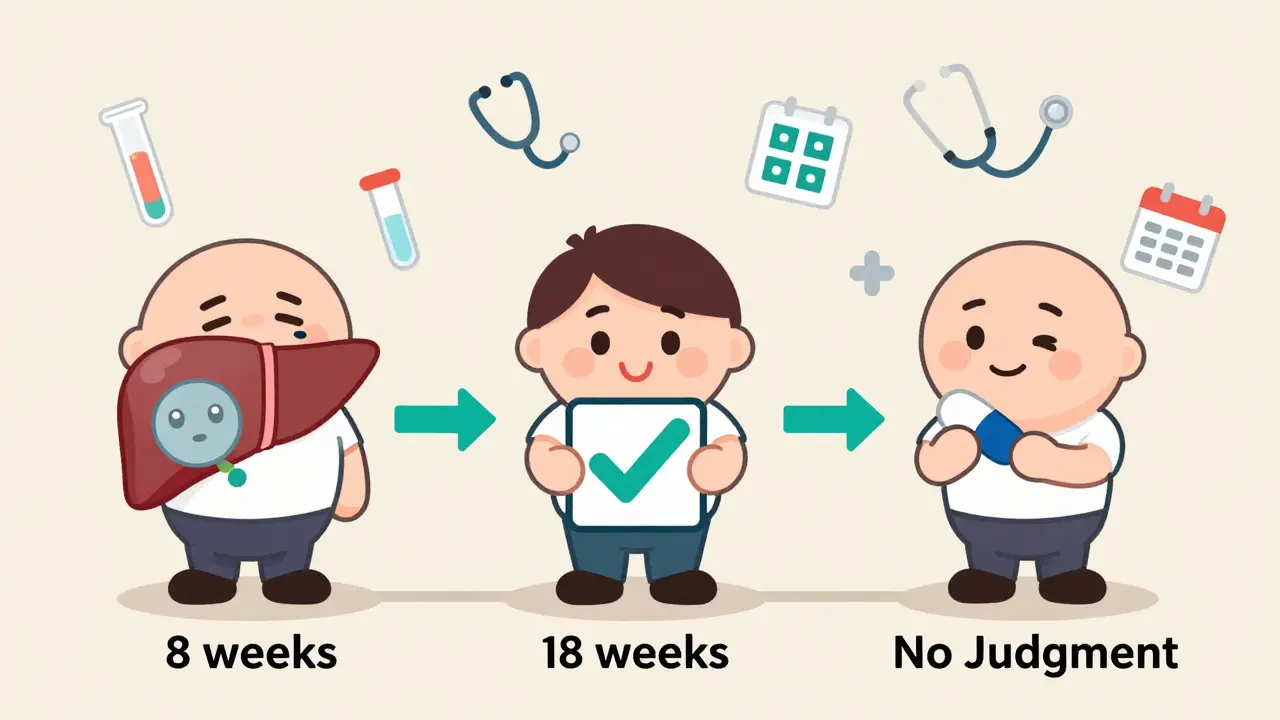
What You Can Do
If you’ve been cured of HCV and still use drugs:- Get tested every 3 months for the first 6 months after treatment.
- Use clean needles every time. If you can’t access a needle program, never reuse or share.
- Ask for opioid agonist therapy if you use opioids. It helps your liver and your life.
- If you get HCV again, don’t give up. Treat it again. It still works.
- Treat everyone, every time. No exceptions.
- Offer same-day HCV treatment. Don’t wait for sobriety.
- Co-locate HCV care with addiction services. One stop. One team.
- Don’t ask about drug use before offering treatment. Just offer it.
Hilary Miller
Just got cured last year. Tested every 3 months like they said. No drama. No shame. Just clean needles and a little luck. 🙌
January 21, 2026 AT 22:34
Daphne Mallari - Tolentino
It is profoundly disconcerting to observe the persistent conflation of medical intervention with moral judgment in public health discourse. The assertion that harm reduction is ‘essential’ is not merely pragmatic-it is ethically non-negotiable. To condition care upon behavioral conformity is to perpetuate the very structural inequities that precipitate viral transmission in the first instance.
Furthermore, the notion that reinfection constitutes a ‘failure’ is a linguistic artifact of a punitive paradigm, one that pathologizes vulnerability rather than addressing systemic failure. The efficacy of DAAs is not diminished by the persistence of social determinants; rather, their deployment without access guarantees is an act of medical performative allyship.
One must interrogate the institutional inertia that permits only 32 U.S. states to offer same-day treatment. This is not a gap in logistics-it is a moral deficit. The WHO targets are not aspirational; they are minimal. We are not falling short of a goal. We are failing a covenant.
And yet, the most disturbing element remains the silence of those who benefit from the system: clinicians who refer patients to ‘recovery programs’ before treatment, administrators who require housing verification before prescribing Mavyret, policymakers who equate substance use with moral failure.
There is no ‘they’ in this epidemic. There is only us-those who have the power to act, and those who have been made to believe they do not deserve to be saved.
January 22, 2026 AT 12:14
Kenji Gaerlan
bro why are we even treating people who still shoot up? like… if they’re gonna do drugs anyway why waste the meds? just let ‘em get it again. save the cash for people who actually care.
January 22, 2026 AT 23:16
Oren Prettyman
While I appreciate the author’s apparent enthusiasm for the pharmacological advancements in HCV management, one must critically examine the underlying epistemological assumptions embedded within this narrative. The conflation of biomedical efficacy with social policy is not merely an oversight-it is a fundamental category error.
Direct-acting antivirals, while statistically remarkable, do not address the ontological condition of addiction. To treat reinfection as a purely medical phenomenon is to reify the disease model of substance use disorder while simultaneously ignoring the sociopolitical architecture that renders individuals vulnerable to viral exposure. One cannot cure a systemic failure with a pill.
Moreover, the assertion that ‘treat everyone, every time’ constitutes ethical care ignores the principle of medical stewardship. Resources are finite. The allocation of expensive therapeutics to populations with high reinfection rates, absent concurrent structural interventions, constitutes a form of distributive injustice that disproportionately disadvantages those who are abstinent and compliant.
Furthermore, the dismissal of sobriety as a prerequisite for treatment is not progressive-it is reckless. The absence of behavioral modification undermines the very notion of therapeutic adherence. If a patient is unable or unwilling to mitigate their risk behaviors, how can one claim they are ‘engaged’ in their own care?
It is not cruelty to demand accountability. It is responsibility. To treat without expectation of change is not compassion-it is enabling. And enabling, in the long run, is the most insidious form of abandonment.
January 24, 2026 AT 00:28
Keith Helm
As a physician with 17 years in infectious disease, I must emphasize: the data is unequivocal. Denial of HCV treatment based on active drug use is not only unethical-it violates the Geneva Conventions on medical neutrality. I have treated over 400 patients with active injection use. Cure rates are identical to those of abstinent patients. Reinfection rates are predictable, manageable, and reversible. The only variable that matters is access.
The notion that harm reduction is ‘optional’ is a myth propagated by those who have never stood in a clinic where a 22-year-old comes in with a positive HCV RNA and no place to sleep. We don’t need more studies. We need more pharmacies. More syringe exchanges. More staff. More courage.
I have seen patients cured three times. Each time, they came back. Not because they didn’t care. Because they were told they didn’t deserve it.
Stop asking if they’re ready. Start asking if we are.
January 25, 2026 AT 10:36
arun mehta
From India, where needle exchange programs are still illegal in most states… this article is a light in the dark. 🌟 We have 3 million HCV cases here, and less than 5% are even tested. No one talks about this. No one funds this.
But I’ve seen it-my cousin got cured, then got it again. He was ashamed. He didn’t go back. We need clinics that don’t judge. We need doctors who say, ‘Come back when you’re ready,’ not ‘Come back when you’re clean.’
Thank you for writing this. I’m sharing it with every NGO I know. 🙏
January 25, 2026 AT 16:15
Chiraghuddin Qureshi
Bro, I’m from Delhi and we don’t even have clean needles in most neighborhoods. But I saw a guy get cured twice. He said the third time, the clinic just gave him the pills and a box of syringes. No lecture. No form. Just ‘here, come back in 3 months.’
That’s the kind of care we need. 🇮🇳❤️
January 25, 2026 AT 22:33
Jasmine Bryant
Wait-so if you get reinfected and treat it again, does your liver get damaged over time from multiple rounds of DAAs? I’ve read conflicting stuff about fibrosis progression in reinfections. Also, does ribavirin still have a role in reinfections or is it just for relapses? Asking because my friend got cured, used again, and now they’re saying ‘we’ll wait and see’…
January 26, 2026 AT 00:46