
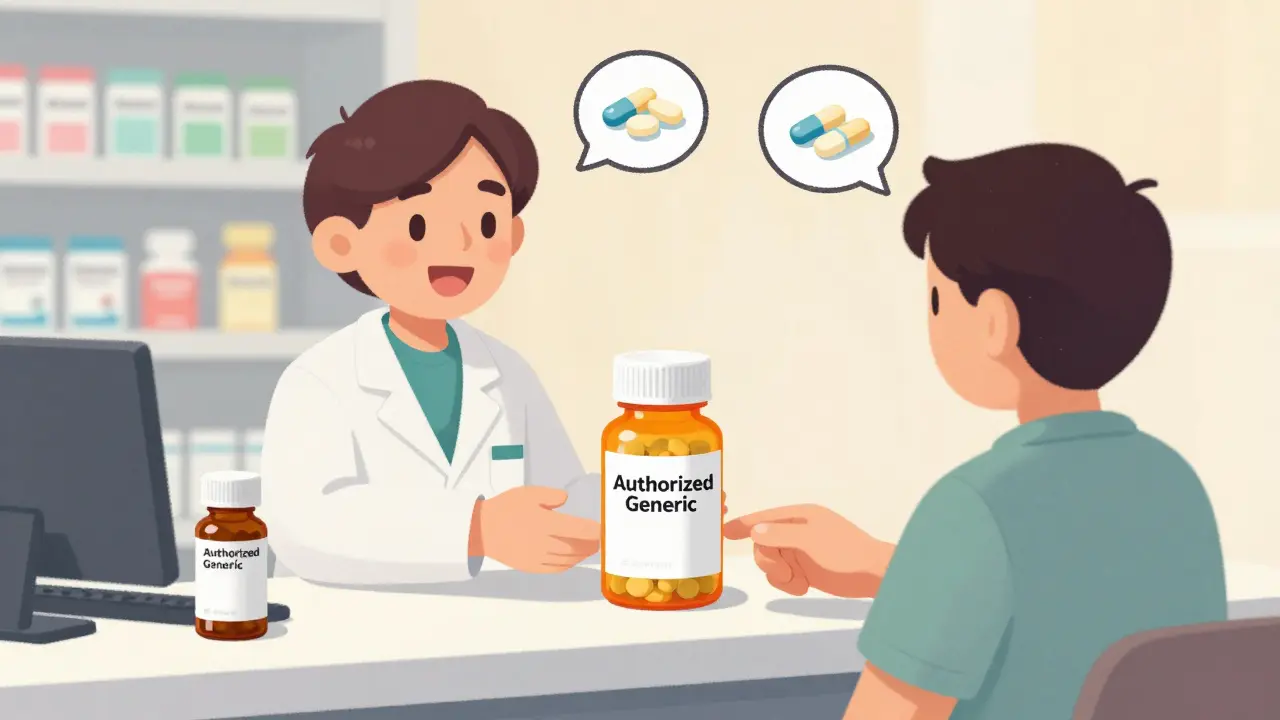
When you pick up a prescription, you might see a different name on the bottle than what your doctor wrote. That’s not a mistake. It could be an authorized generic-and it’s not the same as the generic you’ve probably used before. Many people don’t realize there are two kinds of generics, and the difference matters more than you think.
What Is an Authorized Generic?
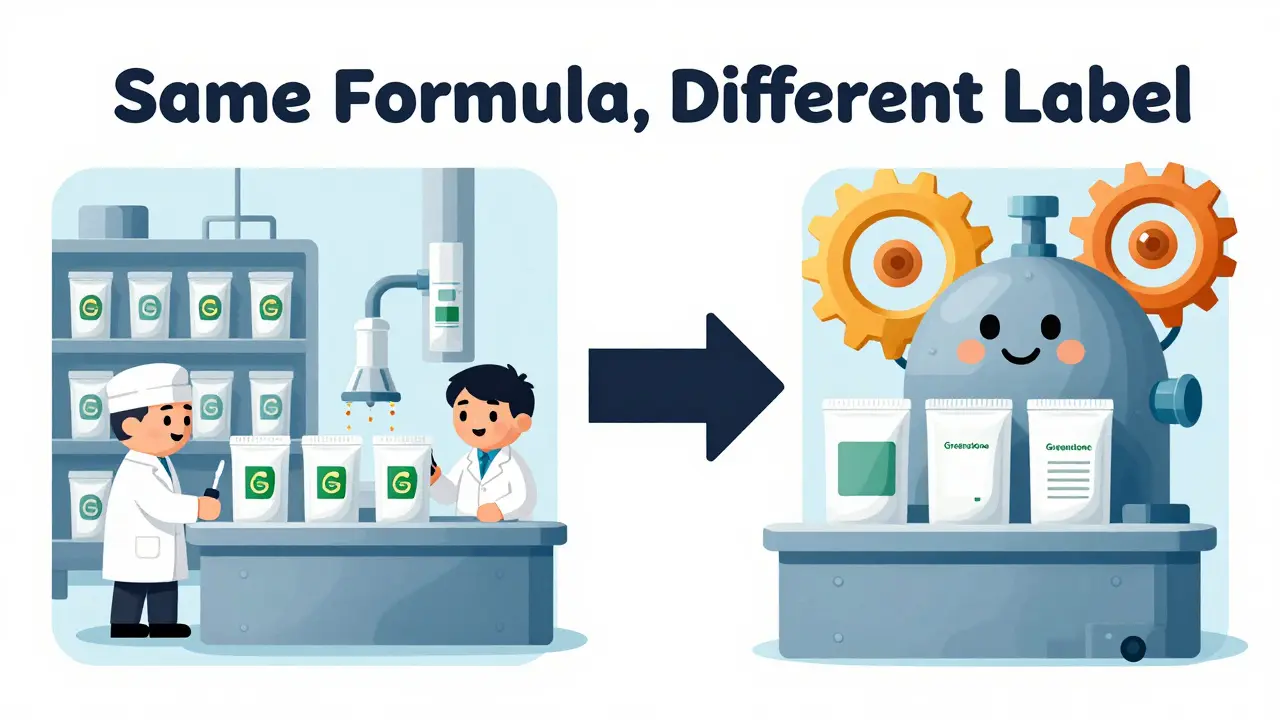
An authorized generic is the exact same drug as the brand-name version, just sold without the brand name on the label. The FDA defines it clearly: it’s the same active ingredients, same inactive ingredients, same manufacturing process, same quality controls, and same packaging-except the brand name is removed. It’s like buying a Coca-Cola in a plain bottle instead of the red can. The drink hasn’t changed at all.
This isn’t a copy. It’s the original product, made by the same company that made the brand-name drug. Sometimes, the brand company makes it themselves. Other times, they license a third party like Greenstone LLC (a Pfizer subsidiary) or Prasco Laboratories to produce and sell it under a different label. These companies don’t develop new drugs. They just package the exact same formula under a cheaper name.
The FDA doesn’t require any new approval for authorized generics. Why? Because they’re not new. They’re already approved under the brand’s original New Drug Application (NDA). That means no extra testing, no bioequivalence studies, no waiting. As soon as the brand decides to sell it as a generic, it hits the market.
How Traditional Generics Work
Traditional generics, the kind most people think of, follow a different path. They’re made by other companies that want to sell the same drug after the brand’s patent expires. To do this legally, they must file an Abbreviated New Drug Application (ANDA) with the FDA. This process requires proof that their version works the same way in the body as the brand-name drug.
That proof comes from bioequivalence studies. The generic must deliver the same amount of active ingredient into the bloodstream at the same rate as the brand. It’s not enough to have the same chemical name. The body has to absorb it the same way. That’s why traditional generics can have different fillers, dyes, or coatings. These inactive ingredients can vary, and sometimes they affect how the drug works for certain people.
Traditional generics are listed in the FDA’s Orange Book, which tracks which drugs are considered therapeutically equivalent. Authorized generics? They’re not in there. Because they’re not a separate product-they’re the brand drug in disguise.
The Key Differences
Here’s the real breakdown:
- Ingredients: Authorized generics have identical active and inactive ingredients as the brand. Traditional generics only need the same active ingredient-inactive ingredients can differ.
- Approval: Authorized generics use the brand’s original FDA approval. Traditional generics must get their own ANDA approval.
- Testing: Authorized generics require no bioequivalence testing. Traditional generics must prove they work the same way in the body.
- Market Entry: Authorized generics can launch anytime after patent expiration. Traditional generics often wait for a 180-day exclusivity period granted to the first filer who challenges the patent.
- Visibility: Traditional generics appear in the FDA’s Orange Book. Authorized generics do not.
Think of it this way: if the brand-name drug is a car model, the authorized generic is that same car with a different sticker on the hood. The traditional generic is a different car that looks similar and drives the same-but it might have a slightly different engine part or seat fabric.
Why It Matters for Patients
Some people have bad reactions to traditional generics-not because the active drug changed, but because of the fillers or dyes. For example, someone allergic to a specific dye used in a generic version of a blood pressure pill might feel dizzy or break out in a rash. When they switch to the authorized generic, the symptoms disappear. Why? Because the authorized version uses the exact same inactive ingredients as the brand.
A 2022 survey by the National Community Pharmacists Association found that 67% of independent pharmacists said patients specifically ask for authorized generics when they’re available. They’re not asking because they’re smarter about drug labels. They’re asking because they’ve had bad experiences with other generics.
But here’s the catch: most people can’t tell the difference. A GoodRx study showed 78% of patients couldn’t tell an authorized generic from a traditional one just by looking at the pill or bottle. That’s partly because pharmacies often don’t explain it. And insurance companies? Sometimes they treat authorized generics like brand-name drugs. That means higher copays-even though the drug is identical.
How to Spot an Authorized Generic
It’s not always obvious. But there are clues:
- Check the manufacturer name on the bottle. If it’s the same company that makes the brand-name drug (like Pfizer, Novartis, or Merck), it’s likely an authorized generic.
- Look for names like Greenstone, Prasco, or Patriot Pharmaceuticals. These are major distributors of authorized generics.
- Ask your pharmacist: “Is this the same as the brand?” If they say yes, and it’s cheaper, it’s probably authorized.
- Check the FDA’s List of Authorized Generic Drugs (updated monthly). You can search by brand name or active ingredient.
Not every drug has an authorized generic. It’s up to the brand company to decide whether to offer one. In 2023, there were 1,872 authorized generic products available in the U.S., covering 467 different active ingredients. That’s a lot-but still less than half of all brand-name drugs.
Why Do Brand Companies Make Authorized Generics?
It seems odd. Why would a company that just spent billions developing a drug turn around and sell a cheaper version of it?
Two reasons:
- They protect their market. If they don’t launch an authorized generic, a traditional generic maker will. And that traditional generic might get 180 days of exclusive sales, cutting into profits. By launching their own generic, they capture the market before competitors can.
- They make more money. Authorized generics are still profitable. They cost less to produce than the branded version, but they’re sold at a discount. Many patients and insurers prefer them over the brand. And because they’re made by the same company, there’s no risk of quality issues.
But this strategy has critics. Some generic manufacturers say brand companies use authorized generics to block competition. If the first company to file for a traditional generic expects 180 days of exclusivity, but the brand drops its own generic at the same time, that exclusivity becomes worthless. A 2022 Health Affairs study found that in 38.5% of cases, authorized generics launched alongside traditional ones-exactly when the law was meant to reward innovation.
What This Means for You
If you’re on a medication that’s become generic, ask your pharmacist: “Is this an authorized generic?” If it is, you’re getting the exact same drug as the brand-just at a lower price. No trade-offs. No guesswork.
Don’t assume all generics are the same. If you’ve ever had side effects from a generic, or if your insurance keeps changing your drug, ask about the authorized version. It might be the solution.
The bottom line? Authorized generics aren’t a loophole. They’re a direct extension of the brand drug. And for patients who need consistency, they’re often the best option.
Are authorized generics as safe as brand-name drugs?
Yes. Authorized generics are made by the same company, in the same facility, with the same ingredients and quality controls as the brand-name drug. The only difference is the label. The FDA considers them therapeutically equivalent, even for drugs with no other generic versions available.
Why aren’t authorized generics listed in the FDA’s Orange Book?
The Orange Book only lists drugs approved under the Abbreviated New Drug Application (ANDA) process. Authorized generics are marketed under the original brand’s New Drug Application (NDA), so they’re not required to be listed. This is a regulatory distinction, not a quality one.
Can I request an authorized generic from my pharmacy?
Yes. You can ask your pharmacist to fill your prescription with an authorized generic if it’s available. Some pharmacies automatically substitute with traditional generics, so you may need to specifically request the authorized version. Your doctor can also write "Do Not Substitute" on the prescription if you prefer the brand or authorized version.
Do insurance plans cover authorized generics the same as traditional generics?
Not always. Some pharmacy benefit managers (PBMs) classify authorized generics as brand-name drugs, which can lead to higher copays. Others treat them like traditional generics. Always check your plan’s formulary, and ask your pharmacist if your insurance is charging you more than it should for an authorized generic.
How do I know if my drug has an authorized generic?
Check the FDA’s official List of Authorized Generic Drugs, updated monthly. You can search by brand name or active ingredient. You can also ask your pharmacist or use tools like GoodRx, which sometimes flag authorized generics in their price comparisons.
Annie Joyce
I had no idea authorized generics were just the brand drug in a plain bottle. My mom switched to one for her blood pressure med last year after she broke out in hives from the regular generic. Poof. Symptoms gone. I thought it was a coincidence until I read this. Now I always ask the pharmacist, 'Is this the real deal?' And yeah, it's usually cheaper too. Mind blown.
Pharmacies don't tell you this stuff. They just slap on whatever's cheapest. But if you're sensitive to dyes or fillers? This is a game-changer.
February 12, 2026 AT 09:20
Luke Trouten
The distinction between authorized and traditional generics is not merely regulatory-it is ontological. An authorized generic is not a substitute; it is a rebranding of the original product under a different label, maintaining identical composition and manufacturing parameters. This challenges the conventional assumption that 'generic' implies 'different.' The FDA's decision to exclude authorized generics from the Orange Book reflects a legal taxonomy, not a therapeutic one. One might argue this creates a paradox: a drug that is therapeutically equivalent yet not formally classified as such. The ethical implications for patient autonomy and informed consent are profound.
February 13, 2026 AT 08:12
Kristin Jarecki
Thank you for this exceptionally clear breakdown. As a pharmacist with over 18 years of experience, I can confirm that authorized generics are indeed the gold standard for patients who require consistency in medication. We frequently encounter patients who report adverse reactions to traditional generics due to excipients-such as lactose, dyes, or preservatives-which vary between manufacturers. Authorized generics eliminate this variable entirely. I encourage all prescribers and patients to request them when available. Insurance formularies often misclassify them as brand-name drugs, resulting in unnecessarily higher out-of-pocket costs. Always verify with your pharmacy benefit manager.
February 14, 2026 AT 12:09
Jonathan Noe
Okay, let me break this down like I’m explaining it to my cousin who thinks ‘generic’ means ‘cheap knockoff.’ Authorized generic? It’s literally the same pill, same factory, same everything-just no logo. Like buying a Nike shoe without the swoosh. Traditional generic? That’s some other company trying to copy it, maybe using cheaper filler, maybe the pill dissolves slower, maybe you get a weird taste or stomach ache. And guess what? The FDA lets them do it as long as it’s ‘close enough.’ Close enough for who? Not for me. I’ve been on the same med for 10 years. I don’t want my body doing a surprise chemistry experiment every time the pharmacy runs out. Authorized generic = peace of mind. Period.
February 14, 2026 AT 15:39
Jim Johnson
yo this is wild. i had no idea. my doc just says 'generic' and i assume it's all the same. but turns out i was getting the sketchy version? i switched to an authorized one last month for my thyroid med and honestly? i feel like a new person. no more brain fog, no more heart palpitations. i think the dye in the other one was messing with me. i told my whole family and now they're all asking their pharmacists. also, side note: if your insurance charges you more for an authorized generic than a regular one? call them. they're scamming you. this stuff is literally the brand drug. you're not paying extra for a name. you're paying extra for ignorance.
February 15, 2026 AT 04:07
Suzette Smith
I think this whole thing is kind of a scam. Brand companies don’t care about patients-they care about profits. They make an authorized generic just to kill off competition, not because they want you to feel better. And then they charge more for it than a real generic. It’s like they’re saying, 'We’ll let you have the same drug… if you pay us a little extra.'
February 16, 2026 AT 17:06
Pat Mun
I’ve been on a med for 12 years, and I’ve had three different generics. One made me nauseous. One made me sleepy. One made me feel like I was underwater. I didn’t know why until I read this. The authorized version? I’ve been on it for two years now. No side effects. No weird feelings. Just… normal. I think what’s wild is that most people don’t even know this exists. Pharmacies don’t tell you. Doctors don’t tell you. Insurance companies don’t tell you. It’s like a hidden layer of the healthcare system. And the fact that brand companies use authorized generics to block competitors? That’s not evil-it’s capitalism. But it’s still messed up that patients have to be detectives just to get the same drug they’ve always taken. I’m glad someone finally explained it in plain terms. Thank you.
February 17, 2026 AT 15:04
Skilken Awe
Oh wow. So the FDA is just letting Big Pharma create a backdoor monopoly by calling their own generics 'authorized'? Brilliant. The ANDA process is a joke if a company can just slap their own product on a new label and skip all the testing. And you call this 'transparency'? This is regulatory arbitrage dressed up as patient care. Meanwhile, real generic manufacturers are stuck waiting for 180 days while the brand company steals their market. This isn’t innovation-it’s legal gaming. And you’re telling me patients should be grateful? Please. This is how monopolies survive. Congrats, FDA. You just helped the pharmaceutical industry outsmart itself-and us.
February 18, 2026 AT 18:53