
Medication Guide Checker
Check if your prescription drug requires a Medication Guide - the FDA-approved safety document you're legally entitled to receive at the pharmacy.
Medication Guide Required
This drug requires a Medication Guide.
According to FDA regulations, your pharmacy is legally required to provide you with this safety document at no cost.
What to do:
When picking up your prescription, simply ask for your Medication Guide.
No Medication Guide Required
This drug does not currently require a Medication Guide under FDA regulations.
Note: This tool is based on common FDA-approved requirements but does not cover all 150+ drugs that require Medication Guides. If you're unsure, always ask your pharmacist.
Why This Matters:
Medication Guides provide critical safety information about serious side effects, drug interactions, and proper usage. Over 23% of patients have reported these guides helped them avoid dangerous situations.
When you pick up a prescription, you might not think to ask for a Medication Guide. But if your drug requires one, you have a legal right to get it-in print-unless you specifically ask for it electronically. Many people never receive these guides, even when they’re required by law. That’s not just a mistake; it’s a violation of federal rules designed to protect your health.
What Exactly Is a Medication Guide?
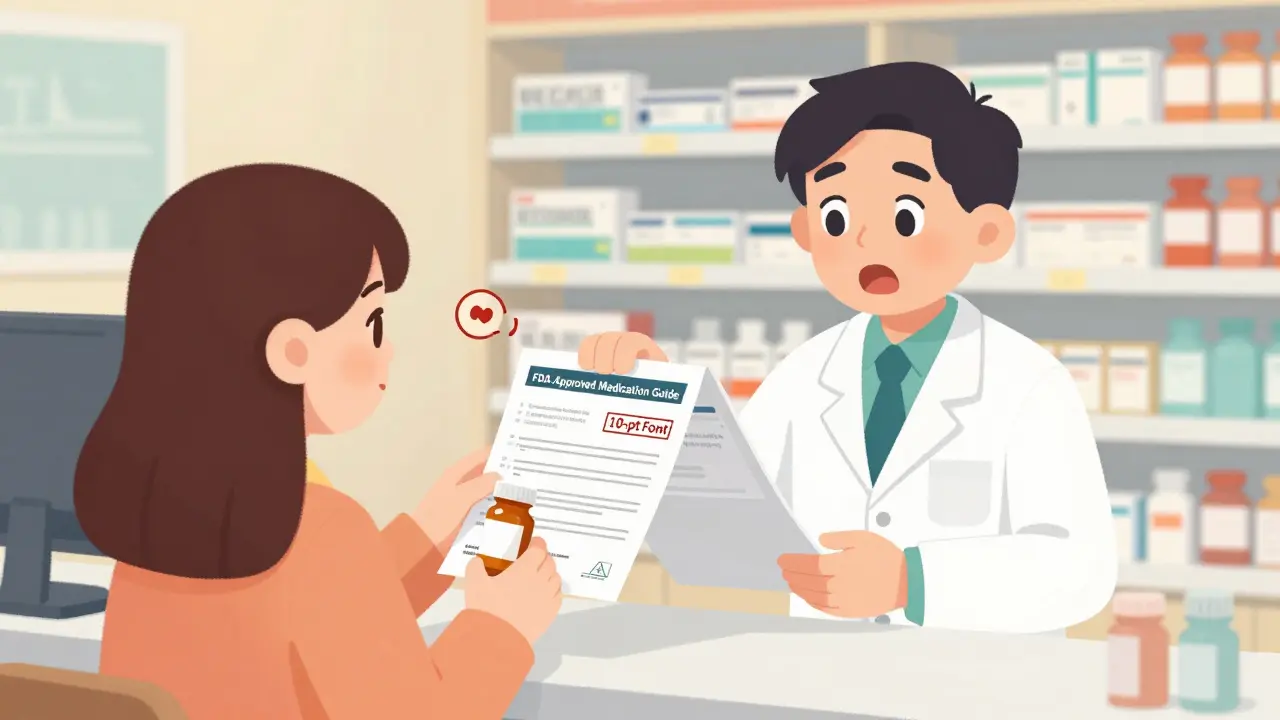
A Medication Guide is not the same as the small leaflet that comes with your pill bottle. It’s a special, FDA-approved document that comes with certain prescription drugs-about 150 of them-as of 2023. These aren’t marketing brochures. They’re safety alerts. The FDA requires them when a drug carries serious risks: dangerous side effects, life-threatening interactions, or when taking it exactly as directed is critical to its effectiveness. These guides are written by drug makers, but they must be approved by the FDA before they can be distributed. They can’t use jargon. They can’t be promotional. They must be written in plain English, using language a typical adult can understand. The type size must be at least 10-point font. The words “Medication Guide” must appear clearly at the top, followed by the brand name and generic name of the drug. And at the bottom, it must say verbatim: “This Medication Guide has been approved by the U.S. Food and Drug Administration.”Why Do These Guides Even Exist?
They were created in 1998 after the FDA saw too many patients harmed by drugs they didn’t fully understand. Think of drugs like warfarin, certain antidepressants, or diabetes medications where a single mistake-like mixing with another drug or skipping doses-can lead to hospitalization or death. The FDA didn’t want patients relying only on their doctor’s explanation or a pharmacist’s quick tip. They wanted a written, standardized safety net. Dr. Janet Woodcock, former head of the FDA’s drug evaluation center, said these guides have prevented countless adverse events. And there’s data to back it up. In a 2022 survey by Patients for Safer Drugs, nearly 23% of people who received a Medication Guide said it helped them avoid a dangerous situation-like catching a drug interaction they didn’t know about or realizing they were taking the wrong dose.Your Legal Right to a Printed Copy
Under 21 CFR §208.24, pharmacies are required to give you the Medication Guide in paper form when you pick up your prescription. That means if you walk up to the counter and the pharmacist doesn’t hand it to you, you can-and should-ask for it. You don’t need to explain why. You don’t need to say you’re worried. You just say, “I’d like my Medication Guide, please.” And here’s something many people don’t know: you have the right to refuse the paper copy. Since May 2023, the FDA clarified that patients can request an electronic version instead. The pharmacy can’t force you to take a printed guide. But they also can’t ignore your request for one. If you want it in print, they must provide it.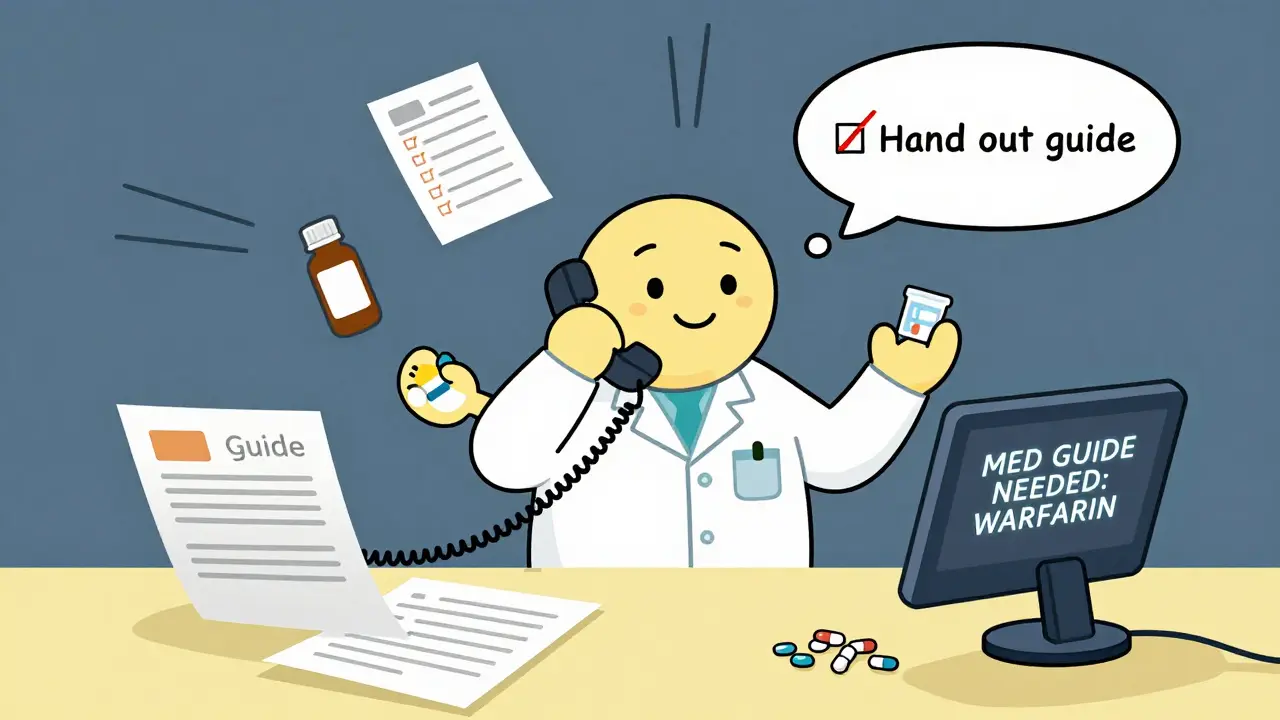
Why Do So Many People Never Get Their Guide?
If you’ve never received one, you’re not alone. A 2022 survey by the National Consumers League found that 43% of patients who were prescribed a drug requiring a Medication Guide never got one. Why? It’s not because pharmacists are ignoring the law. It’s because the system is broken. Most pharmacies don’t have automated systems that flag when a Medication Guide is needed. Pharmacists are juggling dozens of prescriptions at once. They’re answering phones, handling insurance issues, and managing inventory. In a 2021 study, it took pharmacists 15 to 20 seconds per prescription to find, verify, and hand out a guide. That’s time they often don’t have during busy hours. Chain pharmacies like CVS and Walgreens mostly use digital printing systems-they can pull up and print the guide on the spot. But independent pharmacies? Many still rely on manufacturers to mail them physical copies. If those don’t arrive, or if the pharmacist forgets to check the stock, the guide never gets to you. A 2022 audit by the Department of Health and Human Services found that 31% of pharmacy sites had no reliable way to track whether guides were distributed. That’s not just poor service-it’s a compliance failure.What If the Guide Is Hard to Read?
Even when you get the guide, it might not be useful. A 2023 analysis by the American Society of Health-System Pharmacists found that 68% of Medication Guides are written at an 11th-grade reading level or higher. That’s too complex for many adults. The FDA requires plain language, but many manufacturers still use vague phrases like “may cause hepatotoxicity” instead of “may damage your liver.” If you get a guide that’s full of confusing terms, you’re not wrong to feel frustrated. You can ask the pharmacist to explain it. You can ask for a simpler version-some manufacturers offer alternate formats. And if you’re still lost, call the drug maker’s patient help line. They’re required to provide support.The Big Change Coming: Patient Medication Information (PMI)
The FDA knows the current system is outdated. In May 2023, they announced a major overhaul: replacing Medication Guides with something called Patient Medication Information (PMI). This will be a single, standardized one-page document for every drug that needs one. No more inconsistent formats. No more tiny fonts. No more confusing layouts. The PMI will have the same structure for every drug: what the drug is for, how to take it, what to avoid, serious side effects, and when to call your doctor. The FDA tested prototypes and found patients understood the new format 37% better than the old guides. The transition starts now. By 2027, all current Medication Guides will be phased out. Pharmacies will need new software, printers, and training. It’ll cost the industry up to $600 million. But for patients? It means one less thing to guess about.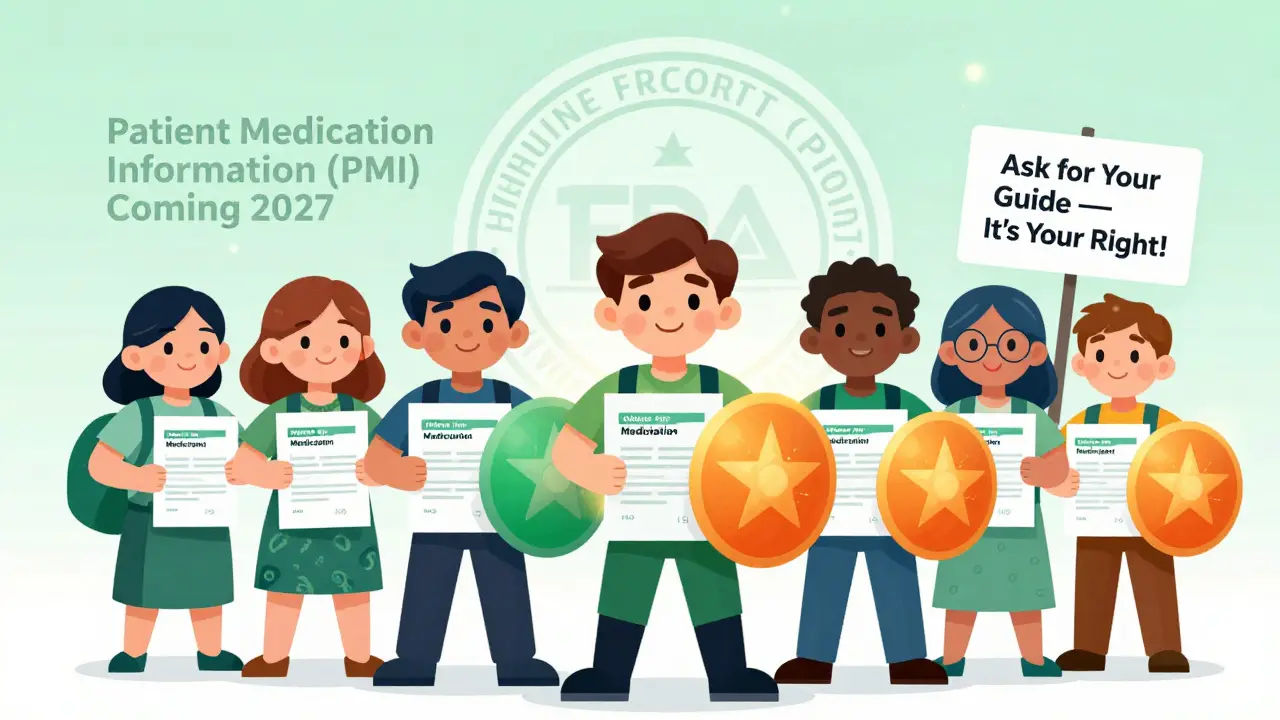
What Should You Do Today?
Don’t wait for the system to fix itself. Here’s what you can do right now:- Always ask for your Medication Guide when picking up a new prescription-especially if it’s a high-risk drug like blood thinners, opioids, or certain mental health meds.
- If the pharmacist says, “We don’t have it,” ask them to check their system or call the manufacturer. They’re required to provide it.
- If you’re offered an email or app version, say yes only if you’re sure you’ll read it. Otherwise, insist on paper.
- If you don’t get it and you know your drug requires one, file a complaint with the pharmacy’s corporate office. Mention 21 CFR §208.24. Most will respond quickly.
- Keep the guide. Don’t throw it away. Refer to it when you start the medication, and keep it handy if you have questions later.
What If You’re Still Not Getting It?
If you’ve asked multiple times and keep being turned away, you’re not imagining it. This happens more than you think. You can report non-compliance to the FDA’s MedWatch program. You don’t need to know the drug’s name or the pharmacy’s license number. Just describe what happened. The FDA tracks these reports and follows up with pharmacies that have repeated issues. You can also contact your state pharmacy board. They regulate pharmacies and can investigate violations of federal distribution rules.Bottom Line
Medication Guides aren’t paperwork. They’re safety tools. They’ve stopped people from having strokes, liver failure, and fatal overdoses. But they only work if you get them. Don’t assume someone else will handle it. Don’t wait for the pharmacist to offer it. Ask for it. Demand it. Your life could depend on it.Do I have to pay for a Medication Guide?
No. Medication Guides are required by federal law and must be provided at no cost to the patient. You should never be charged for one, even if the pharmacy has to print it on the spot. If you’re asked to pay, it’s a violation of FDA regulations.
What if I lose my Medication Guide?
You can ask your pharmacy for another copy. Most pharmacies keep digital copies on file and can reprint them. If they don’t have it, they can contact the drug manufacturer to get a new one. You’re entitled to a replacement.
Can I get a Medication Guide for an over-the-counter (OTC) drug?
No. Medication Guides only apply to prescription drugs that the FDA has specifically flagged as high-risk. OTC medications have different labeling rules, usually on the drug facts label. If you’re unsure, ask your pharmacist.
Are Medication Guides available in languages other than English?
The FDA requires Medication Guides to be in English. Some manufacturers provide translated versions as an added service, but they’re not required. If you need help understanding the guide, ask your pharmacist for assistance or contact the drug company’s patient support line-they often have multilingual staff.
Can I get a Medication Guide before I pick up my prescription?
Yes. Many pharmacies allow you to request a Medication Guide in advance, especially if you’re filling a recurring prescription. Call ahead and ask if they can print it for you to pick up later. Some even email it to you ahead of time if you’ve requested electronic delivery.
Do I need to bring the Medication Guide to my doctor’s appointments?
It’s not required, but it’s a smart idea. Bring it to show your doctor what you’ve been told about the drug. This helps avoid confusion, especially if you’re seeing multiple providers or taking several medications. It’s also useful if you have questions or side effects to report.
Ashley Porter
So the FDA mandates these guides but doesn't enforce distribution? Classic. The system's designed to look like it's protecting you while actually outsourcing accountability to overworked pharmacists. Jargon-heavy compliance documents don't help when the person handing them to you is 17 prescriptions deep and on their third coffee.
It's not about literacy-it's about system design. If you need a 10-point font and plain English, why not just build a mandatory pop-up in the pharmacy management software? Instead, we get another bureaucratic checkbox that gets ignored during peak hours.
And don't get me started on the 68% that still read like a medical journal. If the goal is patient safety, why are we letting pharma copywriters write the safety warnings? They're not clinicians-they're marketers with a compliance checklist.
The PMI transition is a step in the right direction, but only if it's enforced with audits, not just announcements. The FDA needs to start publishing pharmacy compliance scores like restaurant health inspections. Let the public see who's cutting corners.
Also-why are we still using paper for anything in 2024? If I can get my bank statement via email, why can't I get my warfarin safety info in a PDF that auto-updates with new black box warnings?
January 24, 2026 AT 21:14
Peter Sharplin
I work in a community pharmacy and I see this every day. We're not ignoring you-we're drowning. We have 30 scripts to fill, 5 insurance calls, 2 new med reviews, and a guy asking why his insulin isn't working because he stored it in the glove compartment.
Yeah, we're supposed to pull the guide. But if the system doesn't flag it, and the printer's out of ink, and the manufacturer hasn't shipped the physical copies... we're stuck.
I've had patients yell at me for not giving them the guide. I get it. I've seen people end up in the ER because they didn't know a drug interacts with grapefruit. But yelling doesn't fix the system. Calling corporate does.
And yes-we can print them on demand. But if you're the 8th person in line and I'm trying to get you out the door before the next prescription comes in... I forget. Not out of malice. Out of exhaustion.
Ask for it. I promise I'll stop what I'm doing. But also-understand we're trying. We're just not set up to do this right.
And if you want to help? Tell your doctor to flag high-risk meds in the e-prescription. That cuts our workload in half.
And no, we don't charge for the guide. Ever. If someone tries to bill you, report them. That's not just wrong-it's illegal.
January 26, 2026 AT 00:22
Faisal Mohamed
The Medication Guide is a postmodern paradox: a document meant to empower, yet rendered meaningless by the very system that mandates it. 🤔
We live in an age where AI can diagnose cancer from a CT scan, yet we still rely on a 10-point font pamphlet printed on recycled paper to prevent death.
Is this safety-or theater?
The FDA’s PMI initiative is the first glimmer of epistemic humility in decades. Finally, someone admits that information architecture matters more than regulatory compliance.
But let’s be real: the real enemy isn’t the pharmacist. It’s the neoliberal fragmentation of healthcare. When every stakeholder-pharma, pharmacy, insurer, provider-is incentivized to minimize liability rather than maximize understanding, we get guides that look like legal disclaimers and feel like afterthoughts.
Democratizing knowledge isn’t about printing more papers. It’s about dismantling the gatekeeping structure that treats patients as passive recipients of corporate-authored fear.
Until then, we’re just rearranging deck chairs on the Titanic. 🚢🩺
January 27, 2026 AT 18:48
bella nash
It is imperative that patients be cognizant of their statutory entitlements pursuant to 21 CFR §208.24.
Pharmaceutical manufacturers are obligated to submit documentation that conforms to the standards of legibility and linguistic accessibility as prescribed by the Food and Drug Administration.
Noncompliance by dispensing entities constitutes a violation of federal regulatory protocol and may result in administrative sanctions.
It is further recommended that patients maintain a written record of all pharmaceutical dispensations and associated documentation for the purpose of longitudinal health management.
Should a Medication Guide not be forthcoming, the patient is advised to initiate formal correspondence with the pharmacy’s compliance officer, referencing the aforementioned regulation.
Electronic dissemination, while permissible, is not preferable to the tangible artifact, which ensures permanence and mitigates digital obsolescence.
Furthermore, the retention of physical copies is not merely prudent-it is an act of self-advocacy in an increasingly fragmented healthcare ecosystem.
It is not unreasonable to expect that the provision of such materials be treated with the same gravity as the dispensation of the pharmaceutical agent itself.
One must not underestimate the significance of this procedural formality.
Failure to do so may result in adverse outcomes that are entirely preventable.
One must remain vigilant.
January 28, 2026 AT 15:45
SWAPNIL SIDAM
Bro, I just got my blood thinner last week. Didn’t get the guide. Asked twice. Pharmacist said ‘oh yeah, sorry’ and printed it. Took 3 minutes.
It’s not that hard. Just ask.
And don’t let them tell you it’s ‘not in stock.’ They can print it. They have the printer.
I’m from India. We don’t have fancy systems. But we still give the paper. Because people die if they don’t know what they’re taking.
Just ask. Seriously. It’s your life.
January 28, 2026 AT 20:31
Sally Dalton
OMG YES I’VE BEEN WAITING FOR SOMEONE TO TALK ABOUT THIS 😭
I got my antidepressant last month and the pharmacist just handed me the bottle like ‘here ya go’ and I was like… wait… is there a guide? And they looked confused and said ‘ohhh yeah’ and dug around and found it in a drawer like it was a lost sock.
I read it and I literally cried because it explained why I was feeling so dizzy and why I couldn’t drink alcohol. I had NO IDEA.
And then I asked for a copy for my mom because she helps me take my meds and she said ‘why didn’t you get this before?’
So I started telling everyone. My aunt got her blood pressure med and asked for it and they printed it right away. It’s like… it’s not magic. Just ask.
And if they say no? Say ‘I’m gonna call the FDA’ and watch them turn white 😂
Also-save it! I keep mine in my wallet next to my insurance card. It’s my little safety net. 💙
January 29, 2026 AT 10:52
Mohammed Rizvi
Pharmacists are overworked, underpaid, and treated like order-takers by a system that treats human lives like inventory.
But here’s the real joke: the FDA spends millions designing these guides, then lets the industry print them in 8-point font and ship them to pharmacies that don’t even have a dedicated drawer for them.
Meanwhile, the same pharma companies spend $2 billion a year on ads telling you how great their drug is.
So we get a glossy ad for the pill, and a crumpled 2-page guide that looks like it was printed on a 1998 dot-matrix printer.
It’s not negligence. It’s malice dressed up as bureaucracy.
And if you’re still not asking for it? You’re playing Russian roulette with your liver.
Ask. Every. Time.
January 30, 2026 AT 14:00
Allie Lehto
People don’t ask because they’re lazy. That’s it.
I’ve worked in a pharmacy for 12 years. We have a sign that says ‘ASK FOR YOUR MEDICATION GUIDE’ right next to the pickup window. We even have a printed checklist taped to the counter.
And still? 7 out of 10 people walk out without it.
It’s not the system’s fault. It’s the patient’s. You don’t read the manual for your toaster, why would you read the manual for a drug that could kill you?
And then they come back in two weeks saying ‘I got sick’ and blame the pharmacy.
Here’s a radical idea: maybe take responsibility for your own health instead of waiting for someone else to hand you a safety net.
Also-typo in the article. It says ‘medication’ as ‘medication’ in one spot. Fix it.
And yes, I’m still mad about the grapefruit juice thing. 😤
January 31, 2026 AT 08:58
Dan Nichols
Let’s be real. This whole Medication Guide thing is a PR stunt. The FDA doesn’t care if you read it. They care that they can say they ‘required’ it.
And the fact that you can opt for digital? That’s not empowerment. That’s liability avoidance.
Who’s gonna read an email? Nobody. You’ll delete it. You’ll forget. You’ll get a new phone. Boom-no more guide.
Paper is the only thing that survives. Paper doesn’t glitch. Paper doesn’t expire. Paper doesn’t get lost in a spam folder.
And don’t get me started on the ‘plain English’ requirement. I’ve read guides that say ‘may cause hepatotoxicity’ and then in the next paragraph say ‘your liver might get mad.’
So which is it? Clinical? Or condescending?
Also-why are we still using ‘Medication Guide’? It’s not a guide. It’s a warning label. Call it what it is.
And if you think asking for it is hard? You’re not trying hard enough.
January 31, 2026 AT 15:23
Renia Pyles
Oh my god I can’t believe you’re still talking about this like it’s a fucking inconvenience.
I had a stroke because I didn’t know my blood thinner interacted with turmeric. I found out from a Reddit post two months later.
They didn’t give me the guide. They didn’t even say it existed.
And now I have to live with half a brain and a $300k medical bill.
So don’t you dare tell me to ‘just ask.’
It’s not my job to hunt down safety information that’s legally required to be handed to me.
It’s YOUR job to give it to me.
And if you’re a pharmacist who ignores this? You’re not a healer. You’re a liability.
And I will find you.
And I will report you.
And I will make sure your name is public.
Don’t test me.
February 2, 2026 AT 01:24
Rakesh Kakkad
Respected authorities, this matter pertains to the regulatory framework governing pharmaceutical dispensation under Title 21 of the Code of Federal Regulations.
It is a matter of profound concern that the dissemination of Medication Guides remains inconsistent across dispensing entities, despite statutory mandates.
Furthermore, the variance in implementation between chain pharmacies and independent entities suggests a structural inequity in healthcare delivery.
It is respectfully suggested that the FDA institute a centralized digital repository accessible via QR code on prescription labels, thereby ensuring uniform access regardless of pharmacy size or location.
Additionally, the integration of automated alerts within pharmacy management systems should be made mandatory, with compliance audited quarterly.
It is imperative that patient safety not be subject to the operational capacity of individual pharmacists.
Thank you for your attention to this critical public health matter.
Respectfully submitted,
Rakesh Kakkad, Ph.D. (Health Policy)
February 3, 2026 AT 19:46
TONY ADAMS
bro i just asked for my guide and the lady said ‘we don’t have it’ and i said ‘ok cool’ and walked out
then i looked up the drug online and the guide was literally a pdf on the manufacturer’s website
i printed it at the library
and now i have it
so yeah
don’t wait for them
just go get it yourself
February 5, 2026 AT 09:09