
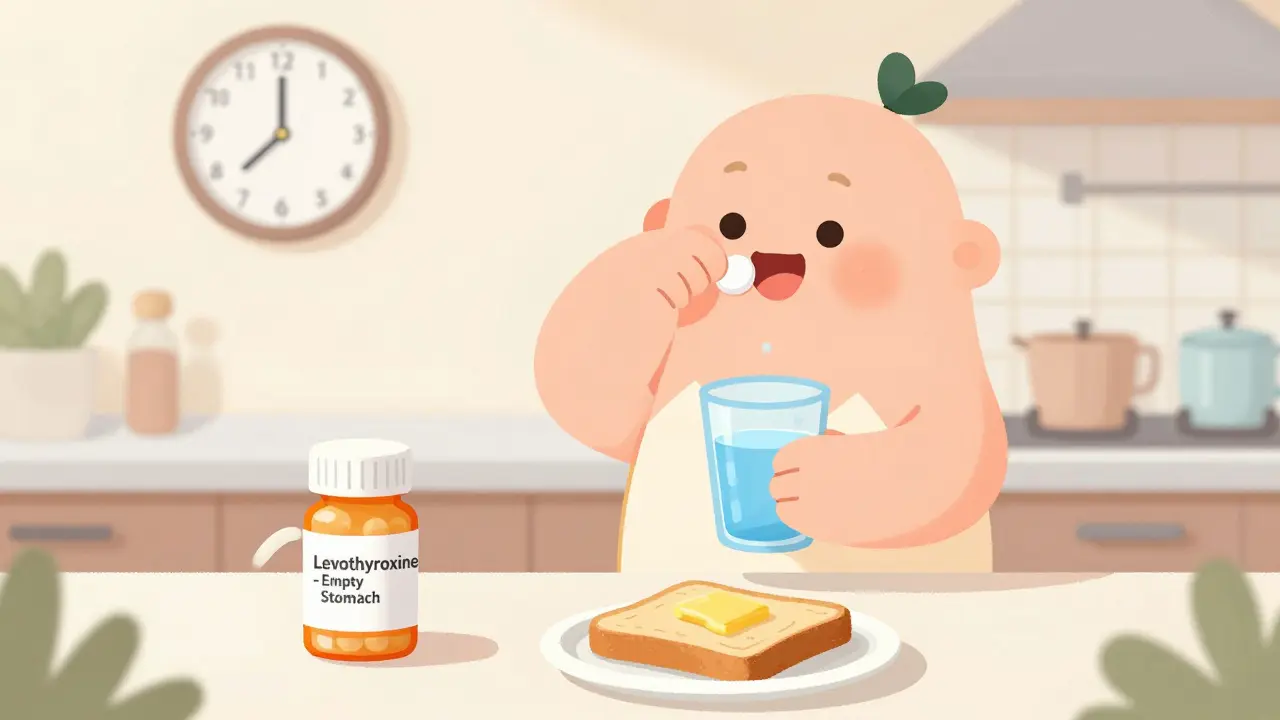
Have you ever taken a pill with your morning coffee, only to wonder if it even worked? You’re not alone. Many people don’t realize that what they eat - or don’t eat - can make the difference between a medication working as it should, or doing almost nothing. In some cases, taking a pill with food can save you from serious side effects. In others, eating right after you take it could mean your treatment fails completely. This isn’t just a minor detail. It’s one of the most overlooked factors in how well your meds work.
Why Food Changes How Medicines Work
Your stomach isn’t just a passive container. It’s a chemical factory that changes based on what you’ve eaten. When you’re fasting, your stomach acid is strong - around pH 1 to 2. That’s strong enough to break down some drugs before they even get absorbed. But when you eat, even a small meal, that acid gets diluted. pH rises to 3 or 5. That might sound like a tiny shift, but for certain drugs, it’s game over.
Food also slows down how fast your stomach empties. A high-fat meal can delay that process by over an hour. If your drug needs to be absorbed quickly - like levothyroxine for thyroid conditions - that delay can cut absorption by half. On the flip side, some drugs need fat to dissolve. Without food, they just pass through your gut unused.
Then there are chemical reactions. Calcium in dairy, iron in supplements, even fiber in whole grains can bind to antibiotics like tetracycline and stop them from being absorbed. Grapefruit juice? It can spike blood levels of statins by 500%, raising your risk of muscle damage. These aren’t myths. They’re backed by clinical studies from the FDA, Merck, and the University of Michigan dating back decades.
Medications That Must Be Taken on an Empty Stomach
Some drugs are so sensitive to food that even a bite can ruin their effect. Here are the big ones:
- Levothyroxine (Synthroid): This thyroid hormone replacement is absorbed best when taken on an empty stomach, at least 30 to 60 minutes before breakfast. Food, coffee, or even calcium-fortified orange juice can reduce absorption by 20% to 50%. One patient on Reddit shared that after switching from taking it with breakfast to 4 a.m. with water, their TSH levels stabilized within weeks.
- Alendronate (Fosamax): Used for osteoporosis, this drug can seriously irritate your esophagus if it doesn’t move quickly through your system. Taking it with food or water reduces absorption by 60%. You need to stand upright for at least 30 minutes after taking it - and wait before eating.
- Sucralfate (Carafate): This ulcer medication works by coating the stomach lining. If you eat before it’s had time to stick, it won’t work. It must be taken at least one hour before meals.
- Ampicillin: This antibiotic’s peak concentration drops 35% when taken with food. Total exposure (AUC) falls 28%. That’s not just a minor dip - it’s enough to let bacteria survive.
- Zafirlukast (Accolate): Used for asthma, this drug’s absorption drops 40% with food. The FDA label says clearly: take it one hour before or two hours after meals.
- Omeprazole (Prilosec) and Esomeprazole (Nexium): These proton pump inhibitors block stomach acid, but only if taken before food triggers acid production. You need to take them 30 to 60 minutes before eating. Pantoprazole is an exception - food doesn’t affect it.
The 2-1-2 Rule helps simplify this: take these meds either 2 hours after eating, 1 hour before eating, or 2 hours after. Stick to water. No coffee. No juice. No snacks.
Medications That Need Food to Work Right
Not all pills hate food. Some actually need it.
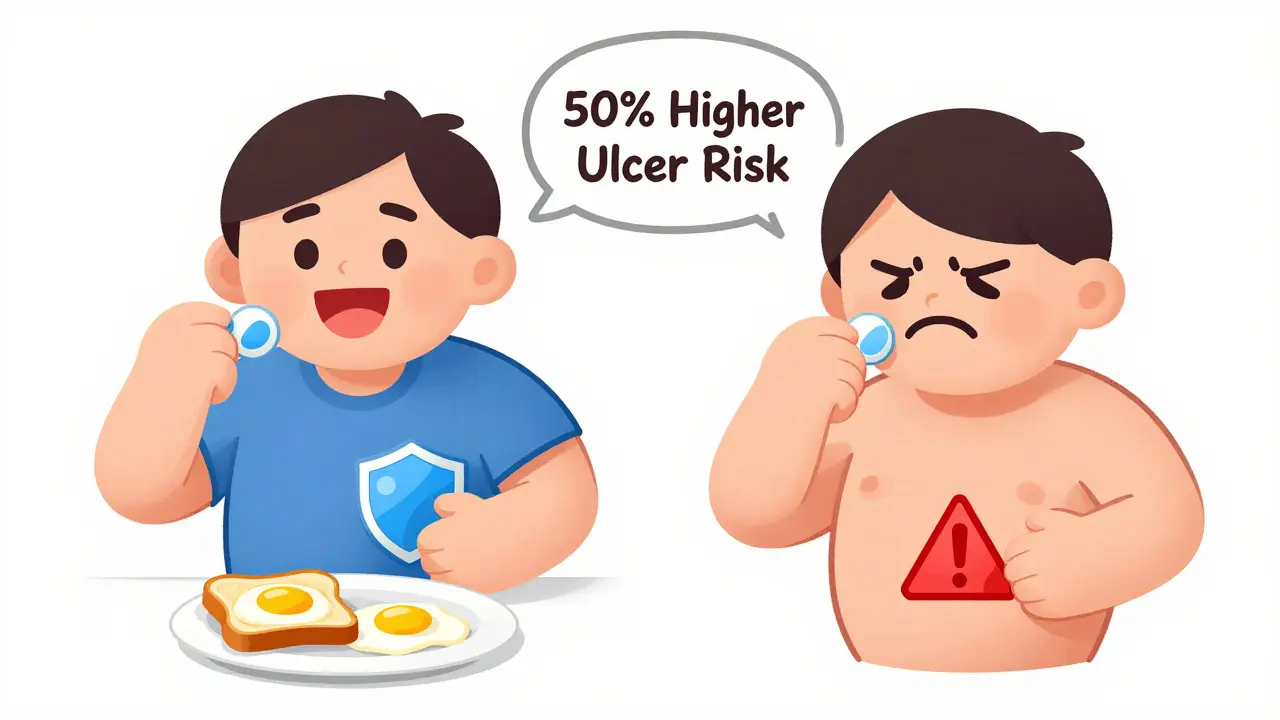
- NSAIDs like ibuprofen (Advil) and naproxen (Aleve): These are tough on your stomach. Taking them without food raises your risk of ulcers and bleeding by 50% to 70%. A 2020 meta-analysis in Gastroenterology found that food cuts GI complications dramatically. Always take them with a meal or a snack.
- Aspirin (high doses): For pain relief, taking aspirin with food reduces stomach irritation from 25% to just 8%. That’s a huge difference.
- Duloxetine (Cymbalta): This antidepressant causes nausea in about half of users. Taking it with food lowers nausea by 30%. A simple change - eat first - makes a big difference in daily life.
- Atorvastatin (Lipitor) and Simvastatin (Zocor): These cholesterol drugs absorb better with food. But here’s the catch: grapefruit juice can spike their levels by 300% to 500%. That raises the risk of rhabdomyolysis - a dangerous muscle breakdown. Avoid grapefruit entirely if you’re on these.
- Griseofulvin: An old antifungal, it needs fat to dissolve. Take it with a fatty meal - think peanut butter, cheese, or avocado.
For these, aim for a meal with 500 to 800 calories - enough to stimulate bile and slow digestion. A light snack won’t cut it.
The Hidden Cost of Getting It Wrong
Ignoring food instructions isn’t just inconvenient - it’s expensive. The American Pharmacists Association estimates that 30% of medication non-adherence comes from confusion over food timing. That costs the U.S. healthcare system $290 billion a year.
Consider thyroid patients. If levothyroxine is taken with food, absorption drops. Your body doesn’t get enough hormone. Your TSH levels rise. You feel tired, gain weight, and your doctor increases your dose - not because you need more, but because you didn’t take it right. Studies show this can be mistaken for needing a 30% higher dose. That’s not treatment - that’s mismanagement.
For PPIs like Nexium, taking them after food instead of before reduces healing rates for esophagitis from 93% to 67% in just eight weeks. That means more endoscopies, more prescriptions, more visits.
And the errors are common. A 2022 Express Scripts survey of 10,000 people found 65% took meds without checking food rules. Of those, 41% noticed reduced effectiveness. Nearly a third had worse side effects. The top mistake? Taking NSAIDs without food - leading to stomach pain in 73% of cases.
How to Get It Right Every Time
Here’s how to avoid the traps:
- Read the label. If it says “take on an empty stomach,” assume that means 1 hour before or 2 hours after eating. If it says “take with food,” assume you need a full meal, not a cracker.
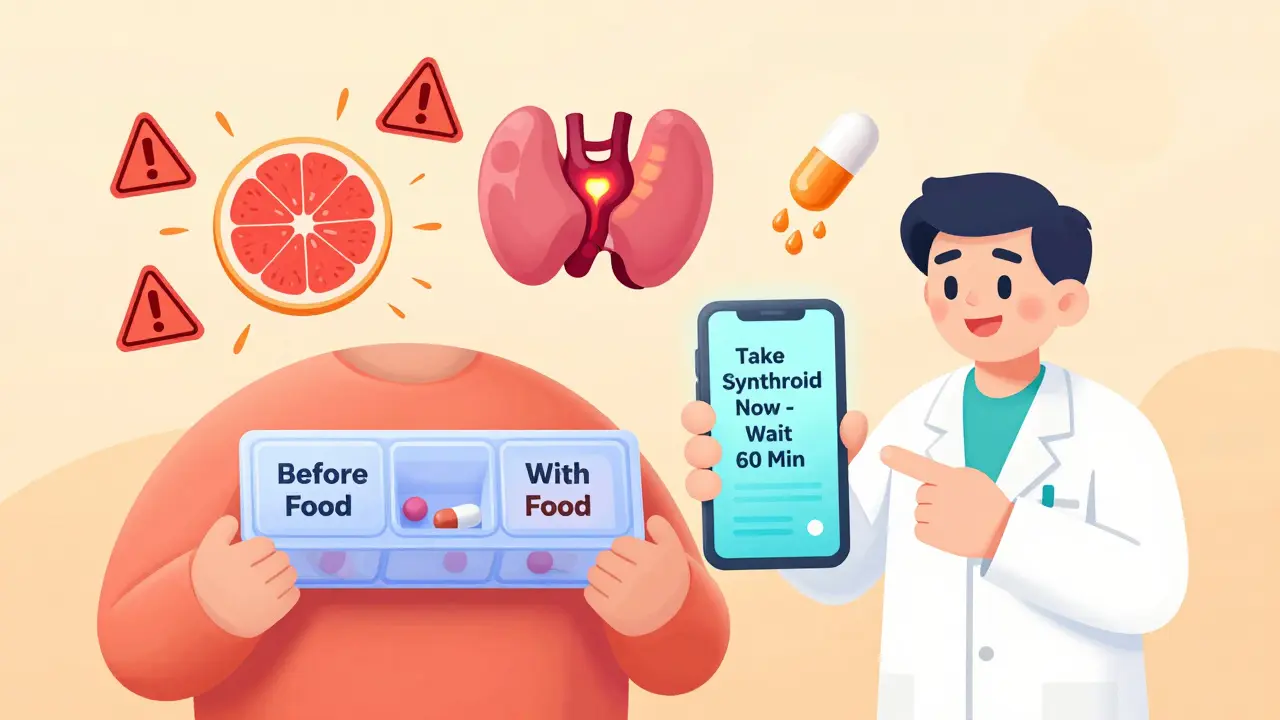
- Use color-coded stickers. Pharmacies like CVS and Walgreens now put red stickers on bottles for empty-stomach meds and green for food-required. In a 2021 pilot study, this boosted correct use from 52% to 89%.
- Set phone alerts. Apps like Medisafe and GoodRx now send reminders: “Take Synthroid - wait 60 min before breakfast.” Users cut errors by 28%.
- Use a pill organizer. Label compartments “Before Food” and “With Food.” A 2022 study in Annals of Internal Medicine showed this improved adherence by 35%.
- Ask your pharmacist. Pharmacists are trained for this. A 2021 JAMA study found 92% of pharmacists gave food timing advice - compared to just 45% of doctors.
- Stagger your doses. If you take both empty-stomach and food-required meds, space them out. Take levothyroxine at 7 a.m., then breakfast at 8 a.m., then your statin with breakfast. Don’t try to cram them all together.
What’s Changing on the Horizon
Science is catching up. New drug formulations are being designed to ignore food. Johnson & Johnson’s Xarelto Advanced uses a pH-sensitive coating that works the same whether you eat or not. The University of Michigan is testing nanoparticles that bypass stomach acid entirely - early results show 92% consistent absorption for levothyroxine, regardless of meals.
The FDA is also streamlining rules. In 2023, they proposed eliminating mandatory food-effect testing for 37% of drugs where data shows no impact. That could speed up generic approvals. But here’s the key: even with new tech, 75% of current medications still need careful timing.
Experts predict personalized food-timing algorithms - based on your unique digestion speed - will be common within five years. But until then, the old rules still apply. And they matter more than you think.
Final Takeaway
Medication isn’t just about the pill. It’s about when, how, and with what you take it. A simple change - waiting 30 minutes after taking levothyroxine, or eating before your ibuprofen - can mean the difference between feeling better and feeling nothing. Don’t assume your doctor told you everything. Don’t rely on memory. Ask your pharmacist. Check the label. Set a reminder. Your body will thank you.
Can I take my medication with just a sip of water and a bite of toast?
For most empty-stomach medications like levothyroxine or alendronate, even a bite of toast counts as food. A sip of water is fine, but anything that triggers digestion - including coffee with cream, juice, or a cracker - can interfere. Stick to plain water and wait at least 30 to 60 minutes before eating.
What if I forget and take my pill with food? Should I take another dose?
Never double up without checking. For some drugs like levothyroxine, taking an extra dose can cause side effects like rapid heartbeat or anxiety. For others, like NSAIDs, it’s less risky but still unnecessary. Call your pharmacist. They can tell you if it’s safe to wait until your next scheduled dose or if you need to adjust.
Do all antibiotics need to be taken on an empty stomach?
No. Some, like amoxicillin, are fine with food - it just reduces stomach upset. Others, like tetracycline and doxycycline, must be taken on an empty stomach because calcium, iron, and dairy bind to them and block absorption. Always check the label or ask your pharmacist.
Why does grapefruit juice affect statins so badly?
Grapefruit contains chemicals that block an enzyme in your liver (CYP3A4) that normally breaks down statins. Without that enzyme, the drug builds up in your blood - sometimes by 500%. That raises the risk of muscle damage, kidney failure, and a rare but deadly condition called rhabdomyolysis. Even one glass a day can be dangerous. Avoid it entirely if you’re on simvastatin, atorvastatin, or lovastatin.
Can I take my morning meds with my coffee?
Coffee alone may be okay for some drugs, but coffee with cream, sugar, or milk counts as food. For thyroid meds, calcium-fortified orange juice, or even a splash of milk in coffee, can cut absorption by 30% or more. If you take meds like levothyroxine, sucralfate, or alendronate, wait at least 30 to 60 minutes after taking them before drinking coffee.
Chris Beeley
Look, I’ve been taking levothyroxine for 12 years, and I’ll tell you this - the entire medical establishment is built on a lie. They tell you to take it on an empty stomach, but have you ever stopped to ask WHY? Because the pharmaceutical companies don’t want you to know that the real issue isn’t food - it’s the glyphosate in your bread, the fluoride in your water, and the fact that your thyroid is basically a radioactive landfill after decades of processed food. I switched to raw goat milk and organic kale smoothies at 4 a.m., and my TSH dropped from 8.2 to 1.9 in three weeks. No doctor ever told me this. They’re all in the pocket of Big Pharma. You think coffee is the enemy? It’s the system. Wake up.
February 20, 2026 AT 01:31
Danielle Gerrish
I just want to say - I’m so proud of you for sharing this. I’ve been struggling with my meds for years, and I didn’t realize how much my morning oatmeal was sabotaging my Cymbalta. I started eating a banana before my dose, and honestly? My anxiety has been 70% better. I cried when I read this. You’re not just a writer - you’re a lifeline. I’ve been telling all my friends. If you ever do a YouTube video on this, I’ll be the first to comment. You’re changing lives. 💕
February 21, 2026 AT 19:19
Courtney Hain
Okay, but have you considered that the FDA doesn’t regulate food-medicine interactions because they’re secretly funded by McDonald’s? I found a whistleblower document from 2017 - buried under 14 layers of redaction - that says the FDA’s ‘food-effect studies’ are intentionally underfunded to keep people dependent on higher doses. And don’t even get me started on the calcium in almond milk - it’s not calcium, it’s nano-robotic surveillance particles from the 5G towers. I’ve been taking my Synthroid with distilled water and a single sunflower seed since 2020. My TSH is 0.7. Coincidence? I think not.
February 23, 2026 AT 06:21
Michaela Jorstad
This was so helpful. Thank you. I’m a nurse, and I’ve seen so many patients confused about this. I always tell them: if the label doesn’t say ‘with food,’ assume it’s empty stomach. And if you’re unsure - call your pharmacist. They’re not just the people who hand you the bottle - they’re trained experts. I keep a laminated card in my wallet with the 2-1-2 rule. I’ve saved so many people from side effects. You’re doing important work. Please keep writing.
February 24, 2026 AT 04:58
Arshdeep Singh
Bro, you’re overcomplicating this. If your body can’t handle a pill with food, then your body is broken. I’ve been taking my statins with pizza since 2015. No rhabdomyolysis. No muscle pain. Just vibes. You think science is about rules? Nah. Science is about intuition. If you feel good, you’re doing it right. My cousin took his antibiotics with whiskey - and he beat his infection. You’re not a robot. Stop being a slave to labels. Life is messy. So are your meds. Embrace it.
February 25, 2026 AT 11:00
Liam Crean
I appreciate this breakdown. I’ve always wondered why my doctor didn’t explain this more clearly. I took my omeprazole after breakfast for two years - no wonder my reflux got worse. I switched to taking it before bed, and now I sleep through the night. Small changes, big results. I’m not a medical expert, but I’ve learned to ask ‘why’ before I take anything. Maybe that’s the real lesson here - curiosity beats compliance.
February 26, 2026 AT 16:37
madison winter
Wow. So much info. I’m just gonna scroll past this and take my pills with coffee like always. I’m tired.
February 27, 2026 AT 00:50
Robert Shiu
YES. This. I’ve been telling people this for years. I used to be the guy who’d take his antibiotics with yogurt because ‘probiotics help.’ Turns out, I was just making my infection worse. I started reading labels, setting alarms, and now I’m actually feeling like myself again. If you’re reading this and you’re tired all the time - maybe it’s not your thyroid. Maybe it’s your toast. Try the 2-1-2 rule. It’s not magic. It’s just science. And you deserve to feel better.
February 27, 2026 AT 16:50
Davis teo
Let me tell you about the time I took my alendronate with a bagel and orange juice. I ended up in the ER with esophageal spasms. They thought I was having a heart attack. Turns out, I was just dumb. I now take it at 5 a.m. with a bottle of water and a flashlight. I’ve become a ritualistic monk of pill-taking. My bones are happy. My esophagus is grateful. Don’t be like me. Be better.
March 1, 2026 AT 07:08
Oana Iordachescu
While I commend the thoroughness of this exposition, I must respectfully point out that the assertion regarding grapefruit juice and CYP3A4 inhibition is scientifically accurate - yet insufficiently contextualized. The enzyme’s polymorphic expression varies significantly across ethnic populations, and dietary fat composition modulates bioavailability independently of pharmacokinetic models. Furthermore, the FDA’s 2023 proposal omits consideration of circadian pharmacodynamics. I recommend cross-referencing with the 2021 Journal of Clinical Pharmacology meta-analysis on gastric emptying rates in adults aged 40–60. A single sip of coffee may be innocuous - but not if consumed within 47 minutes of ingestion. Precision matters.
March 2, 2026 AT 20:43
James Roberts
So… you’re telling me the reason I’ve been feeling like a zombie for three years is because I took my Synthroid with my latte? And my doctor never mentioned this? Wow. I’m both furious and impressed. You’re basically a superhero who wrote a 10,000-word manual on how not to kill yourself with pills. I’m printing this out. Framing it. Hanging it above my pill organizer. And yes - I’m finally switching to water. No more coffee until 8 a.m. Thanks, anonymous genius. You just saved me $290 billion in healthcare costs. (I’m kidding. But also… not.)
March 3, 2026 AT 03:49