
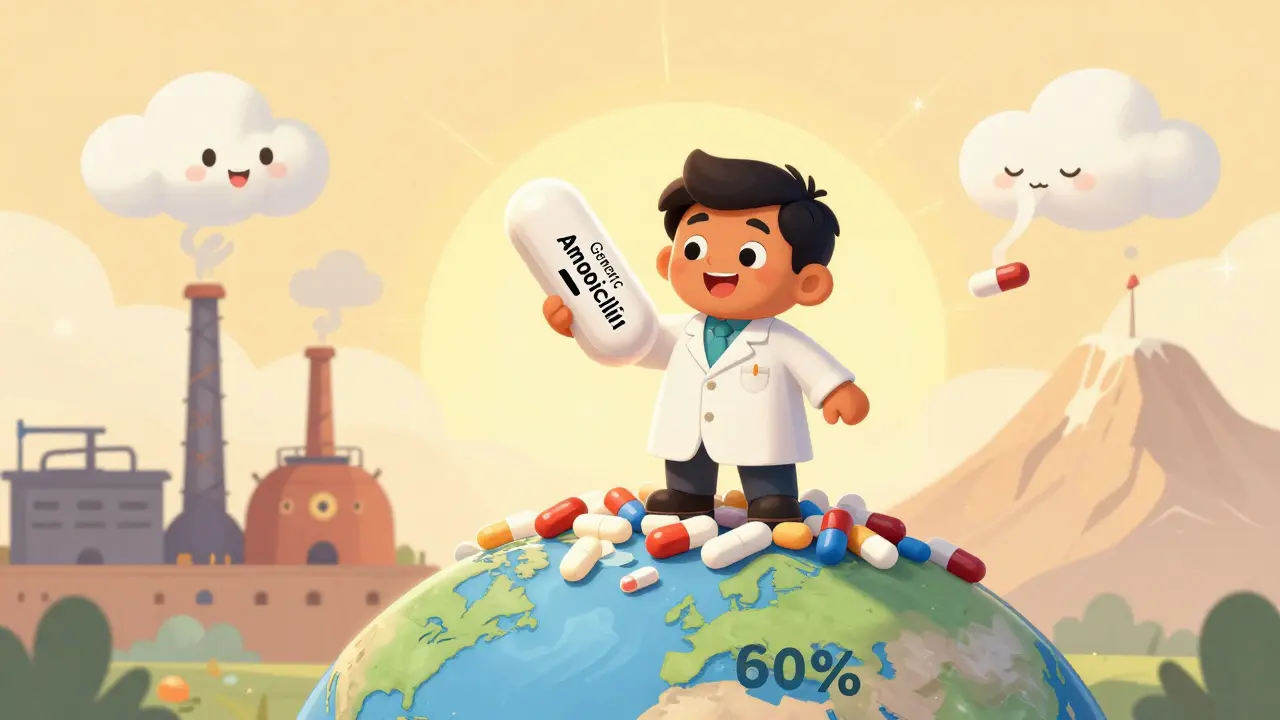
The world doesn’t just rely on pills - it relies on Asian generic markets. When you pick up a bottle of amoxicillin, metformin, or a cancer drug at your local pharmacy, there’s a high chance it came from India or China. These two countries don’t just make generics - they control the backbone of global medicine. India supplies over 60% of the world’s vaccines and 40% of U.S. generic drugs. China produces nearly 70% of the world’s Active Pharmaceutical Ingredients (APIs), the raw building blocks of every pill. Together, they keep billions of people alive at prices Western manufacturers can’t match.
India: The Volume Powerhouse
India’s rise as the "pharmacy of the world" wasn’t luck. It was policy. In the 1970s, the government changed patent laws to allow only process patents, not product patents. That meant companies could copy any drug formula as long as they made it a different way. Suddenly, Indian firms like Cipla and Sun Pharma could produce life-saving HIV drugs for $1 a day instead of $10,000. That move didn’t just save lives - it built an industry.
Today, India’s pharmaceutical market is worth $61.36 billion. But here’s the catch: most of that value comes from volume, not price. Over 75% of what India makes are low-cost, high-volume generics. The country has more than 3,000 FDA-approved manufacturing plants - more than any other nation. Gujarat and Maharashtra are the engines, churning out billions of tablets every year.
What makes India special isn’t just how much it makes - it’s how fast it responds. If a U.S. pharmacy chain needs a custom formulation of a generic antibiotic, Indian manufacturers can deliver a prototype in 14 days. Chinese suppliers? At least 30. Indian companies also offer 24/7 customer support, something U.S. buyers say cuts operational errors by 60%. Trustpilot reviews show Indian suppliers score 4.1 out of 5, beating China’s 3.8, mostly because of communication and reliability.
But India has a hidden weakness: it depends on China for 68% of its APIs. Even though India launched "Pharma Vision 2020" to become self-sufficient, domestic API production still only meets 18% of demand. Now, with "Pharma 2047," the government is spending $13.4 billion to build 12 new API parks. The goal? Cut that dependency to 30% by 2030. If they pull it off, India could shift from being a drug maker to a drug innovator.
China: The Value Leader
China’s story is different. It didn’t start by making pills - it started by making the chemicals inside them. Today, China controls 70% of the global API market. That’s not just supply - it’s leverage. If China slows down API exports, drug shortages ripple across the U.S., Europe, and Africa.
China’s pharmaceutical market is bigger - $80.4 billion in 2024 - but its growth is slower. Why? Because it’s moving up the value chain. While India still churns out simple generics, China is investing heavily in biologics, biosimilars, and novel drugs. Between 2020 and 2024, 45% of new Chinese pharma facilities were built for biologics production. In 2024, 10% of China’s pharmaceutical output was biologics. By 2030, the government wants that to hit 25%.
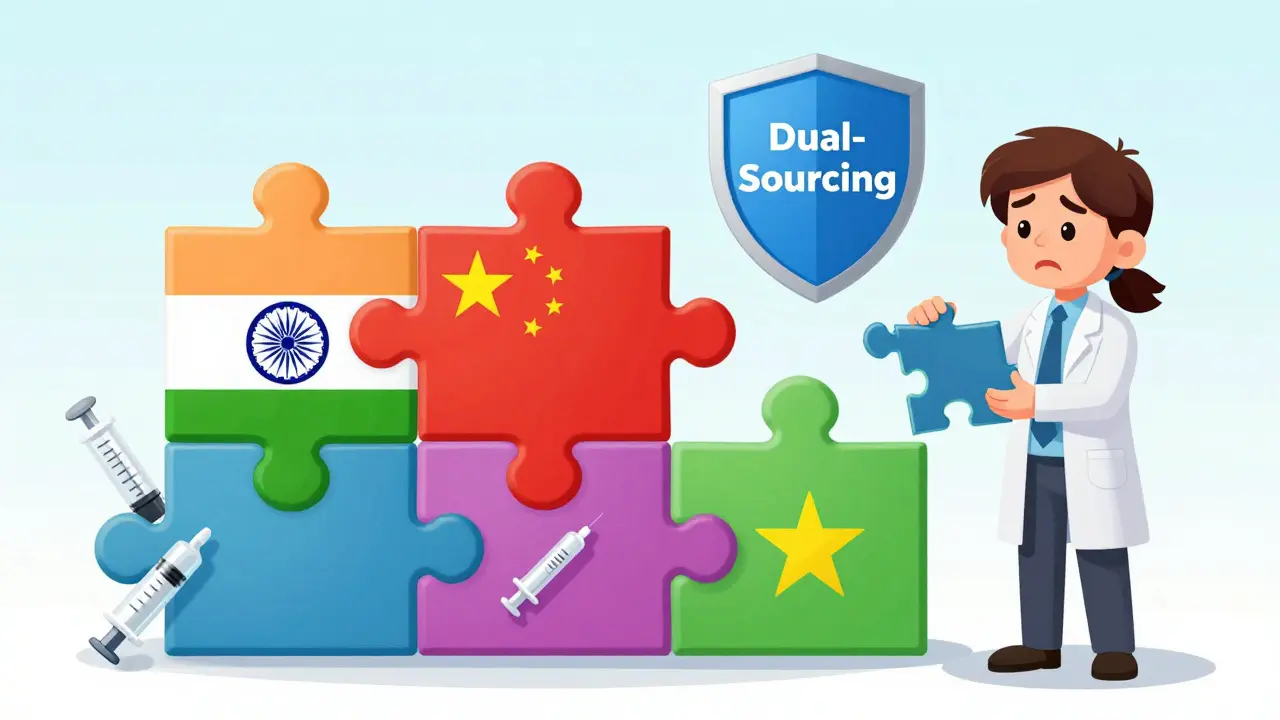
China’s manufacturing is also more centralized. Instead of 17 different regulators like in India, companies deal with just 8 national agencies. That makes compliance faster - approval timelines dropped from 24 months in 2018 to just 9 months in 2024. But quality control is a problem. In 2024, the U.S. FDA issued 142 warning letters to Chinese manufacturers - nearly twice as many as India’s 87. Many buyers now use dual-sourcing: 40-60% of their generics come from India, 25-35% from China. It’s a hedge against risk.
Chinese suppliers are cheaper - often 20% lower than Indian prices. But that savings comes with hidden costs. One German healthcare company said they had to spend 18% more on testing and audits after FDA warnings. Still, for bulk buyers, the math adds up. China’s exports hit $48.7 billion in 2024, with 63% being generics. The rest? High-value products like insulin, monoclonal antibodies, and complex injectables.
Emerging Economies: The Quiet Contenders
India and China aren’t alone. Smaller countries are carving out niches by doing what the giants can’t - or won’t - do.
Vietnam’s pharmaceutical market grew 12.3% annually from 2020 to 2024. It’s not making finished drugs. It’s making antibiotic intermediates - the chemical steps before the final API. With lower labor costs and ASEAN trade deals, Vietnam is becoming a hidden supplier to both India and China. In 2024, its pharmaceutical exports hit $2.8 billion, up 24.7% from the year before.
Cambodia? It’s not making pills at all. It’s assembling medical devices - syringes, IV bags, glucose monitors. Its medical device sector grew 32% in 2024, hitting $1.2 billion. Why? Because it’s part of ASEAN’s preferential trade rules. No one’s trying to out-innovate China here. They’re just filling the gaps.
These countries aren’t replacing India or China. They’re becoming specialized partners. For global buyers, that means more options - and more resilience in the supply chain.
Who Wins? Volume vs. Value
India and China aren’t competitors - they’re complements. India wins on volume, speed, and customer service. China wins on scale, cost, and high-end production.
India exports $24.2 billion in pharmaceuticals, 87% of it generics. China exports $48.7 billion, but only 63% are generics. The rest? Biologics, injectables, patented formulations. That’s the difference between selling a $0.10 tablet and a $100 biologic injection.
India’s market is growing faster - forecasted at 11.32% CAGR through 2030. But China’s growth is bigger in dollar terms. A 7.8% rise on an $80 billion base is $6.2 billion. India’s 11.32% on $61 billion is $6.9 billion. Almost the same. But China’s profit margins are higher.
India’s advantage? Demographics. 65% of its population is under 35. That means a huge domestic market for drugs - and a growing pool of young scientists. China’s advantage? Capital. The government poured $150 billion into pharmaceutical R&D under its 14th Five-Year Plan. 40% of that went to biologics.
By 2030, India’s market may hit $130 billion. China’s might hit $126.6 billion. But China will have more high-value exports. India will have more volume. Neither can afford to ignore the other.
The Real Challenge: Quality, Regulation, and Supply Chain Risk
Here’s what no one talks about enough: regulators are catching up.
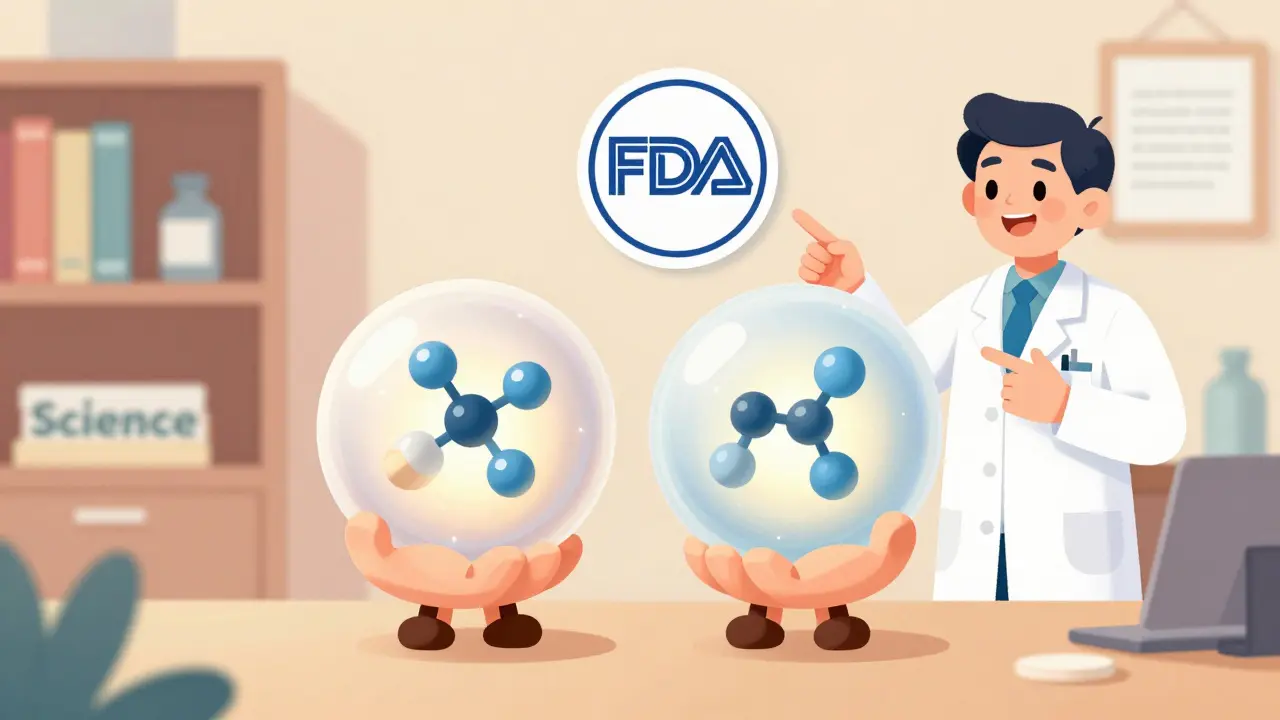
The U.S. FDA’s "Project BioSecure," launched in late 2024, demands full traceability of APIs from raw materials to finished pills. That means every batch must be tracked digitally - a nightmare for factories still using paper logs. Compliance could cost Asian manufacturers 18-22% more.
The WHO reported a 27% jump in inspection failures at Asian facilities in 2024. That’s not just about dirty floors or missing gloves. It’s about data integrity, contamination controls, and process validation. India’s decentralized system - 17 regulatory bodies - makes this harder. China’s centralized model helps, but its history of falsified data records still haunts it.
Meanwhile, both countries are racing to become self-sufficient. India wants to stop importing APIs. China wants to stop exporting low-value ones. That’s creating a supply glut. S&P Global warns of a 15-20% price drop in APIs by 2026-2027. When that happens, smaller manufacturers - especially in emerging economies - will struggle to survive.
What This Means for Buyers
If you’re a pharmacy chain, hospital, or distributor, here’s what you need to know:
- Don’t put all your eggs in one basket. Dual-sourcing is no longer optional - it’s essential.
- India is better for fast-turnaround, complex generics. China is better for bulk, low-cost APIs.
- Pay attention to FDA warning letters. A spike in them from one country means reevaluate your supplier list.
- Ask for batch-level traceability. If they can’t give it, walk away.
- Consider regional partners like Vietnam for intermediates. They’re cheaper and less risky than relying on China alone.
The era of cheap, unregulated generics is over. The new game is reliable, traceable, and scalable. India and China are adapting. The question is - are you?
Why is India called the "pharmacy of the world"?
India earned that title because it produces and exports more generic drugs than any other country - supplying over 60% of global vaccines and 40% of U.S. generic medicines. Its 1970s patent law changes allowed local companies to copy branded drugs at a fraction of the cost, creating a massive, low-cost manufacturing base. Today, it has over 3,000 FDA-approved facilities and leads in volume, speed, and customer service for generic drugs.
Does China make more drugs than India?
By value, yes. China’s pharmaceutical market is worth $80.4 billion compared to India’s $61.36 billion. China also exports more total pharmaceuticals - $48.7 billion in 2024 versus India’s $24.2 billion. But India makes more volume of simple generics. China leads in high-value products like biologics and complex injectables, while India dominates low-cost, high-volume tablets and capsules.
Why do U.S. pharmacies source from both India and China?
It’s a risk-mitigation strategy. India offers faster turnaround, better communication, and fewer regulatory surprises. China offers lower prices and higher volumes of APIs. By splitting sourcing - say, 50% from India and 30% from China - pharmacies avoid being crippled by a single supplier’s failure, FDA warning, or geopolitical disruption. Nearly 68% of major U.S. chains now use this dual-sourcing model.
Are Indian generic drugs safe?
Yes - but not all are equal. Over 1,500 Indian manufacturing facilities are FDA-approved, and many meet global quality standards. Companies like Dr. Reddy’s, Cipla, and Sun Pharma consistently pass inspections. However, quality varies across smaller manufacturers. The FDA issued 87 warning letters to Indian firms in 2024, mostly for data integrity and cleanliness issues. Buyers should verify certifications and audit records before committing.
Is China’s pharmaceutical industry becoming more reliable?
Improving, but slowly. China has cut FDA approval times from 24 months to 9 months since 2018, showing it’s streamlining compliance. But in 2024, it received 142 FDA warning letters - nearly double India’s. The biggest issues? Data falsification, poor sanitation, and unvalidated processes. While large firms like Sinopharm and Sinovac now meet international standards, smaller suppliers still cut corners. Buyers are responding by demanding third-party audits and blockchain traceability.
What’s the future of generic drugs in Asia?
The future is bifurcated. India will grow by expanding into biosimilars and digital health, fueled by its young population and domestic demand. China will dominate high-value biologics, leveraging its massive R&D investment. Meanwhile, countries like Vietnam and Cambodia will grow by specializing - making intermediates or medical devices. The winners will be those who combine scale with traceability, quality, and responsiveness - not just low prices.
Chris Buchanan
Let’s be real - if we didn’t have India and China making meds at these prices, half of us would be paying $500 for an antibiotic. I’ve seen the bills. I’ve seen the waitlists. This isn’t just business - it’s survival. And yes, quality varies, but so does everything else in global supply chains. Stop acting like we’re somehow morally superior while outsourcing the dirty work.
December 22, 2025 AT 18:43
siddharth tiwari
u think its just pharma? nah. china controls the rare earths too. india? theyre just middlemen who buy api from china and slap a label on it. this whole 'pharmacy of the world' thing is a lie. its a chinese puppet show with indian puppets dancing. dont trust the fda reports - theyre paid off. 90% of those warning letters are staged to scare you into buying american. its all a scam.
December 24, 2025 AT 07:02
claire davies
It’s fascinating how we’ve built a global health system on the backs of workers in Gujarat and Shanghai who never see the final product. I’ve walked through some of those factories in Pune - the noise, the precision, the exhaustion. And yet, we treat these places like disposable factories, not the life-support systems they are. Maybe if we saw the faces behind the APIs, we’d stop treating them like commodities. This isn’t just about cost - it’s about dignity. And dignity doesn’t come with a barcode.
December 24, 2025 AT 07:25
Usha Sundar
India’s got 3000 FDA plants? Cool. But half of them are just warehouses with a sign that says ‘GMP Certified.’
December 24, 2025 AT 16:59
suhani mathur
China’s cheaper? Sure. But remember that time your insulin batch had particulates? Yeah. That was a Chinese supplier. We had to recall 12k units. Now we do 70/30 split. India for reliability, China for bulk. Simple math.
December 26, 2025 AT 16:00
Bhargav Patel
The philosophical underpinning of this global arrangement is not economic efficiency, but moral compromise. We have outsourced the very act of healing - the sacred labor of synthesizing life-sustaining molecules - to nations whose labor laws and environmental standards are measured in relative terms, not absolutes. The price we pay is not merely monetary, but existential: we have traded autonomy for accessibility, and in doing so, we have surrendered agency over our own biological destiny. The FDA’s warning letters are not bureaucratic noise - they are the coughing of a system on the brink of ethical collapse. We must ask ourselves: is a pill that saves a life still sacred if its origin is obscured by layers of opacity and exploitation?
December 27, 2025 AT 10:08
bharath vinay
They're all lying. The real reason India and China dominate is because the West banned their own factories decades ago. Now they blame the 'poor quality' of Asian labs when they're the ones who shut down their own API plants to save money. This isn't globalization - it's planned obsolescence of Western medicine. The FDA is just the enforcer for Big Pharma's cartel. They want you dependent on Asia so they can control the price later. Watch - next year, they'll say 'we need to bring it back' and jack up the cost 500%.
December 28, 2025 AT 18:55
Joe Jeter
Wow. So the entire global pharmaceutical supply chain is held hostage by two countries with questionable governance? And you’re just… okay with this? We’re not just buying medicine - we’re buying geopolitical vulnerability. If China decides to ‘pause’ exports during a Taiwan crisis, millions of Americans die quietly. And India? They’re just the polite middleman who takes your money while their factories pollute rivers with cancer-causing sludge. This isn’t innovation. It’s collective suicide dressed up as capitalism.
December 29, 2025 AT 02:13
Dan Gaytan
Y’all are overcomplicating this 😅 Look - we need medicine. India gives us speed and reliability. China gives us scale and cost. Vietnam gives us backup. It’s not perfect, but it works. And honestly? The fact that a kid in rural Kenya gets insulin because of this system? That’s the win. Let’s fix the flaws - data integrity, traceability, worker safety - but don’t throw the whole system out because it’s messy. We can do better without pretending it’s broken.
December 30, 2025 AT 00:30
Diana Alime
so like… i just found out my blood pressure med is from india and now i’m terrified. like what if it’s laced with something? or what if they used the same machine for antibiotics and antidepressants?? i’m not even joking. i just Googled ‘fda warning letters india’ and now i’m crying in my car. why is no one talking about this??
December 30, 2025 AT 07:23